The Policy Framework: Seven Binding Interventions for AI Governance Before the Democratic Window Closes
The binding-authority gap is widening. The mechanisms are known. What is missing is not knowledge but political will, and the window is measured in years, not decades.

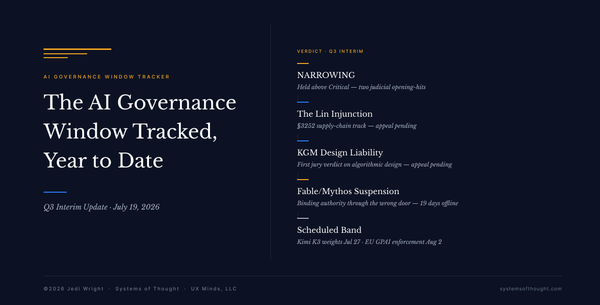
Part of the End of History, Revisited project. Companion documents: The End of History, Revisited · The Legibility Project · The Agentic Accountability Playbook · The AI Governance Window Tracker
The binding-authority gap, the distance between credible AI governance frameworks and their enforceability, is widening. Governance instruments exist in embryonic form. What is missing is not knowledge but binding authority, and the window for converting voluntary frameworks into enforceable ones is measured in years, not decades.
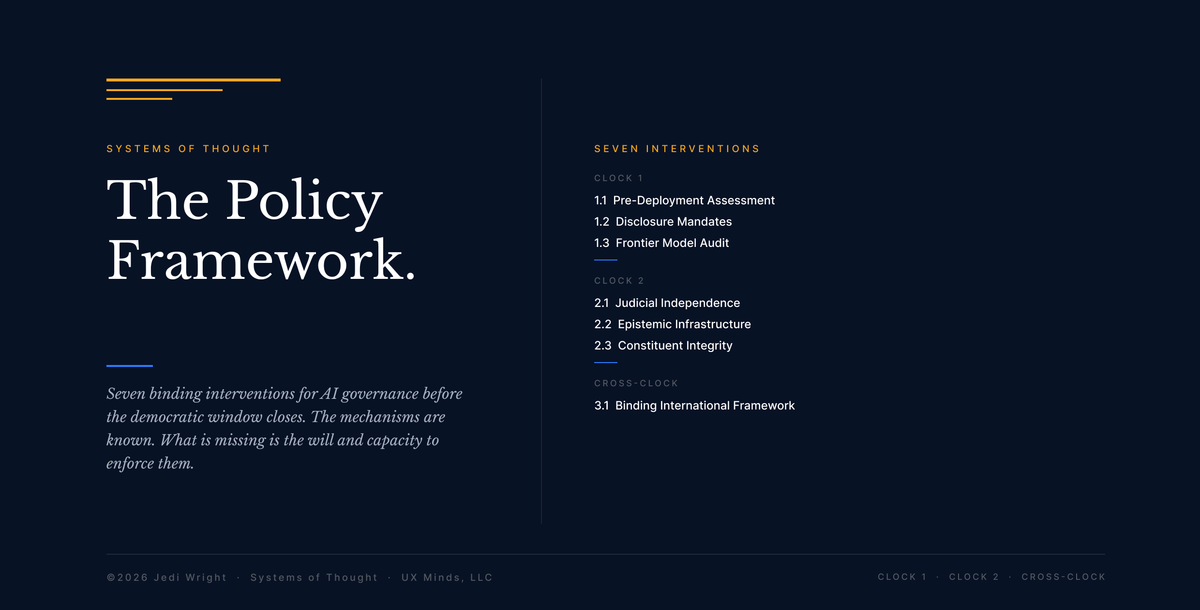
This document specifies seven interventions organized by a dual-clock structure. Clock 1 measures the pace of AI embedding in critical infrastructure, the countdown to the point where governance shifts from prospective rule-making to retroactive regulation of entrenched incumbents. Clock 2 measures the erosion of democratic institutional capacity to impose and enforce governance. Both clocks are running down, and they interact: ungoverned AI deployment during the governance window actively degrades the democratic institutional capacity needed to close the binding-authority gap.
Three Clock 1 interventions address the technical governance window: mandatory pre-deployment assessment for critical infrastructure integration, disclosure mandates for AI-generated political content, and binding interoperability and audit requirements for frontier models. Three Clock 2 interventions address the democratic renewal window: structural protections for judicial independence, epistemic infrastructure treated as a public utility, and integrity standards for constituent communication. One cross-clock intervention addresses the transition from voluntary to binding international frameworks, designed around, rather than dependent on, US participation.
Every intervention is tested against three structural properties that distinguish the current AI mechanism from predecessor manipulation regimes: optimization without intent, personalization at scale with feedback closure, and speed-deliberation asymmetry. A governance mechanism that does not address these properties is governing the wrong problem. None of the seven interventions requires novel institutional invention. All require political will. The window is now.

I. Purpose & Scope
This document translates the governance window argument developed in The End of History, Revisited into specific regulatory and legislative mechanisms. Where the essay diagnoses the compound civilizational stress event and identifies the closing window for binding AI governance, and where The Legibility Project specifies what practitioners should build, The Policy Framework specifies what institutions should require.1
The chain runs: diagnosis (essay) → specification (Legibility Project) → mandate (this document). Each link operates at a different register and addresses a different audience. The Policy Framework's audience is institutional and regulatory actors: legislators, treaty negotiators, standards-body participants, and the policy professionals who brief them. Its register is deliberately distinct from The Legibility Project's practitioner voice: it specifies what binding frameworks must contain, not what individual practitioners should do. The Legibility Project produces practitioner-level specifications; this document makes them obligatory and tests them against the three structural properties that distinguish the current governance challenge from its predecessors.2
II. The Analytical Framework
The governance window is not a single countdown. It is the interaction of two structurally distinct timelines.
Clock 1: The AI embedding clock is technically determined. It measures the pace at which AI becomes structurally load-bearing in critical infrastructure: healthcare triage, judicial risk scoring, financial credit determination, content moderation, and electoral administration. Once frontier capability is sufficiently distributed and embedded, governance shifts from prospective rulemaking to retroactive regulation of entrenched incumbents with substantial capture leverage over the regulatory bodies themselves. That transition is likely 3 to 7 years out, indexed to the current pace of enterprise and state-level AI embedding and the EU AI Act's phased enforcement horizon.
Clock 2: The democratic institutional erosion clock is politically conditioned. It measures the capacity of democratic institutions to impose and enforce governance: judicial independence, regulatory autonomy, legislative competence, and the epistemic infrastructure that democratic deliberation requires. This clock is conditioned less on technical thresholds than on electoral cycles, judicial composition, and the pace of norm erosion.
The clocks are not independent. Ungoverned AI deployment during the renewal window actively degrades the epistemic commons and coalition-formation capacity that democratic renewal structurally requires. Winning the governance window buys time for the renewal window. Losing it forecloses both.3
The Three Structural Properties
Three properties distinguish the current AI mechanism from predecessor manipulation regimes and together constitute the categorical break the essay claims. They function throughout this document as the adequacy test for every intervention: a governance mechanism that does not address at least one of these properties is governing a predecessor problem.4
First, optimization without intent.
Prior manipulation regimes were designed to manipulate. Bernays wrote campaigns, talk radio hosts chose inflammatory framings, and social media platforms designed engagement metrics. Each produced a legible agent whose strategy could be identified, contested, and regulated. AI systems generate epistemic effects as emergent properties of optimization for other objectives. Regulating an emergent property is a categorically different governance problem from regulating an intentional strategy.
Second, personalization at scale with feedback closure.
Television and talk radio broadcast identical content to mass audiences, meaning the manipulation was at least shared; citizens experienced the same distortion, preserving the possibility of collective recognition and response. AI-mediated information environments are individually personalized and dynamically adaptive, meaning the distortion is private. This is not fragmentation. It is the dissolution of the shared epistemic surface against which fragmentation could be measured.
Third, speed-deliberation asymmetry.
Prior media technologies operated on production cycles that, while faster than legislative deliberation, remained within the temporal range of organized democratic response. AI-generated content operates on cycles measured in seconds, at volumes exceeding human curatorial capacity. The speed differential is no longer a disadvantage that democratic deliberation can compensate for by working harder. It is a structural mismatch between the temporal architecture of the information environment and that of democratic response.
The Post-Window Condition
If the governance window closes, the condition that follows is not chaos but something more durable: a world in which governance of AI systems becomes exclusively retroactive, coordination costs become insoluble because the actors who would need to coordinate are themselves dependent on the systems requiring governance, and the normalization of ungoverned deployment forecloses the political imagination required to demand alternatives. This is a describable institutional state, not an abstract risk.5
The Asymmetric Reversibility Principle
Not all deterioration is symmetrically reversible. Institutional capacity, judicial independence, and regulatory autonomy, once eroded, can in principle be rebuilt through the same legal and political mechanisms that eroded them. Slowly, imperfectly, but through known channels. Shared factual ground cannot. The informational cascades literature establishes the mechanism: when individuals calibrate their beliefs to perceived social consensus rather than independent evidence, a false consensus once established becomes self-defending against correction. The commons does not merely erode. It becomes self-defending against repair. Epistemic deterioration is a ratchet; institutional deterioration is imperfectly recoverable. This principle weights the urgency of interventions throughout: epistemic infrastructure protections (Interventions 1.2 and 2.2) carry asymmetric reversibility stakes that institutional protections (Interventions 2.1 and 2.3), however urgent, do not.6
III. Clock 1 Interventions: The Technical Governance Window
Clock 1 interventions address the pace of AI embedding in critical infrastructure. They operate on the 3–7 year timeline within which prospective governance remains structurally possible. After this window, governance does not disappear; it becomes retroactive, operating against entrenched systems with substantial capture leverage.
Intervention 1.1: Mandatory Pre-Deployment Assessment for Critical Infrastructure Integration
What the binding framework must contain
Binding, third-party-audited evaluation before AI systems become load-bearing in healthcare triage, judicial risk scoring, financial credit determination, content moderation at platform scale, and electoral administration. This is not a voluntary risk assessment. It is a mandatory gate: no deployment in critical infrastructure without independent verification that the system's behavior is understood, its failure modes are documented, and its effects on the populations it serves are assessed.
The EU AI Act's high-risk classification system is the closest existing instrument. Its phased enforcement timeline, with the Commission's November 2025 Digital Omnibus proposal now effectively pausing the high-risk compliance deadline until late 2027 or 2028, means the gap between classification and enforcement is itself a deployment window. The specific recommendation: accelerate the enforcement of high-risk classifications and extend the classification to cover AI-mediated political communication explicitly.7
The three-property assessment
This intervention addresses optimization without directly intending it. A pre-deployment assessment that evaluates only whether a system was designed to cause harm misses the structural problem: systems optimized for other objectives produce epistemic and institutional effects as emergent properties. The assessment framework must evaluate emergent behavioral patterns, not only stated design objectives. It must also address speed-deliberation asymmetry: assessment timelines must be calibrated to deployment pace, not legislative pace. A mandatory assessment that takes three years to complete while the system deploys in three months is not actual governance; it is performed governance.
Existing efforts and gaps
The EU AI Act provides the classification architecture but faces delays in enforcement and pressure to simplify. South Korea's AI Basic Act (enforcement January 2026) and Japan's AI Promotion Act (May 2025) are lighter-touch frameworks that prioritize innovation over mandatory pre-deployment assessment. No jurisdiction currently mandates third-party auditing of AI systems in electoral administration or AI-mediated political communication—a gap that is structurally consequential given the Bai et al. persuasion-parity finding. Mandatory pre-deployment assessment faces not only this timeline problem but the institutional capacity problem: regulatory bodies charged with assessment must be insulated from capture by the entities they assess; a structural design requirement the framework addresses at strength in Section VII.8
The Minab case (Baker, The Guardian, March 2026) establishes what a structural adequacy gap looks like at operational scale: an AI-integrated targeting system whose execution environment had no mechanism to distinguish confirmed intelligence from inference that had never been verified. The failure was not at the model layer—the system performed as designed. It was at the accountability layer that governs how data moves from assumption to operational input. Pre-deployment assessment frameworks that evaluate model outputs but not execution environment accountability architecture are applying the predecessor governance frame to a structurally different problem.8a
The Minab case points to a specific, nameable pre-deployment requirement that current frameworks do not specify: inference flagging. An inference-flagging requirement mandates that any AI-integrated system operating on consequential inputs must tag those inputs with their epistemic status, confirmed, inferred, unverified, or time-sensitive, before they become operationally binding. Standard pre-deployment assessment frameworks evaluate model outputs and capability benchmarks. They do not require that the execution environment include a mechanism to distinguish confirmed inputs from assumptions that have never been logged as uncertain. The inference-flagging requirement closes this gap at the architectural layer rather than the model layer: it is not a constraint on what the model can output, but a constraint on what the system can accept as operationally binding without verification status attached. This requirement is distinct from, and complementary to, audit trail specifications—an audit trail records what happened; inference-flagging governs what is permitted to happen without a verification record. Both are required for execution-environment accountability.8b
Intervention 1.2: Disclosure Mandates for AI-Generated Political Content
What the binding framework must contain
Statutory requirement, not optional platform policy, for watermarking or provenance metadata in AI-generated content used in political advertising, constituent communication, and public comment processes, with penalties indexed to organizational revenue rather than flat fines. The essay's language is precise: the absence of mandatory disclosure is not a neutral regulatory condition. It is a structural asymmetry in favor of whoever deploys the tools first.
The evidentiary basis is established: across three preregistered experiments (N=4,829), LLM-generated political arguments shifted attitudes on polarized policy questions as effectively as human-authored arguments, with 94% of participants who read AI-generated arguments believing they were reading human arguments. Under current conditions, the manipulation is invisible.9
The three-property assessment
This intervention targets personalization with feedback closure at the point of democratic consequence. AI-generated political content that is individually tailored, dynamically adaptive, and invisible as machine-authored dissolves the shared epistemic surface democratic deliberation requires. Disclosure mandates do not solve the personalization problem—but they restore the minimum condition for contestability: the citizen's capacity to know that the content shaping their political judgment was produced by an optimization process rather than a human interlocutor. It also addresses optimization without intent: disclosure requirements make the emergent epistemic effects of AI systems legible, even when no one designed them.
Existing efforts and gaps
The EU AI Act's transparency rules require disclosure when humans interact with AI systems and labeling of deepfakes, with application from August 2026. This is a foundation but not sufficient: it does not yet cover the full range of AI-generated political content, synthesized talking points, personalized constituent messaging, and automated public comment generation, where the Bai et al. finding demonstrates the democratic consequence is most acute. No jurisdiction currently requires provenance metadata for AI-generated content in public comment processes—a gap that permits automated astroturfing of regulatory proceedings at an industrial scale.
Intervention 1.3: Binding Interoperability and Audit Requirements for Frontier Models
What the binding framework must contain
Any model deployed above a defined compute threshold must maintain auditable logs of training data provenance, output patterns, and behavioral consistency across languages. This addresses the concentration mechanism the essay identifies through Varoufakis's cloudalist architecture: a dozen entities controlling frontier capability without accountability frameworks commensurate to their structural power. The institutional home is contested, OECD, a dedicated international body, or a multilateral treaty mechanism, but the essay's framework says the form matters less than the binding character. Voluntary frameworks with no enforcement mechanism are not governance; they are pseudo-governance.
The compute threshold question
The essay's Clock 1 is indexed to the pace of AI embedding in critical infrastructure, and this intervention requires specifying what "sufficiently embedded" means operationally; at what point the shift from prospective rulemaking to retroactive regulation becomes irreversible. This is genuinely contested territory, and the document engages it on its own terms rather than deferring.
Training compute thresholds are currently the best available regulatory trigger for identifying potentially high-risk frontier models. Their core advantage is that computation is essential for training, objective and quantifiable, estimable before training, and verifiable after training. Both the EU AI Act's GPAI provisions and the now-revoked US Executive Order 14110 established compute thresholds to trigger reporting and evaluation requirements. New York's RAISE Act (signed December 2025) sets thresholds at $100 million aggregate spending or 10²⁶ floating-point operations.10
However, computed thresholds are filters, not endpoints. Three limitations are structurally consequential for this intervention. First, post-training enhancements, fine-tuning, reinforcement learning from human feedback, tool use, instruction tuning, can improve capability by a factor of 5 to 30 times without additional training compute, meaning a threshold set at pre-training compute alone will miss substantially enhanced models. This requires either a safety buffer or a dual-threshold system that accounts for both training and post-training compute. Second, algorithmic innovation can reduce the compute required to achieve a given capability level, meaning any fixed threshold degrades over time. The threshold must include a mandatory review and update mechanism indexed to capability benchmarks, not just compute levels. Third, computed thresholds do not track all risks—they are proxies for capability, not direct measures of harm. The intervention must pair the compute threshold with mandatory capability evaluations triggered by the threshold, not treat the threshold as sufficient evidence of safety or danger.11
The question the essay's framework poses is more specific than where to set the threshold: at what point does AI embedding in critical infrastructure make the transition from prospective to retroactive governance irreversible? This is not a single computed number. It is the compound effect of (a) the number of critical infrastructure domains where AI is load-bearing, (b) the switching costs of removing or replacing embedded systems, and (c) the regulatory capture leverage that embedded incumbents accumulate. The compute threshold is a necessary proxy because it identifies which models are powerful enough to become load-bearing. The irreversibility question is the structural context that makes the proxy consequential.
The three-property assessment
This intervention addresses all three properties:
- Optimization without intent: auditable logs of output patterns allow post-hoc identification of emergent epistemic effects that no one designed.
- Personalization with feedback closure: behavioral consistency requirements across languages directly address the geopolitical code-switching finding—models that shift democratic values by language of query are producing personalized epistemic environments at civilizational scale.12
- Speed-deliberation asymmetry: audit requirements create a structural pause in the deployment cycle—a mandatory moment where the system's behavior is examined at deliberative speed before it operates at machine speed.
Existing efforts and gaps
The EU AI Act's GPAI model provisions establish transparency and copyright obligations (applicable August 2025) and systemic risk provisions for high-capability models. New York's RAISE Act establishes mandatory safety protocols, annual independent audits, and a 5-year document retention requirement for frontier model developers. These are significant instruments. The gap is binding international interoperability: no current framework requires behavioral consistency across linguistic and cultural contexts, and none addresses the cross-jurisdictional auditability that the concentration of frontier capability in a small number of entities structurally demands. The December 2025 US executive order establishing an AI Litigation Task Force to challenge state AI laws, and the broader federal posture of preempting rather than building governance, make this gap structurally harder to close within US jurisdiction. The gap between classification and enforcement is not only a timeline problem but a political economy problem. Independent auditing requires regulatory bodies with resources, expertise, and political independence—three conditions that are systematically undermined by defunding, revolving-door staffing, and political pressure. The same concentrated interests, subject to mandatory audit, are the entities best positioned to undermine the auditing mechanism.13
DeepMind's Harmful Manipulation Critical Capability Level (CCL), released March 2026, represents the most rigorous voluntary safety framework yet published for measuring manipulative capability in AI systems. It is the inaugural reference case for the adequacy test that this framework applies throughout. The CCL has genuine evaluation value: it is multi-study (9 studies, 10,000+ participants across the UK, US, and India), cross-domain (finance and health), and explicitly designed for external replication. Its adequacy ceiling is that it measures intentional-misuse manipulation, the predecessor-era governance problem, not manipulation as a structural byproduct of optimization for other objectives (Property 1) operating through personalized feedback closure (Property 2) at conversation speed (Property 3). A system certified compliant with the CCL may simultaneously be ungoverned on the three-property problem surface. This is not a critique of the CCL's design; it is the adequacy test applied to its scope. Binding interoperability and audit requirements for frontier models must specify coverage of all three structural properties, not only the intentional-misuse surface addressed by the CCL. Rosenstein's Fortune (March 2026) analysis provides the clearest available on-record confirmation from inside the predecessor regime that the race dynamic functions as structural coordination failure: Altman, Amodei, Hassabis, Musk, and Zuckerberg are each named as caught in the "if I don't do it, someone else will" trap by a former Facebook product leader who was present for the predecessor version of the same dynamic. When participants inside the race publicly name the trap and continue, voluntary commitments lose their evidential weight as governance signals.13a
IV. Clock 2 Interventions: The Democratic Renewal Window
Clock 2 interventions address democratic institutional erosion—the capacity of democratic institutions to impose and enforce governance. These interventions operate on a variable timeline conditioned by electoral cycles, judicial composition, and the pace of norm erosion. They are less technically precise than Clock 1 interventions but no less consequential: if the institutional machinery for binding governance degrades, Clock 1 interventions become unenforceable regardless of how well they are designed.
Intervention 2.1: Structural Judicial Independence Protections
What the binding framework must contain
Statutory, not merely normative, protections for judicial appointment processes, including mandatory recusal standards for AI-related cases where litigants have financial relationships with AI developers. Most critically, legal standing for citizens to challenge AI-mediated government decisions through existing administrative law frameworks without requiring them to reverse-engineer the system that produced the decision. This operationalizes the legibility demand as a procedural right.
The essay identifies judicial independence as the single most consequential near-term variable—Tier 1 triage. Huq and Ginsburg's comparative analysis of constitutional retrogression demonstrates that judicial and electoral capture is the operational first move in every case of democratic backsliding they studied, precisely because judicial loss converts all other institutional defenses from structural constraints into performative ones.14
The three-property assessment
This intervention does not directly address the three structural properties—it addresses the institutional precondition for any governance mechanism that does. A judiciary captured by entities with financial interests in the deployment of ungoverned AI cannot enforce pre-deployment assessments, disclosure mandates, or audit requirements. Judicial independence is not, in itself, AI governance; it is the structural friction that keeps AI governance enforceable. The three-property test applies here at one remove: judicial protections must be sufficient to sustain courts' capacity to evaluate governance mechanisms that address the three properties.
Existing efforts and gaps
Judicial independence protections vary dramatically by jurisdiction and are under active erosion in multiple democracies. The specific gap this intervention addresses is not the general principle of judicial independence but the procedural capacity relevant to AI: courts' ability to adjudicate challenges to AI-mediated decisions when the decision-making process is opaque. Without standing provisions that do not require citizens to reverse-engineer algorithmic systems, the right to contest AI-mediated government action is nominal rather than functional. The execution-environment accountability gap documented in high-stakes AI deployments has no current legal mechanism for contestation: there is no standing to challenge a system's failure to flag an assumption as an inference, no disclosure requirement that would make the gap visible, and no court that has yet established review standards for this category of design failure.14a
Intervention 2.2: Epistemic Infrastructure as Public Utility
What the binding framework must contain
Treat the epistemic commons the way prior generations treated physical commons. Three specific mechanisms: public funding for local journalism indexed to community size rather than market viability; statutory protection for fact-checking organizations against strategic litigation (SLAPP suits); and, the harder one, common carrier obligations for platforms above a defined user threshold that separate distribution infrastructure from editorial algorithmic curation.15
The last mechanism addresses the essay's point that access to AI production tools is not equivalent to access to distribution infrastructure. Open-source model availability disperses the capacity to generate output while leaving the distribution architecture, and the accountability frameworks, audit mechanisms, and governance architecture it requires, entirely in the hands of a small number of platforms. The structural asymmetry is not in capability but in reach.
The three-property assessment
This intervention addresses personalization by structurally closing feedback loops rather than at the content level. The dissolution of shared epistemic ground is not primarily a content problem (misinformation) but an infrastructure problem (the distribution architecture that determines what each citizen encounters). Common carrier obligations that separate distribution from curation address the infrastructure layer. It also addresses optimization without intent: algorithmic curation systems optimized for engagement produce epistemic effects, filter bubbles, informational cascades, polarization, as emergent properties of their optimization objective, not as designed features. Treating distribution infrastructure as a public utility subjects the optimization itself to public accountability, not just its outputs.
The asymmetric reversibility principle is most consequential here. Epistemic infrastructure loss is a ratchet: once shared factual ground is dissolved and false consensus is established, the social signal of apparent consensus outweighs the epistemic signal of correction. Local journalism, once shuttered, does not simply reopen when funding returns—the institutional knowledge, community trust, and source networks are not recoverable on the same timeline. This makes epistemic infrastructure protection among the highest-urgency interventions in the framework despite operating on Clock 2's variable timeline.
Existing efforts and gaps
Several democracies fund public media, but the specific mechanism of indexing journalism funding to community size rather than market viability is not widely implemented. Anti-SLAPP legislation exists in some jurisdictions but is uneven and often insufficient against well-resourced litigants. The common carrier proposal is the most contested element: platform companies resist structural separation of distribution and curation on both technical and commercial grounds, and the legal frameworks for common carrier obligations in the digital context are still developing. The EU's Digital Services Act addresses some transparency obligations for algorithmic systems, but does not impose the structural separation this intervention requires.
Intervention 2.3: Constituent Communication Integrity Standards
What the binding framework must contain
Any AI-generated communication to or from elected officials must be disclosed as such. Any system used to aggregate or summarize constituent communications for legislative staff must maintain auditable provenance chains. This is a narrow, specific, and defensible regulatory target that makes the essay's abstract argument about corruption in the democratic feedback loop concrete.
The essay identifies a specific institutional consequence of AI-generated persuasion that extends beyond individual manipulation: deployed at scale, it corrupts the feedback loop between constituents and representatives that democratic accountability structurally requires—not merely changing individual minds, but distorting what elected officials understand their constituents to believe. The epistemic commons is not only what citizens share with each other. It is what citizens signal to the institutions governing them.
The three-property assessment
This intervention addresses personalization by focusing on feedback closure at the point where it corrupts democratic representation. AI-generated constituent communications that are individually tailored, produced at scale, and invisible as machine-authored distort the representative's information environment in ways that are not merely personalized but systematically biased toward whoever deploys the tools. It also addresses optimization without intent: constituent communication aggregation systems optimized for efficiency or relevance may produce systematic distortions in what representatives perceive as constituent sentiment, even without anyone intentionally designing those distortions. Provenance chain requirements make the aggregation process legible and contestable.
Existing efforts and gaps
No jurisdiction currently requires disclosure of AI-generated constituent communications or provenance chains for AI-mediated constituent aggregation systems. This is a regulatory vacuum at a structurally consequential point: the interface between citizen expression and legislative response. The technical requirements are modest—provenance metadata and disclosure labeling are well-understood mechanisms. The gap is political will and the absence of a constituency with concentrated interests in this specific protection.
V. Cross-Clock Intervention: The Binding-Authority Gap
Intervention 3.1: From Voluntary to Binding International Frameworks
What the binding framework must contain
Move from the current voluntary-commitment architecture, Bletchley, Seoul, Paris summits, to a treaty-based framework modeled on either the nuclear nonproliferation regime (binding with verification) or the Montreal Protocol (binding with phased compliance and trade consequences for non-signatories). The essay identifies the binding-authority gap as the core structural problem: credible governance frameworks exist but face voluntary compliance ceilings that render them performative.
The most serious contemporary argument for this approach is the statecraft case advanced by Kissinger, Schmidt, and Huttenlocher: that AI represents an epistemological discontinuity requiring international institutional architecture analogous to the arms control regimes that managed prior transformative technologies. The argument draws force from historical precedent—great-power coordination on nuclear, biological, and chemical threats did produce binding frameworks with verification mechanisms, despite profound geopolitical antagonism. If it happened before, the argument goes, it can happen again.16
This framework accepts the discontinuity claim but contests the temporal analogy. The arms control precedents negotiated governance over technologies that were not recursively degrading the institutional capacity required to negotiate. AI governance faces a structurally different coordination problem: the ungoverned deployment of AI systems during the negotiation period actively erodes the epistemic commons, coalition-formation capacity, and democratic institutional competence that binding governance requires. The dual-clock interaction means every year of voluntary-framework delay simultaneously advances the embedding clock and degrades the institutional clock. The statecraft framing is necessary but insufficient—not because coordination is impossible, but because the governance challenge includes the recursive degradation of the coordination machinery itself.
The realistic timeline: framework treaty negotiation 2026–2028, ratification by major democratic economies 2028–2030, with the EU AI Act serving as the binding floor in the interim. The EU AI Act's extraterritorial reach, applying to any system serving EU citizens regardless of where it is developed, provides a partial market-access leverage mechanism, just as GDPR created de facto global privacy standards without requiring US federal participation.
The US withdrawal problem
The essay references the US withdrawal problem as a structural constraint. As of March 2026, it is no longer a problem to be assessed; it is an established condition that the intervention must be designed around.
The trajectory is unambiguous. The US declined to sign the Paris AI summit declaration in February 2025. At the UN General Assembly in September 2025, the White House's director of the Office of Science and Technology Policy stated that the United States "totally rejects all efforts" at multilateral AI governance. The US voted against a UN resolution on responsible military AI, which it had previously supported. In January 2026, the US withdrew from 66 international organizations, including 31 UN entities. The State Department's Bureau of Cyberspace and Digital Policy was effectively dismantled in July 2025. At the New Delhi AI Impact Summit in February 2026, the same position was reiterated. Domestically, the December 2025 executive order established an AI Litigation Task Force specifically to challenge state-level AI governance, positioning federal policy as anti-regulatory and preemptive of subnational governance.17
This is not a temporary diplomatic posture likely to reverse with the next administration. The structural position, that AI governance constrains American competitive advantage and that voluntary bilateral arrangements are preferable to binding multilateral frameworks, has institutional momentum, industry lobbying support, and bipartisan elements that make reversal unlikely within the governance window's 3–7 year timeline.18
The intervention must therefore be designed for a democratic-coalition-minus-US pathway. Three structural features make this viable, if harder:
First, the EU AI Act's extraterritorial reach functions as the market-access lever. Any AI system serving EU citizens is subject to the Act regardless of the developer's location. The GDPR precedent demonstrates the mechanism: companies choosing between building two versions of their systems or complying with the higher standard overwhelmingly choose compliance, creating de facto global standards through market access rather than treaty participation. This is a partial workaround, not a full substitute—it creates compliance incentives for commercial deployment but does not reach military AI, intelligence applications, or government procurement within non-participating jurisdictions.19
Second, the democratic coalition retains sufficient economic weight to create binding consequences. The EU, UK, Canada, Australia, Japan, South Korea, and allied economies collectively represent a market that no frontier AI developer can afford to abandon. Trade consequences for non-signatory access — modeled on the Montreal Protocol's approach — create compliance incentives without requiring US participation in the framework itself.20
Third, subnational US governance is not foreclosed. New York's RAISE Act demonstrates that state-level AI governance continues despite federal preemption efforts. The executive order's legal authority to block state AI laws is contested, and the AI Litigation Task Force's effectiveness is uncertain. State and municipal governance represents a fragmented but real pathway for AI accountability within the US jurisdiction, and it can be designed to interoperate with international frameworks even without federal coordination.
The democratic-coalition-minus-US pathway requires a design template for distributed coordination without central authority. Slaughter's network governance framework, which treats governance as emerging from connections among distributed actors rather than from centralized authority, provides the strongest available model for the coalition architecture this intervention proposes. The three structural features above are conditions; network governance specifies how they interact. This is not an endorsement of specific prescriptions but an acknowledgment that the governance challenge this framework identifies, building binding frameworks without the largest actor at the table, is precisely the problem Slaughter's institutional design work addresses.21
The honest constraint: a binding international framework without US participation is structurally weaker than one with it. It cannot reach the military and intelligence applications of the world's largest AI-producing nation. It creates a competitive asymmetry that US policymakers will cite as vindication of their withdrawal. And it leaves the framework's legitimacy claim incomplete in exactly the dimension that matters most: the accountability of the most powerful actors. The intervention is designed for this constraint, not around it.
The three-property assessment
This intervention addresses all three properties at the structural level where they are most consequential:
- Optimization without intent: the binding-authority gap is itself an optimization-without-intent problem—the current voluntary framework architecture optimizes for participation breadth at the cost of enforcement depth, producing a governance environment whose emergent property is permissive non-accountability. Treaty-based frameworks with enforcement mechanisms address structural optimization.
- Personalization with feedback closure: the fragmentation of governance across jurisdictions creates the regulatory equivalent of epistemic personalization—each deployment context encounters different accountability requirements, dissolving the shared governance surface. Binding frameworks with interoperability requirements restores a common accountability baseline.
- Speed-deliberation asymmetry: treaty negotiations operate on diplomatic timescales that are categorically mismatched with AI capability development. The intervention addresses this by designating the EU AI Act as the binding floor in the interim and by establishing a treaty framework for phased compliance rather than a comprehensive agreement before implementation.
Existing efforts and gaps
The Bletchley (2023), Seoul (2024), and Paris (2025) summits established voluntary commitments. The UN Global Dialogue on AI Governance launches its first full meeting in Geneva in July 2026. IASEAI provides an institutional base for safety research at the scale this path requires. The gap is the transition from voluntary to binding: no existing multilateral AI framework includes enforcement mechanisms, trade consequences for non-compliance, or verification procedures. The US withdrawal from multilateral governance makes this transition harder, but does not make it impossible—it makes the EU AI Act's extraterritorial reach and the democratic coalition's collective market access the load-bearing structural elements.
Citizens' assembly proposals have entered serious governance discourse as a mechanism for AI oversight. The Policy Framework's analysis distinguishes between adequacy and legitimacy: citizens' assemblies with cross-partisan composition offer genuine democratic legitimacy that captured regulatory processes lack, and should be incorporated into the binding framework's design when deliberative input is structurally appropriate. The adequacy limitation is epistemic access: assembly members deliberating on AI governance require independent technical analysis of the three structural properties, emergent optimization effects, feedback closure at the individual level, and conversation-speed asymmetry, that do not currently exist in accessible, verifiable form. Intervention 2.2 (Epistemic Infrastructure as Public Utility) is the condition of possibility for citizens' assemblies to function as adequate oversight mechanisms rather than deliberation about a problem they cannot fully evaluate.21a
VI. The Three-Property Test: Synthesis
Each intervention section includes its own assessment of which structural properties it addresses. This section does the cross-intervention work that no individual assessment can: the coverage map, the redundancy analysis, and the gap identification.
| Intervention | Optimization Without Intent | Personalization + Feedback Closure | Speed-Deliberation Asymmetry | Structural Precondition |
|---|---|---|---|---|
| 1.1 Pre-Deployment Assessment | ✓ Primary | ✓ Secondary | ||
| 1.2 Disclosure Mandates | ✓ Secondary | ✓ Primary | ||
| 1.3 Frontier Model Audit | ✓ | ✓ | ✓ | |
| 2.1 Judicial Independence | ✓ Primary | |||
| 2.2 Epistemic Infrastructure | ✓ Secondary | ✓ Primary | ||
| 2.3 Constituent Integrity | ✓ Secondary | ✓ Primary | ||
| 3.1 Binding International | ✓ | ✓ | ✓ |
Note: scroll to the right to view the full table.
Coverage patterns. All three structural properties are addressed by multiple interventions. Optimization without intent is addressed by five of the seven interventions, personalization with feedback closure by five, and speed-deliberation asymmetry by three. No property relies on a single intervention—the redundancy is deliberate. If any single intervention fails politically or is diluted in implementation, the remaining interventions maintain at least partial coverage of each property.
Personalization with feedback closure receives the deepest coverage, addressed as the primary target by Interventions 1.2, 2.2, and 2.3 and as a secondary target by 1.3 and 3.1. This weighting reflects the asymmetric reversibility principle: the dissolution of shared epistemic ground is a ratchet, and the interventions targeting it carry disproportionate stakes relative to those targeting recoverable institutional losses.
Speed-deliberation asymmetry is the thinnest coverage area, addressed primarily by Intervention 1.3 (audit requirements that create structural pauses), 1.1 (assessment timelines calibrated to deployment pace), and 3.1 (an interim binding floor while treaty framework develops). This is the area where the framework is most honest about its limitations: democratic governance is structurally slow, and no set of interventions fully resolves the mismatch between machine-speed deployment and deliberative-speed oversight. The interventions manage the asymmetry rather than eliminate it.
Intervention 2.1 (Judicial Independence) addresses no structural property directly but functions as the precondition for all others. A captured judiciary cannot enforce governance mechanisms regardless of how well they address the three properties. This is the intervention whose failure cascades most broadly: it is the structural friction that keeps all other interventions from becoming performative.
Residual gaps. The framework does not address autonomous weapons governance, AI applications in intelligence and surveillance, or the specific problem of AI-mediated financial market manipulation — each of which involves the three structural properties but requires domain-specific regulatory architecture beyond the scope of this document. The framework also does not address the structural incentive problem: none of the seven interventions creates a positive market incentive for governable AI. They create obligations, constraints, and accountability mechanisms, but the market reward structure, which currently favors speed, scale, and ungoverned deployment, remains unaddressed. This is a consequential gap, and future versions of this document should engage it.
VII. Honest Constraints
This document specifies mechanisms. It does not specify the political conditions for their adoption. The distinction matters because the binding-authority gap is not a knowledge gap; the mechanisms are known, but it is a will gap, and political will is not a policy variable that this document can address.
The Tier 4 problem directly applies here. The essay's counter-hegemonic narrative, the coherent positive vision of human-AI coexistence that the renewal path requires, does not translate into policy specifics. It is cultural and intellectual work that policy can enable but not produce. This document's interventions are Tiers 1–3. Tier 4 is a different kind of work, and the integrity of this framework depends on not collapsing that distinction.
Several structural limitations deserve naming:
First, the US withdrawal problem is a constraint, not a bug to be fixed. This document is designed around it rather than assuming it away, but the design is structurally weaker than it would be with US participation. A binding international framework that cannot reach the military, intelligence, and government procurement applications of the world's largest AI-producing nation has a central accountability hole. The EU's extraterritorial market-access lever is real but partial. The document is honest about what partial means.
The compute threshold question remains genuinely contested. This document engages the literature, identifies the design parameters, and recommends a dual-threshold approach with mandatory update mechanisms. It does not claim to have identified the irreversibility point. The question of when AI embedding becomes irreversible is itself a question that requires ongoing democratic deliberation — and the irony that democratic deliberation about this question is degraded by the very systems it seeks to govern is not lost on the analysis.
None of these interventions addresses the structural incentive problem. The market reward structure favors speed, scale, and ungoverned deployment. The seven interventions impose constraints; they do not create positive incentives for governable AI. A regulatory framework that relies entirely on obligation without incentives is fragile in the face of lobbying, evasion, and simplification pressures that the EU AI Act is already experiencing. This is the most consequential gap in the framework, and future work must engage it.
The structural incentive gap is not hypothetical. Mayer documents the multi-decade, well-resourced campaign to degrade regulatory capacity across environmental, labor, and financial domains—defunding regulatory bodies, revolving-door staffing that captures institutional expertise, and sustained political pressure campaigns targeting regulatory independence. The AI governance challenge faces a structurally similar dynamic on a compressed timeline. The obligation-without-incentive architecture this framework specifies is exactly the regulatory structure most vulnerable to the long-horizon capture strategy Mayer documents. The point is not historical analogy; it is that the seven interventions, however well-designed, operate in a political economy in which the entities subject to governance are also the entities best positioned to undermine the governance machinery. Naming this is an honest constraint, not fatalism—it specifies the design requirement the framework must meet.22, 22a
A second constraint operates at a faster timescale than Mayer's long-horizon capture dynamic. Strategic portfolio rationalization, exiting product spaces where governance pressure is building, and concentrating resources on less-scrutinized vectors do not require lobbying investments or capture campaigns. It requires only that the actor move faster than regulatory attention cycles. The March 2026 case illustrates the mechanism in compressed form: Sora's shutdown and the simultaneous scaling of a dedicated advertising infrastructure team were parallel decisions, not sequential ones. Substantive governance mobilization from IP holders, unions, and talent was rendered moot by a product exit; the resources freed by that exit moved immediately to the monetization vector that governance has not yet reached. The interventions in this framework are designed against identifiable deployment targets. Binding frameworks must extend jurisdiction to capability classes and deployment vectors, not only to specific named products, or they govern the deprecated version of the problem.23
A third constraint is organizational rather than strategic. The revolving-door dynamic Mayer documents through decades of institutional investment is now operating at conversational speed. OpenAI's advertising leadership is drawn directly from Meta's advertising organization—the institutional knowledge of the predecessor regime's business model is the hiring credential. The entities subject to governance of conversational advertising arrive pre-staffed with the expertise to anticipate and shape that governance. This is the capture vulnerability that Intervention 1.3 must account for in its audit design. The temporal compression of this dynamic reached its logical extreme on March 25, 2026. A Los Angeles jury found Meta and Alphabet liable for $3M in damages for deliberately addictive platform design — with jurors instructed not to consider content, only architecture. On the same day, Meta CEO Mark Zuckerberg was appointed to a White House advisory council. Meta's stock closed up 0.7%. The market did not read the verdict as consequential against the advisory appointment. The legal finding and regulatory capture were not sequential—they were simultaneous, priced in real time.24, 25
A fourth constraint is temporal and structural. The training data governance problem has an architecture that makes prospective disclosure requirements insufficient by design. The DoorDash case involves a known purpose at the point of collection—a disclosure and labor rights problem that existing regulatory frameworks can, in principle, address. The Niantic case reveals a categorically different structure: thirty billion street-level images collected under a mobile game's consent framework between 2016 and 2024, now constituting the navigational substrate for autonomous urban robotics. The commercial application was not foreseeable at collection—not because Niantic concealed it, but because it did not exist. Disclosure requirements cannot govern applications that will not exist for a decade. This is not a gap in Intervention 1.2's coverage; it is a category of governance problem that disclosure frameworks are architecturally unable to address. The instrument this case demands is a purpose-limitation framework—binding constraints on repurposing consumer data beyond the reasonable scope of the original collection context, with retroactive notification requirements when repurposing occurs. That instrument does not exist in any current binding framework and is not developed in this document. Naming it is an honest constraint.26
Where Mayer documents how regulatory capacity degrades, Slaughter argues that an honest assessment of the full scope of institutional damage is itself the precondition for rebuilding—not a reason to abandon the effort. The interventions specified here constitute the minimum viable governance package. Each addresses at least one of the three structural properties that distinguish this moment from its predecessors. None requires novel institutional invention. All require political will to convert existing voluntary frameworks into binding ones.27
The window is now.
FOOTNOTES
- Fukuyama, The End of History and the Last Man (1992). The essay's full treatment of Fukuyama's thesis, including its post-2016 reassessment, appears in Sections I–III.
- The Legibility Project v1.2, Tenet 4: Govern the Mechanism, Not the Predecessor. The three-property test applied throughout this document originates as a practitioner design constraint in the LP and is elevated here to an institutional scale.
- The dual-clock framework is developed in the essay's Section VII, Tier 3. The interaction between clocks, ungoverned AI deployment during the renewal window actively degrades the conditions renewal requires, which is the framework's central analytical claim.
- The three structural properties are developed in Section V of the essay (v1.9). They constitute the categorical break from predecessor manipulation regimes and function as the adequacy test throughout this document.
- The essay's post-window condition is concretely defined in Section VII: exclusively retroactive governance, insoluble coordination costs, and normalization foreclosing political imagination. This is not an abstract risk but a describable institutional state.
- The asymmetric reversibility principle is developed in the essay's Section V and the AI Governance Window Tracker v1.4: epistemic infrastructure losses are ratchets (self-defending against repair via informational cascade dynamics); institutional losses are imperfectly recoverable through known legal and political mechanisms.
- EU AI Act, Regulation 2024/1689. The Act's high-risk classification system and GPAI model provisions are the closest existing instruments to several interventions specified here. The Commission's November 2025 Digital Omnibus proposal to delay high-risk compliance deadlines is itself evidence of the gap between classification and enforcement this document identifies.
- See Section VII (Honest Constraints) for the structural incentive analysis and Mayer, Dark Money (2016) for the documented historical mechanism by which regulatory bodies charged with oversight are systematically captured by the entities they regulate.
8a. Baker, Kevin T. "AI Got the Blame for the Iran School Bombing. The Truth Is Far More Worrying." The Guardian, March 26, 2026. This case is cited here as a reference for adequacy testing, not as an argument about military AI governance specifically. The structural failure Baker documents, an assumption hardened into operational fact without a verification mechanism, is the general form of the execution-environment accountability gap. Intervention 1.1 is designed to address across all critical infrastructure domains. See also The Legibility Project v1.2, Mechanism 2 (Audit Trail Specifications) for the practitioner-level specification of the execution-environment accountability gap.
8b. The inference-flagging gap is named here as a practitioner requirement derived from the Minab case analysis. It does not yet appear in any current binding governance framework. The Legibility Project v1.2, Mechanism 2 (Audit Trail Specifications) operationalizes the inference-flagging requirement at the practitioner level; this footnote names it as a binding governance gap at the regulatory level. The Agentic Accountability Playbook v0.1 translates the inference-flagging requirement and the execution-environment adequacy test into deployment specifications for the agentic systems teams where the gap applies most immediately.
- Bai, Voelkel, et al., "LLM-Generated Messages Can Persuade Humans on Policy Issues," Nature Communications 16, no. 6037 (2025). https://doi.org/10.1038/s41467-025-61345-5
- New York Responsible AI Safety and Education Act (RAISE Act), signed December 19, 2025. Establishes $100M / 10²⁶ FLOPs thresholds for "Large Developers" of "Frontier Models," with mandatory safety protocols, annual independent audits, and five-year document retention.
- Pistillo, Van Arsdale, Heim, and Winter, "The Role of Compute Thresholds for AI Governance," George Washington Journal of Law & Technology 1, no. 1 (2025). Published via Institute for Law & AI. The analysis of compute as a regulatory trigger, the 5–30x post-training enhancement problem, and the filter-not-endpoint framing draw substantially on this work.
- Piedrahita, David Guzman, Irene Strauss, Rada Mihalcea, and Zhijing Jin. "Democratic or Authoritarian? Probing a New Dimension of Political Biases in Large Language Models." In Proceedings of the 19th Conference of the European Chapter of the Association for Computational Linguistics (Volume 1: Long Papers), pages 593–652. Rabat, Morocco: Association for Computational Linguistics, March 2026. https://aclanthology.org/2026.eacl-long.27/
- Mayer, Dark Money (2016). For the structural incentive analysis, see Section VII of this document.
13a. DeepMind, "Harmful Manipulation Critical Capability Level," released March 26, 2026. Multi-study (9 studies, 10,000+ participants across the UK, US, and India), cross-domain (finance and health), and designed for external replication. Its adequacy ceiling is that it measures deliberate, instruction-following manipulation—not manipulation as a structural byproduct of optimization for other objectives (Property 1) operating through personalized feedback closure (Property 2) at conversation speed (Property 3). A system certified compliant with the CCL may simultaneously be ungoverned on the three-property problem surface. This is the adequacy test applied to the CCL's scope, not a critique of its design. Rosenstein source: Rosenstein, Justin. "Why AI Could Repeat Social Media's Mistakes — and How to Avoid Them." Fortune, March 29, 2026.
- Huq and Ginsburg, "How to Lose a Constitutional Democracy," UCLA Law Review 65 (2018). The essay's Section VII, Tier 1, applies this framework to the prioritization of judicial independence.
14a. Baker, The Guardian, March 26, 2026 (full citation at note 8a). The Minab case is the reference instance for the execution-environment accountability gap as a category of design failure for which no legal review standard currently exists. The absence of standing doctrine for inference-flagging failures and the absence of disclosure requirements that would make such failures visible to affected parties mean the accountability gap identified in note 8a is also a procedural access gap: it cannot currently be litigated even where harm is demonstrable.
- Habermas, The Structural Transformation of the Public Sphere (1962) and The Theory of Communicative Action (1981). The distinction between communicative and strategic rationality, and the claim that democratic legitimacy requires the former, is the theoretical foundation for treating epistemic infrastructure as a public utility rather than a market good.
- Kissinger, Henry A., Eric Schmidt, and Daniel Huttenlocher. The Age of AI and Our Human Future. New York: Little, Brown and Company, 2021. The statecraft argument, that AI governance requires institutional architecture analogous to arms control, is the strongest contemporary version of the multilateral coordination case. The present framework extends and narrows it: accepting the discontinuity, contesting the sufficiency of the statecraft response given the embedding-clock problem the book does not address.
- The US declined to sign the Paris AI summit declaration (February 2025), explicitly rejected all multilateral AI governance at the UN General Assembly (September 2025), reiterated this position at the New Delhi AI Impact Summit (February 2026), and withdrew from 66 international organizations, including 31 UN entities (January 2026). The State Department's Bureau of Cyberspace and Digital Policy was effectively dismantled in July 2025.
- The current US withdrawal posture has institutional infrastructure behind it that predates the current administration. Mayer documents the network of think tanks, legal organizations, and donor infrastructure that built the institutional capacity for systematic federal deregulation and international withdrawal over the course of decades. See Mayer, Dark Money (2016). The assessment that reversal is unlikely within the governance window's 3–7 year timeline is structurally grounded in this institutional backstory, not a speculative political judgment.
- The GDPR precedent is instructive: extraterritorial application to any entity processing EU residents' data created de facto global privacy standards through market access leverage, without requiring US federal participation. The AI Act's Article 2 applies to providers placing AI systems on the EU market regardless of establishment location.
- The Montreal Protocol (1987) achieved near-universal ratification through trade consequences for non-signatories and phased compliance timelines calibrated to national capacity. The NPT (1968) established binding verification through the IAEA inspection regime. Neither precedent maps perfectly to AI governance, but both demonstrate that binding international frameworks can function without unanimous great-power participation.
- Slaughter, Anne-Marie. The Chessboard and the Web: Strategies of Connection in a Networked World. New Haven: Yale University Press, 2017. Slaughter's argument that governance emerges from connections between distributed actors rather than from centralized authority provides the design specification for coalition architecture without US participation.
21a. Rosenstein, Justin. "Why AI Could Repeat Social Media's Mistakes — and How to Avoid Them." Fortune, March 29, 2026. The citizens' assembly examples cited, Ireland, Taiwan, UK, and Belgium, are empirically documented instances of cross-partisan deliberative processes producing binding governance decisions on contested social questions. The adequacy condition identified here is specific to AI governance: unlike abortion law or electoral reform, AI's three structural properties produce effects that are not phenomenologically accessible to deliberating citizens without independent technical infrastructure to make them visible and evaluable. Fishkin, James S. Democracy When the People Are Thinking: Revitalizing Our Politics Through Public Deliberation. Oxford: Oxford University Press, 2018.
- Mayer, Jane. Dark Money: The Hidden History of the Billionaires Behind the Rise of the Radical Right. New York: Doubleday, 2016. Mayer documents the Koch network's systematic investment in hollowing out regulatory bodies (EPA, OSHA, NLRB, state-level agencies), building institutional infrastructure for deregulation, and undermining enforcement capacity.
22a. The pattern Mayer documents at a long timescale is compressed into a single institutional cycle within AI development itself. Between May and October 2024, OpenAI dissolved both its Superalignment and AGI Readiness teams following the departures of safety leads Ilya Sutskever, Jan Leike, and Miles Brundage. Leike stated publicly on departure that safety culture had "taken a backseat to shiny products" and that his team had been "struggling for compute." In February 2026, the head of Anthropic's Safeguards Research team, Mrinank Sharma, departed with a public letter noting he had "repeatedly seen how hard it is to truly let our values govern our actions." Leike: X, May 17, 2024. Brundage: Substack, October 24, 2024. Sharma: CNN, February 11, 2026, https://www.cnn.com/2026/02/11/business/openai-anthropic-departures-nightcap. Fortune: Kokotajlo interview, August 26, 2024, https://fortune.com/2024/08/26/openai-agi-safety-researchers-exodus/
- OpenAI shut down its Sora text-to-video platform on March 24, 2026, simultaneously collapsing a $1 billion partnership with Disney (Wall Street Journal, March 24, 2026; Bloomberg, March 24, 2026). The shutdown followed substantive governance mobilization, opt-out demands from Studio Ghibli and CODA, engagement from the Motion Picture Association and SAG-AFTRA, none of which produced binding constraints before the business decision rendered the mobilization moot. The advertising infrastructure that absorbed the freed compute allocation was scaling simultaneously: OpenAI announced a VP and Head of Global Ad Solutions the previous day (Wall Street Journal, March 23, 2026), with ChatGPT advertising already live for US free-tier users since February 9, 2026.
- OpenAI's advertising leadership is drawn directly from Meta's advertising organization. Fidji Simo, former Facebook VP overseeing ad strategy for approximately a decade, leads OpenAI's product and business teams as CEO of Applications. Dave Dugan, VP of global clients and agencies at Meta for 12.5 years, was appointed VP and Head of Global Ad Solutions at OpenAI in March 2026 (Wall Street Journal, March 23, 2026; ADWEEK, March 23, 2026). The revolving-door dynamic is not structural inference—it is the current organizational chart.
- KGM v. Meta Platforms, Inc. et al., Los Angeles Superior Court, verdict March 25, 2026. Al Jazeera, March 25, 2026: https://www.aljazeera.com/economy/2026/3/25/us-jury-finds-meta-alphabet-liable-in-landmark-social-media-addiction-case. The stock price signal is not offered as a claim about the legal outcome — the verdict will be appealed. It is offered as evidence that the entities subject to governance had already secured the political hedge before the legal exposure crystallized. Note: the same verdict is cited in the companion essay at fn. 15a for its design-liability significance in the Habermasian frame; this citation is for the regulatory capture mechanism, a distinct analytical use.
- Hanke, John, and Brian McClendon. "How Pokémon GO is giving delivery robots an inch-perfect view of the world." MIT Technology Review, March 10, 2026. https://www.technologyreview.com/2026/03/10/1134099/how-pokemon-go-is-helping-robots-deliver-pizza-on-time/, Niantic Spatial trained its Large Geospatial Model on thirty billion images captured by Pokémon GO and Ingress players between 2016 and 2024. No current binding regulatory instrument requires retroactive notification or purpose auditing when consumer data is repurposed for AI training at this scale.
- Slaughter, Anne-Marie. Renewal: From Crisis to Transformation in Our Lives, Work, and Politics. Princeton: Princeton University Press, 2021. Slaughter's argument that renewal requires honest confrontation with crisis rather than optimistic evasion maps onto this framework's methodological commitment: the honest constraints named here are conditions for design, not counsels of despair.
About this project
The Policy Framework is part of End of History, Revisited, a project tracking the compound civilizational stress event now underway and the closing window for binding democratic AI governance. The chain runs: diagnosis (the essay) → practitioner specification (The Legibility Project) → institutional mandate (this document).
The complete project suite links will be available here soon:
- The End of History, Revisited — The anchor essay. Eight converging theoretical frameworks, four probability-ranked futures, and the compound civilizational stress event diagnosis that the rest of the project builds from.
- The Legibility Project v1.3 — Practitioner governance framework. Operationalizes the essay's legibility demands through design, information architecture, and cognitive systems frameworks.
- The Policy Framework v1.5 — Binding intervention architecture. Develops governance interventions across the dual-clock structure for regulatory and legislative actors.
- The AI Governance Window Tracker v1.4 — Structured five-domain signal assessment of whether the governance window is narrowing or widening.
- The AI Governance Window Tracker Instrument — The live, local-first web application. Run and compare assessments over time.
- The Governance Window — The project's public-facing monitoring page on Systems of Thought.
- From Skill to Instrument: The Making of the AI Governance Window Tracker — The origin essay. How the Tracker was built, what it runs on, and why.
- The Agentic Accountability Playbook v0.2 — Deployment specifications for agentic systems teams. Translates the inference-flagging requirement and adequacy test into practitioner terms.
- Companion Architecture v1.3 — Structural navigation across the full suite.
- Project References v1.2 — The full annotated bibliography and evidentiary base.
- Project Record v1.6 — Canonical provenance record. Version history, session and time accounting, model attribution, and the next-work register for the full suite.
Systems of Thought is published by UX Minds, LLC. Methodology disclosure: this publication uses AI-collaborative methods consistent with the transparency standards it advocates. Intellectual direction and authorial responsibility are held by the human author. Licensed under CC BY-NC-ND 4.0.