Design Systems Scaled the Interface. Nobody Scaled the Content.
Design systems spent thirteen years solving the interface problem. The content layer never got its equivalent model—and for most of that time, the cost was manageable. Then AI arrived. This is the argument for why the gap existed, why it persisted, and why closing it became critical.

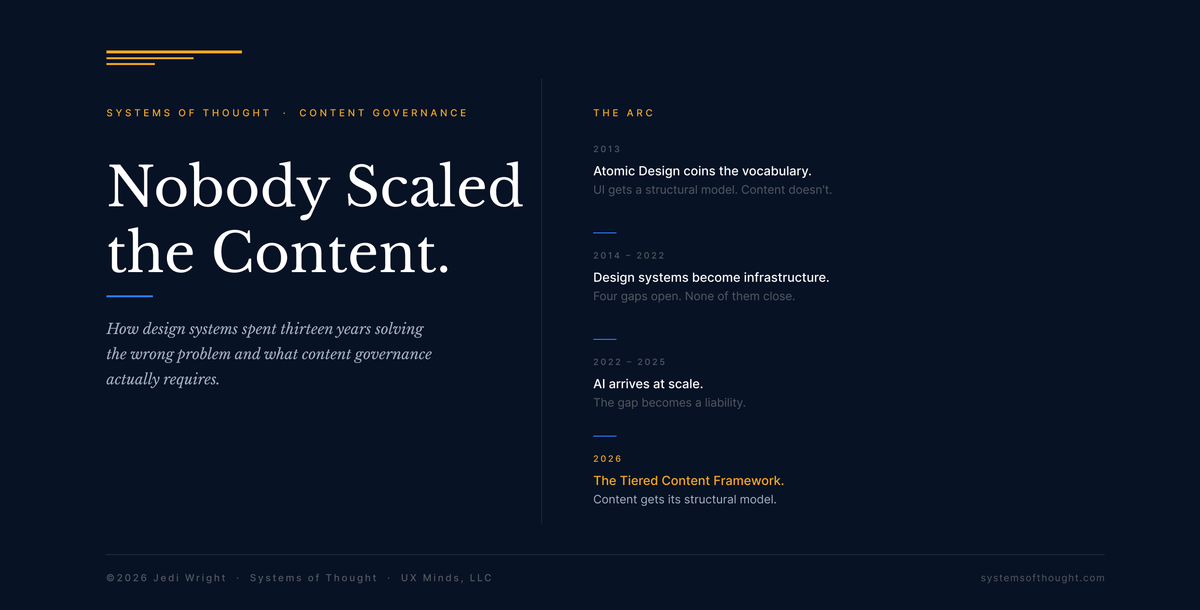
On the Tiered Content Framework, the thirteen-year gap it addresses, and why AI made the absence critical.
In June 2013, Brad Frost published a blog post called "Atomic Design." It introduced five tiers: atoms, molecules, organisms, templates, pages, and gave an industry a shared vocabulary it had been waiting for without knowing it was waiting.
Within a few years, that vocabulary was everywhere. It shaped how design teams organized their work, how engineering teams structured their component libraries, how product organizations thought about building at scale. By 2018, design systems weren't a cutting-edge practice. They were table stakes.
Here is the question that nobody asked loudly enough, for thirteen years:
We've spent all of this time getting extraordinarily good at designing systems of components. So why does content still feel like it was bolted on at the end?
The problem hiding in the methodology
Atomic Design is a model for organizing interface components. That's not a limitation, it's the point. Frost's framework did exactly what it set out to do, and it did it well enough to become foundational infrastructure for the digital product discipline.
What it didn't model was the content that flows through those components. And because Atomic Design became the dominant organizing framework for design systems work, the content layer inherited its structure by default, without anyone building the equivalent model for content itself.
This isn't a critique of Atomic Design. It's a description of a gap that the design systems community documented, discussed, and largely left open. Voice and tone guides proliferated. Microcopy style sheets became standard deliverables. Content strategy practice matured considerably over the same period. But none of that produced a structural model for how content units compose, how they should be governed as systems, or how content architecture should integrate with the design systems work happening in parallel.
Four gaps opened at the start of the design systems era and never closed.
- Content strategy stayed editorial.
The discipline produced excellent guidance: brand voice documents, microcopy frameworks, writing principles, but almost no structural models. The question of how content is organized and governed remained separate from the question of how it should be written. - Interfaces were designed with lorem ipsum.
This is more than a workflow complaint. Designing components before content means the structure governs the meaning rather than the meaning informing the structure. Content arrives after the system is built and gets reshaped to fit. The design system's structural decisions are made without the content they're supposed to carry. - Information architecture lived in silos.
Sitemaps in one tool. CMS data models in another. Navigation schemas somewhere else. Taxonomy in whatever spreadsheet someone built last year. The structural decisions that govern how content is organized and retrieved were never integrated into the design systems layer. They were adjacent to it, important to it, but not part of it. - Taxonomy was an afterthought.
Tags added after publication. Classification schemes that diverged across teams, products, and channels. No shared vocabulary. Which meant the content infrastructure couldn't reason systematically about what it contained.
Every design system scaled interfaces. None of them scaled the meaning behind the interfaces.
Why the gap persisted
The gap persisted for structural reasons, not failure of effort. Understanding the structure matters, because it explains why closing it required a formal framework rather than better process.
Scale masked the problem for a long time. Small teams carrying content governance in their heads: the editor who knows the brand voice, the designer who knows what copy goes where, the CMS administrator who maintains the taxonomy, can operate coherently without a structural model. The friction becomes a systemic failure only when scale makes informal coordination impossible: more teams, more products, more markets, more channels. Most organizations didn't hit that scale until the mid-to-late 2010s.
The disciplines were separated organizationally. Content strategy sat in one function. Information architecture in another. UX writing in a third. Design systems in engineering and design. There was no shared structural vocabulary that crossed all of them, so no one built the bridge—not because the need wasn't felt, but because no single discipline owned the problem completely enough to solve it.
The tooling didn't require it. The major design tools were component-first. They made it easy to build and maintain component libraries and difficult to model content as a first-class governance concern. CMS platforms were content-first but architecturally isolated from the design tools. Nothing in the standard toolchain surfaced the gap as a failure condition.
And then the AI inflection arrived.
Why 2026
The inflection started in earnest in 2022 and has accelerated since. What changed isn't just the volume of AI-generated content, it's the nature of the governance failure when the structural model is absent.
When content governance failures meant inconsistent microcopy or off-brand tone, the cost was real but bounded. A human production process has natural friction that limits how far ungoverned content can propagate. When AI systems generate, assemble, and deliver content at machine speed and volume, the same governance gap becomes an attack surface with no natural bound. Content generated without a structural model, no tier specification, no taxonomy, no machine-legibility layer, propagates incoherence at scale, faster than any editorial process can catch it.
The gap that was manageable at human production speed becomes a compounding structural problem at machine production speed.
This is why the Tiered Content Framework is public in 2026 and not 2021. The framework has been in practice for five years. What changed is that the cost of the absent model became impossible to ignore.
What the framework is and where to find it
The Tiered Content Framework is a content governance model that extends Atomic Design into the content layer. Six tiers: Particles, Clusters, Zones, Structures, Ecosystems, Biomes, with three cross-cutting governance dimensions: the Intelligence Layer (how each tier behaves under AI generation), the Taxonomy Layer (machine-readable classification across all tiers), and the Machine-Legibility Layer (how content declares itself to external systems).
The structural specification, the production chain it operates on, and the creation layer built out first are all documented at jediwright.com/content-strategy-framework. That's the right place to start if you want the operating model.
What's here is the argument for why the model was necessary, the thirteen-year arc that made it inevitable, and the inflection point that made it urgent.
Design systems scale interfaces. Content frameworks scale the intelligence behind every digital experience. The distinction took thirteen years to name clearly. It's named now.
Systems of Thought is published by UX Minds, LLC. Methodology disclosure: this publication uses AI-collaborative methods consistent with the transparency standards it advocates. Intellectual direction and authorial responsibility are held by the human author. Licensed under CC BY-NC-ND 4.0.