The AI Inference Flagging Gap
A missing governance requirement for AI-integrated execution environments and why no current binding framework specifies it.
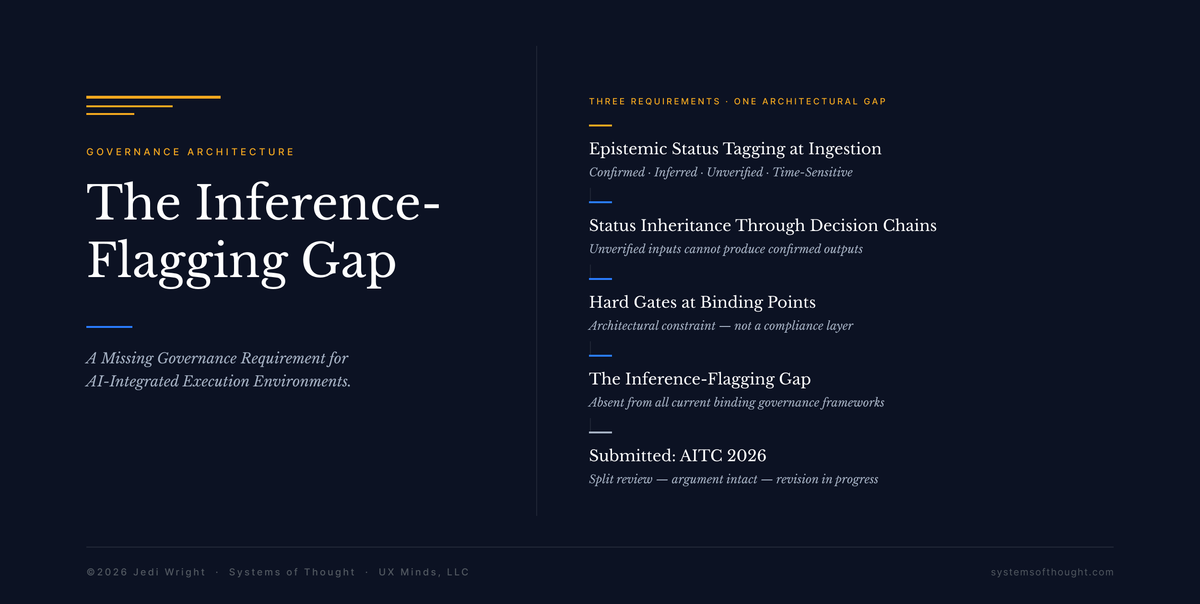
A missing governance requirement for AI-integrated execution environments
Current AI governance frameworks ask the wrong question, or rather, an incomplete one.
They ask whether the model can be trusted: whether its outputs are accurate, unbiased, and within defined capability bounds. The EU AI Act's GPAI provisions, the NIST AI Risk Management Framework, sector-specific frameworks in healthcare and finance; all evaluate what models produce. Output audits. Capability benchmarks. Bias assessments. Pre-deployment testing under controlled conditions.
A system can pass every one of these requirements and still have no architectural mechanism to distinguish a confirmed input from an unverified inference at the moment that input becomes operationally binding.
That absence has a name: the inference-flagging gap.
What the gap is
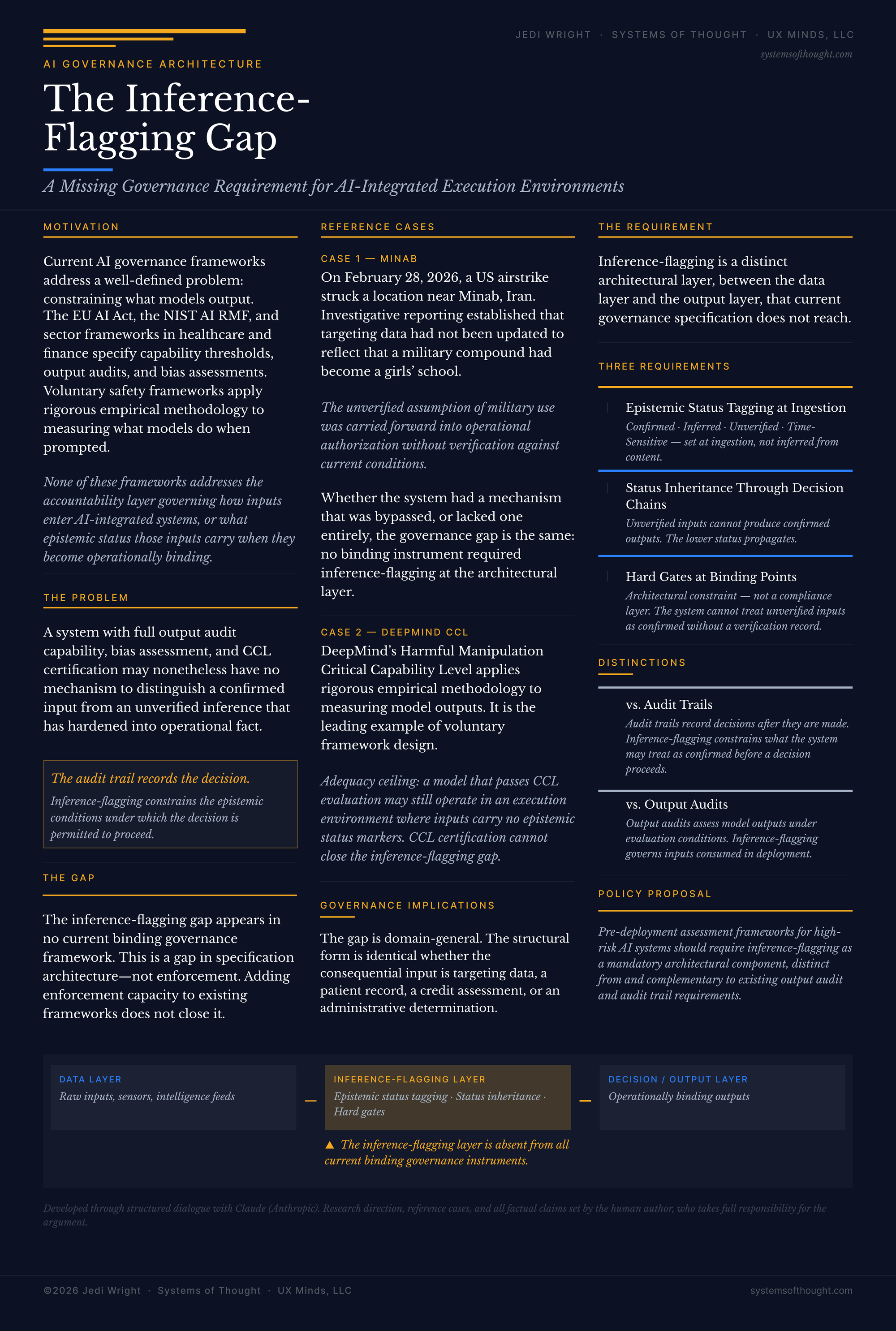
The inference-flagging gap is not a refinement of existing governance requirements. It is a distinct architectural layer, between the data layer and the output layer, that current governance specification does not reach.
An audit trail is downstream of the decision. It records what the system did.
Inference-flagging is upstream of the decision. It governs what the system is permitted to treat as confirmed before action is taken.
A system can have a complete audit trail and satisfy no inference-flagging requirement, because the audit records the action without recording the epistemic condition under which the action was authorized. Both are required for execution-environment accountability. Neither substitutes for the other.
The formal requirement has the following structure:
Any AI-integrated system operating on consequential inputs must tag those inputs with their epistemic status—confirmed, inferred, unverified, time-sensitive—before they become operationally binding. The system must not treat an input as confirmed unless a verification record is attached. Time-sensitive inputs must carry a currency timestamp and a re-verification trigger threshold.
This requirement is architectural: it is not a constraint on what the model outputs, but a constraint on what the execution environment accepts as operationally authoritative without verification status attached.
Why it's AI-specific
Input-verification problems are not new. Sensor fusion, intelligence assessment, and database integrity have been studied for decades. What distinguishes AI-integrated execution environments is the combination of three properties that prior systems rarely combined at scale:
- Autonomous execution.
Outputs become operationally binding without human review at the decision point. The speed of action compresses or eliminates the verification step that prior systems preserved by design. - Inferential opacity.
The system can derive operationally binding outputs from inputs in ways the operator cannot trace or verify in real time. The reasoning chain between input and action is not fully legible to the humans nominally overseeing it. - Cascading consequence.
A single unverified input can propagate through a decision chain to terminal action without re-verification at any node. Each downstream node inherits the epistemic status, or lack of one, from upstream.
Earlier systems with input-validation problems generally exhibited at most one of these properties. AI-integrated execution environments routinely exhibit all three. That combination is what makes an architectural requirement at the input-binding layer necessary here in a way it was not for predecessor systems.
The reference cases
Minab, February 2026
On February 28, 2026, a US airstrike struck a location near Minab, Iran. Investigative reporting established that targeting data had not been updated to reflect that a military compound at the site had become a girls' school, and that the assumption of military use was carried forward into operational authorization without verification against current conditions.
The AI system performed exactly as designed. The failure was not at the model layer. It was at the accountability layer; the layer that governs what the system is permitted to treat as confirmed without a verification record attached.
Whether the Minab system happened to have an inference-flagging capability that was bypassed, or happened to lack one entirely, the governance gap is the same: no current governance framework specifies such a requirement. The system was not required to distinguish confirmed intelligence from outdated inference before that input became operationally binding.
The audit trail recorded what the system did. Inference-flagging would have governed what the system was permitted to do. The first existed. The second did not.
DeepMind's Harmful Manipulation CCL
The Critical Capability Level for Harmful Manipulation is the most rigorous voluntary safety framework yet published for measuring manipulative capability in AI systems: nine studies, 10,101 participants across the UK, US, and India, measuring both efficacy and propensity for manipulative behavior across three domains.
Its adequacy ceiling is scope. It measures deliberate manipulation: models instructed to be manipulative, or exhibiting propensity for manipulative tactics when so instructed. It does not address the epistemic status of inputs in integrated execution environments.
A system certified CCL-compliant may simultaneously have no inference-flagging mechanism. CCL certification does not substitute for inference-flagging requirements. Governance frameworks that treat voluntary safety certifications as sufficient are governing a different problem surface, the output layer, while leaving the input-binding layer unspecified.
These two cases do different work. Minab establishes that the gap is consequential. The CCL establishes that the gap is unaddressed even at the frontier of voluntary safety work.
The governance gap
The inference-flagging gap doesn't seem to appear currently in any current binding governance framework.
The EU AI Act's high-risk system provisions address transparency and human oversight at the output and decision layer. They do not specify requirements for epistemic status tagging of inputs within integrated execution environments.
The NIST AI Risk Management Framework addresses documentation and audit but does not distinguish confirmed from inferred inputs as an architectural requirement.
Sector-specific frameworks in healthcare and finance address model validation, not execution environment input accountability.
This is a gap in the specification architecture of current governance, not an enforcement or compliance gap. Adding enforcement capacity to existing frameworks does not close it. It requires a new named requirement at the architectural layer.
The gap is domain-general. The structural form is the same whether the consequential input is targeting data, a patient record, a credit assessment, or an administrative determination. Any AI-integrated system that converts inputs into consequential outputs faces the same structural absence.
The requirement
Pre-deployment assessment frameworks for high-risk AI systems should require inference-flagging as a mandatory architectural component, distinct from and complementary to existing output audit and audit trail requirements.
Implementation means three things concretely:
- Epistemic status tagging at ingestion.
Every input entering a consequential decision chain carries a status field, confirmed, inferred, unverified, time-sensitive, set at the point of ingestion, not derived by downstream nodes from the input's content or apparent source. - Status inheritance.
If a node derives an output from an unverified or inferred input, the output inherits the lower status. Unverified inputs cannot produce confirmed outputs without a verification record. - Hard gates at binding points.
At the point where an input becomes operationally binding, where action is authorized, the system must be architecturally constrained from treating an unverified or inferred input as confirmed without a verification record attached.
Primary documents
The Inference-Flagging Gap: A Missing Governance Requirement for AI-Integrated Execution Environments — Submitted to the First AI Transparency Conference (AITC 2026). Rejected with a split review (Rating 6 / Rating 2, both Confidence 4). The rejection was documented. The argument is intact.
The Agentic Accountability Playbook — Practitioner framework. Three audit tools for organizations deploying agentic systems: the Inference-Flagging Audit, the Adequacy Test, and the Decision-Chain Traceability Map.
The AI Governance Clock Won't Wait for Its Framework — Policy context. Where inference-flagging sits within the broader governance window argument.
On the AITC submission
The abstract was submitted to the first AI Transparency Conference in April 2026 and rejected in May 2026. The split between reviewers, one who engaged substantively and one who reviewed only the abstract, is itself an instance of the problem the work documents: a process with no mechanism to weight a thin review differently from a careful one, producing a decision that averaged them.
The rejection is not a refutation. The governance gap identified here is verifiable by direct examination of what binding frameworks specify and do not specify. That examination is reproducible by anyone with access to the frameworks cited.
A revision plan exists and is documented. The argument will find its venue. In the meantime, the concept is being developed here, in public, on its own terms.
The inference-flagging gap is a concept under active development. This page is updated as the work advances. For the practitioner framework, start with the Playbook. For the governance argument, start with the paper.
Systems of Thought is published by UX Minds, LLC. Methodology disclosure: this publication uses AI-collaborative methods consistent with the transparency standards it advocates. Intellectual direction and authorial responsibility are held by the human author. Licensed under CC BY-NC-ND 4.0.