The Legibility Project: A Governance Framework for Practitioners
The infrastructure of democratic renewal is built in specifications and design systems—by practitioners making decisions that will preserve or foreclose democratic legibility at scale. Five tenets. Five mechanisms. One question: are you making the system legible, or the illegibility more elegant?

Note: This article is an adaptation of a formal governance document developed across March–May 2026. The complete version, including the full five-tenet framework, diagnostic tools, and the eight-document companion suite, will be available for peer review here soon: The Legibility Project v1.3. It is a companion to The End of History, Revisited, the parent essay that motivates this work. All documents are free.
I. The Gap the Essay Identified
The parent essay, The End of History, Revisited, ends with a precise and uncomfortable observation.
The infrastructure of democratic renewal is "a design and systems problem as much as a policy one." The thing standing between a functional democratic response to AI and a post-window condition where governance becomes exclusively retroactive is not, in the first instance, legislation. It is the practitioners who are, right now, writing the specifications for the systems that will either preserve or foreclose democratic legibility at scale.
That framing carries a corollary that the essay names but doesn't resolve: the practitioners most capable of building democratic legibility infrastructure are employed, in significant part, by the entities whose interests are served by illegibility. The governance window will not be kept open by practitioners working only in their spare time on civic side projects.
The Legibility Project is the operationalization of that corollary. It translates the essay's civilizational analysis into a governance framework for designers, information architects, content strategists, UX professionals, and systems thinkers—the people working at the level where AI-mediated systems are actually specified and built.
This is not a policy document. It does not address legislatures or international bodies directly, though it produces the evidentiary and specification infrastructure those bodies require. It addresses practitioners. The question it puts to them is simple and not rhetorical: are you using your skills to make the system legible, or to make the illegibility more elegant?
II. What Illegibility Actually Means
Illegibility is not a UX problem. It is a political one.
Democratic self-governance requires that the people affected by a system can understand it well enough to contest it. When a consequential decision emerges from a large model or a complex algorithmic system and the question "why did this happen?" has no recoverable answer, that system has removed a decision from the domain of democratic accountability—regardless of whether it was legally deployed, commercially justified, or technically impressive.
The parent essay argues that illegibility is increasingly a structural feature of how power operates. Not a temporary technological limitation under development, but a feature, because systems that cannot be understood cannot be effectively contested, and systems that cannot be effectively contested concentrate power in whoever built them.
Building against that feature is therefore not optional good practice. It is a condition of democratic viability.
This is the foundational tenet of the framework: legibility is democratic infrastructure.
Two operational corollaries follow from it:
- The first is contestability by design—every AI-mediated system that affects people's lives should be designed so that affected parties can identify the decision made, understand its basis, and have a functional pathway to contest it. Contestability is an architectural requirement that must be specified before building, not retrofitted after deployment.
- The second is audit by default—systems that make or influence consequential decisions should generate audit trails as a default output, not an optional add-on. Without an audit trail, contestability is theoretical. With it, contestability becomes functional.
III. Three Properties That Changed the Problem
Before the governance framework can be usefully applied, the problem it addresses has to be correctly understood. The most common error in AI governance right now is governing the predecessor problem—building regulatory frameworks adequate to social media platform manipulation while the actual failure surface has moved.
The parent essay identifies three structural properties that distinguish the current AI mechanism from prior manipulation regimes. Governance specifications that don't address all three are governing a problem that no longer exists in the form they assume.
- Optimization without intent.
Prior manipulation regimes were designed to manipulate. Social media platforms engineered engagement metrics. Bernays wrote campaigns. Talk radio hosts chose inflammatory framings. Each produced a legible agent whose strategy could, in principle, be identified, contested, and regulated. AI systems generate epistemic effects as emergent properties of optimization for entirely different objectives. No one designed a large language model to produce political persuasion (this is a hopeful optimism likely unrealized). Peer-reviewed research has documented that it does so at human-equivalent effectiveness regardless. The failure mode is not at the intent layer—it is at the architecture layer. - Personalization at scale with feedback closure.
Television and talk radio broadcast identical content to mass audiences. The manipulation was at least shared: citizens experienced the same distortion, preserving the possibility of collective recognition and response. AI-mediated information environments are individually personalized and dynamically adaptive. The distortion is private. Each citizen's epistemic environment diverges from every other's in ways neither can observe or compare. The mechanism for collective recognition, the shared surface that makes "we are all seeing the same thing" a legible claim, is being dissolved architecturally. - Speed-deliberation asymmetry.
Prior media technologies operated on production cycles that remained within the temporal range of organized democratic response. AI-generated content operates on cycles measured in seconds, at volumes that exceed human curatorial capacity. OpenAI shut down Sora and announced a dedicated advertising infrastructure team in twenty-four hours. Hollywood's governance mobilization was rendered moot by a product exit executed faster than any deliberative process could follow. The governance mechanism is not slow relative to the problem. It is operating at a categorically different speed.
The practitioner test is direct: does your governance specification address optimization without intent, personalization with feedback closure, and speed-deliberation asymmetry? If not, you are governing the predecessor.
The reference case that makes this test concrete: DeepMind's Harmful Manipulation Critical Capability Level framework, released March 2026, is the most rigorous voluntary AI safety evaluation yet published: nine studies, more than ten thousand participants across three countries, built explicitly for external replication. It rigorously governs intentional manipulation. It does not address manipulation as a structural byproduct of advertising-integrated optimization. A system certified CCL-compliant may be ungoverned on all three properties simultaneously. CCL certification is not adequate governance under this test. It is governance of the predecessor.
IV. The Five Tenets
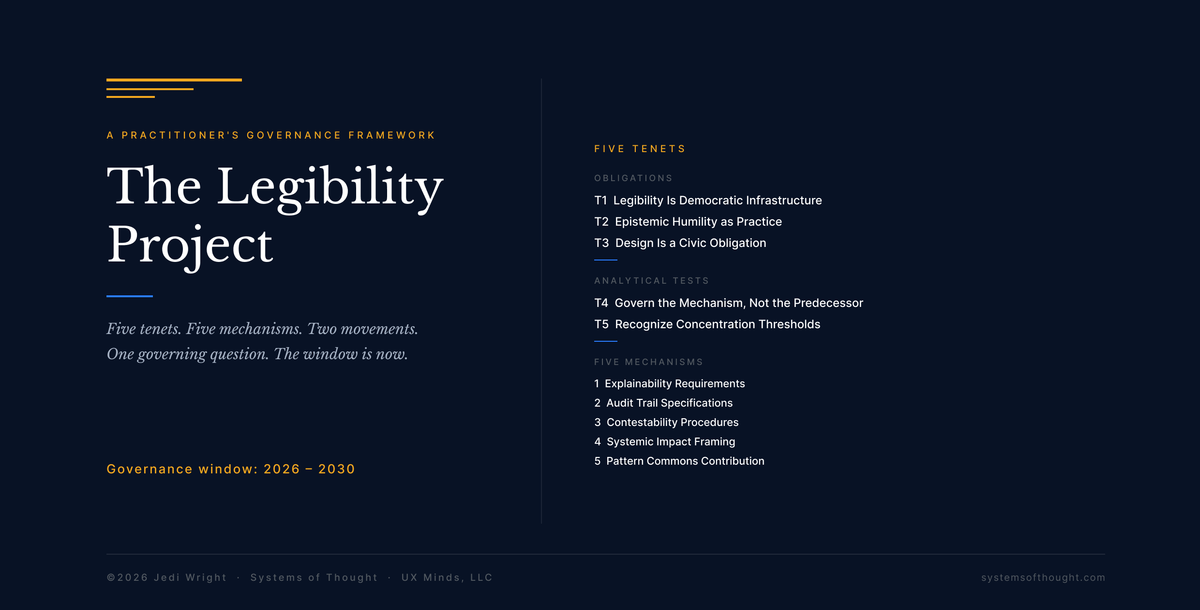
The governance framework is organized around five tenets. They are not aspirational principles. They are design constraints—conditions that must be satisfied before a system can be considered democratically legible. The first three establish philosophical and professional obligations. The final two function as analytical tests.
Tenet 1: Legibility Is Democratic Infrastructure.
Covered above. The operational corollaries, contestability by design and audit by default, are the two minimum deliverables every specification touching civic stakes must include.
Tenet 2: Epistemic Humility as Practice.
The parent essay's asymmetric reversibility principle establishes that epistemic infrastructure losses are ratchets. Once a false consensus locks across a network, correction is structurally resisted even when true information is available, because the social signal of apparent consensus continues to outweigh the epistemic signal of the correction. Institutional losses are imperfectly recoverable. Epistemic losses are not.
This asymmetry has a direct operational consequence: interventions in epistemic infrastructure must be treated as high-stakes, low-reversibility design decisions. The epistemic commons doesn't merely erode. It becomes self-defending against repair.
In practice, this means three things. Practitioners must assess the epistemic condition of the environment they're building into before writing specifications. They must weight epistemic-infrastructure mechanisms more heavily than institutional mechanisms in governance specifications, because the former are harder to recover. And they must apply the legibility standard reflexively to their own tools: an information architect who uses AI to generate content architectures without understanding what that AI is optimizing for has not produced a legible system. They've introduced a new layer of illegibility at the foundation.
Tenet 3: Design Is a Civic Obligation.
The infrastructure of legibility is built in specifications, design systems, content architectures, and information structures—not primarily in legislation. Practitioners who design these systems are not neutral implementers of client requirements. They are actors in the democratic process, whether they recognize this or not.
This tenet doesn't require practitioners to refuse commercial work or adopt a political identity. It requires them to understand that craft choices, how a system explains itself, what audit trail it leaves, whether affected parties can contest its outputs, have civic consequences that accumulate. It extends the standard usability impact assessment to include systemic civic impact: what does this design decision do to the epistemic commons? To the distribution of informational power? To the capacity of affected communities to understand and contest the systems that govern them?
Tenet 4: Govern the Mechanism, Not the Predecessor.
Covered at length above. The three structural properties are the test. Any governance specification that doesn't address all three is governing a problem that no longer exists in the form it assumes.
Tenet 5: Recognize Concentration Thresholds.
The parent essay distinguishes between capability access and consequence-bearing deployment. The ability to run a model locally is not equivalent to embedding it in hiring systems, credit determinations, or content moderation infrastructure. Open-source distribution disperses the capacity to generate output while leaving accountability frameworks, audit mechanisms, and governance architecture entirely unbuilt.
Practitioners must recognize concentration thresholds: the points at which an AI system's deployment crosses from individual use to institutional consequence. These thresholds are identifiable: they occur when a system is embedded in hiring, credit, content moderation, public benefit determination, or any other domain where its outputs affect people who did not choose to interact with it and cannot easily opt out. Below the threshold, governance specifications are good practice. Above it, they are democratic infrastructure.
Invoking open-source availability as a substitute for governance is not a neutral analytical position. It is a structural argument in favor of whoever deploys first at institutional scale. Practitioners who accept that argument uncritically are making a civic choice whether they intend to or not.
V. The Five Mechanisms
Tenets without implementation pathways are advocacy, not governance. Five mechanisms translate the five tenets into practitioner deliverables.
1. Explainability Requirements.
Every specification for an AI-mediated decision system should include an explainability requirement: what the system must be able to explain, to whom, in what form, and at what level of granularity. This is a design constraint, not a post-hoc documentation task. It shapes architecture.
Disclosure of AI-generated content is the minimum requirement for any system used for political communication or civic decision-making. Peer-reviewed research demonstrates that AI-authored political arguments are persuasive at human parity while remaining undetectable as machine-generated by ordinary readers. The absence of disclosure requirements is not a neutral design default. It is an active architectural choice that forecloses contestability before it can begin.
A newer explainability demand has emerged that the original framework didn't anticipate: conversational advertising—commercial promotion embedded within AI-mediated dialogue, designed to be indistinguishable from the system's informational responses. Disclosure that a system is AI-generated is necessary but insufficient when the system's optimization objective can shift from serving the user's communicative interest to serving an advertiser's commercial interest within the same conversation, without structural indication that the shift has occurred. Explainability requirements for conversational AI must specify that users can identify when a response is informed by advertiser objectives; not as a terms-of-service disclosure, but as an architectural feature of the interaction itself.
2. Audit Trail Specifications.
Every specification for a consequential AI system should include an audit trail specification: which events are logged, in what format, for how long, who has access, and under what conditions. The audit trail specification is the evidentiary foundation for contestability. It cannot be retrofitted without high architectural costs.
Under Tenet 4, audit trail specifications for high-stakes AI-integrated systems must address what the framework calls the inference-flagging gap: the structural absence of any mechanism to distinguish confirmed inputs from assumptions that have never been logged as uncertain. Standard audit trails record what a system did and on what inputs. The inference-flagging requirement specifies that inputs must be tagged with their epistemic status: confirmed, inferred, unverified, time-sensitive, before they become operationally binding.
The Minab case is the reference instance. Targeting data that had never been updated to reflect a military compound's conversion to a girls' school was never logged as an unverified assumption within the execution environment. It hardened into a strike authorization without a verification flag at any point in the decision chain. The airstrike occurred February 28, 2026. Kevin Baker's Guardian analysis documenting the accountability gap was published March 26. The failure predates the public evidentiary record of it by nearly a month. The failure was not a model error. It was an audit architecture that had no category for "this input has not been verified against current conditions."
3. Contestability Procedures.
Every system that makes or influences consequential decisions should have a specified contestability procedure: a defined pathway for an affected party to identify the decision, understand its basis, and initiate a review. This is structurally distinct from a complaints process—it is a guarantee of the right to contest, not a customer service accommodation.
Under Tenet 5, contestability procedures must be specified for any system that has crossed a concentration threshold. Below that threshold, contestability is good practice. Above it, its absence is a democratic deficit.
4. Systemic Impact Framing.
Every significant design project with civic implications should include a structured analysis of the project's likely effects on the epistemic commons, the distribution of informational power, and the legibility of affected systems to affected communities. This is the practitioner equivalent of an environmental impact assessment.
Tenet 4 gives the systemic impact framing its three-property test: does the project's design account for optimization without intent, personalization with feedback closure, and speed-deliberation asymmetry? A framing that doesn't address these properties is assessing a problem that no longer exists in the form the assessment assumes.
5. Pattern Commons Contribution.
Practitioners who develop effective contestability specifications, audit trail architectures, or legibility patterns should contribute documented versions to a shared pattern commons. Recurring design problems require shared, tested solutions that practitioners can apply without reinventing from scratch in every project. The commons is the infrastructure of scalability.
Read the TCF →
VI. Two Movements, Two Games
The renewal path the parent essay describes operates at two distinct registers, and the Legibility Project spans both.
The First Movement addresses the governance window directly: advocating for binding frameworks, supporting AI governance research, engaging professional organizations and standards bodies, and building the evidentiary record those frameworks require. The EU AI Act, now in phased enforcement, with full applicability arriving August 2026, represents the current institutional target: not an embryonic framework needing credibility, but a binding framework facing a voluntary-compliance ceiling and active US withdrawal from multilateral governance. Practitioner contributions to contestability specifications are most valuable when directed toward hardening that framework into enforceable standards.
Before writing governance specifications, practitioners in this movement need a diagnostic tool. The parent essay's dual-clock structure provides it. The AI embedding clock measures the pace at which AI becomes structurally load-bearing in the domain a project operates in. The democratic institutional erosion clock measures the capacity of democratic institutions to impose and enforce governance in the project's jurisdiction. The two clocks interact: ungoverned AI deployment during the governance window actively degrades the epistemic commons and coalition-formation capacity that democratic renewal structurally requires. A practitioner working in a domain where both clocks are advanced is doing categorically different work: more urgent, higher stakes, lower reversibility, than one working where embedding is early and institutional capacity is intact.
The first movement's honest constraint: every AI-mediated force in the current environment works against the coalition formation the renewal path requires. The first movement works around this by operating at institutional nodes: professional standards bodies, regulatory consultations, academic governance research, where algorithmic disruption is weakest.
The Second Movement operates within the organizations that specify and build AI systems. It does not require waiting for binding frameworks. It requires practitioners to apply the legibility standard: can the people affected by this system understand it well enough to contest it? –in every specification they write, every architecture they design, every system they build.
The Illegibility Audit is the primary diagnostic tool for this movement. For any AI-mediated system with civic stakes, it asks five questions:
- Decision traceability: Can an affected party identify that a decision was made, by what system, on what inputs, producing what output? If the decision chain cannot be traced, the system is illegible at the first order.
- Explanation adequacy: Can the basis for the decision be explained in terms the affected party can understand and evaluate? If the explanation is technically accurate but functionally incomprehensible, the system is illegible at the second order.
- Contestation pathway: Does a functional pathway exist for the affected party to initiate a review? If contestation requires resources, expertise, or access the affected party lacks, the pathway is nominal rather than functional.
- Temporal viability: Can the affected party identify, understand, and contest the decision within a timeframe that permits meaningful remedy? If the system operates at speeds that render contestation structurally retrospective, where consequences have been absorbed before the contest can begin, the system has a speed-deliberation asymmetry the specification must address.
- Shared surface preservation: Does the system maintain a common information layer that permits comparison across individual experiences? If outputs are personalized in ways that make each user's experience structurally incomparable to others', the conditions for collective recognition and response have been dissolved.
A system that fails on any dimension requires governance intervention. A system that fails on the final two, temporal viability and shared surface preservation, exhibits the structural properties Tenet 4 identifies as the current mechanism and requires governance designed for that mechanism, not inherited from prior regulatory frameworks.
The second movement's honest constraint is sharper than the first's: the practitioners most capable of building democratic legibility infrastructure are employed, in significant part, by the entities whose interests are served by illegibility. That is the inside game. It carries professional risk. It will sometimes fail. It requires a practitioner culture that treats craft as a civic obligation—not instead of commercial practice, but as the orienting standard within it.
VII. The Practitioner Compact
The framework consolidates into five obligations practitioners take on when they work on AI-mediated systems with democratic stakes.
Apply the legibility standard to every project with civic stakes—can the people affected by this system understand it well enough to contest it?
Produce, at minimum, a draft contestability specification, audit trail specification, and systemic impact framing for every project with democratic implications—even if the client doesn't require it.
Apply the three-property test to every governance specification: does it address optimization without intent, personalization with feedback closure, and speed-deliberation asymmetry? If not, revise before submitting.
Contribute documented patterns, specifications, and case studies to the pattern commons, building the shared infrastructure of scalable legibility.
Apply reflexivity to your own practice—the tools you use to build legibility must themselves be legible. Understand what your AI tools are optimizing for.
VIII. The Post-Window Condition
The parent essay defines what happens if the governance window closes. The condition is not chaos. It is something more durable and more difficult to contest.
Governance of AI systems becomes exclusively retroactive—regulation of entrenched incumbents with substantial capture leverage over the regulatory bodies themselves. Coordination costs become insoluble because the actors who need to coordinate are themselves dependent on the systems that require governance. The normalization of ungoverned deployment forecloses the political imagination required to demand alternatives.
For practitioners, the post-window condition means that the specifications they write today will either become the foundation of binding governance frameworks or will represent the last moment at which such specifications were structurally possible to implement. The window is the same window the parent essay identifies. The tools are the same tools.
The question the two movements together produce is the same question the essay ends with, restated in practitioner terms:
Are you using your skills to make the system legible, or to make the illegibility more elegant? That question has an answer in every specification you write. The answer accumulates. The window is now.
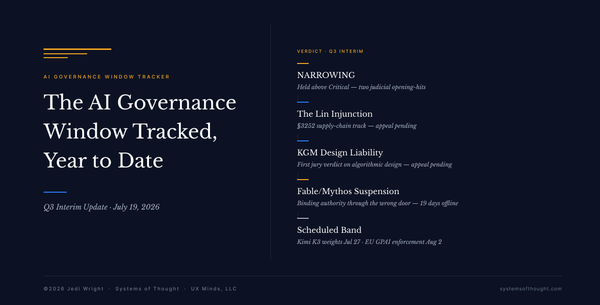
The Legibility Project v1.3 is a practitioner governance document developed across March–May 2026. It is part of an eight-document project suite anchored by the essay The End of History, Revisited: A Compound Civilizational Stress Event and the 10% Path. The full suite, including The Policy Framework, The AI Governance Window Tracker, The Agentic Accountability Playbook, and supporting documents, is available for peer review. All documents are free.
Systems of Thought is published by UX Minds, LLC. Methodology disclosure: this publication uses AI-collaborative methods consistent with the transparency standards it advocates. Intellectual direction and authorial responsibility are held by the human author. Licensed under CC BY-NC-ND 4.0.