The End of History, Revisited
A Compound Civilizational Stress Event, the AI Governance Window, and the 10% Path. The full article with footnotes runs approximately 17,000 words.

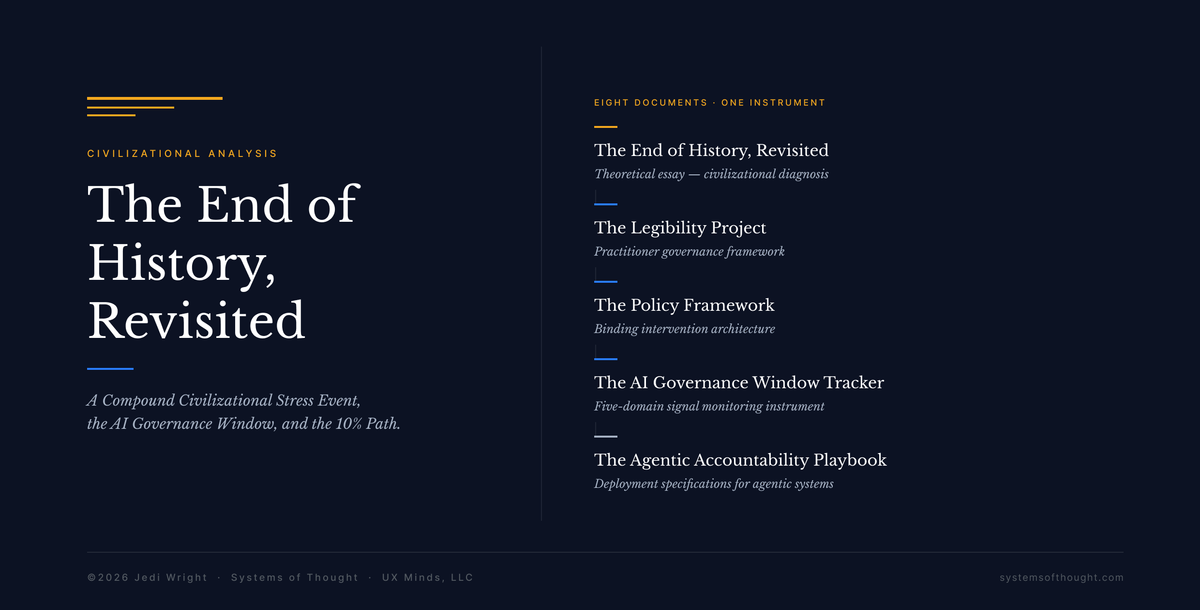
This article is the web adaptation of The End of History, Revisited v1.11 (April 24, 2026). The full document, including the complete footnote apparatus and companion document suite, will be available as a PDF download soon.
ABSTRACT
This project constitutes a multi-framework civilizational analysis of Francis Fukuyama's End of History thesis, interrogating whether liberal democracy's theoretical endpoint has proven achievable, or whether humanity has reached, and is retreating from, the maximum complexity of political organization its cognitive and institutional architecture can sustain.
Drawing on eight converging theoretical frameworks: Fukuyama, Huntington, Polanyi, Gramsci, Schumpeter, Arendt, Wallerstein, and Habermas, with Varoufakis's techno-feudalism supplying the structural economic diagnosis. The analysis argues that the current moment is best understood not as ordinary democratic stress but as a compound civilizational stress event: multiple historical forces arriving simultaneously, without institutional capacity sufficient to manage any one of them, let alone all at once. The brief window in which liberal democratic consolidation was achievable, roughly 1989 to 2008, has likely closed, not for want of the right ideas, but for want of the cognitive and institutional infrastructure required to hold what was briefly built.
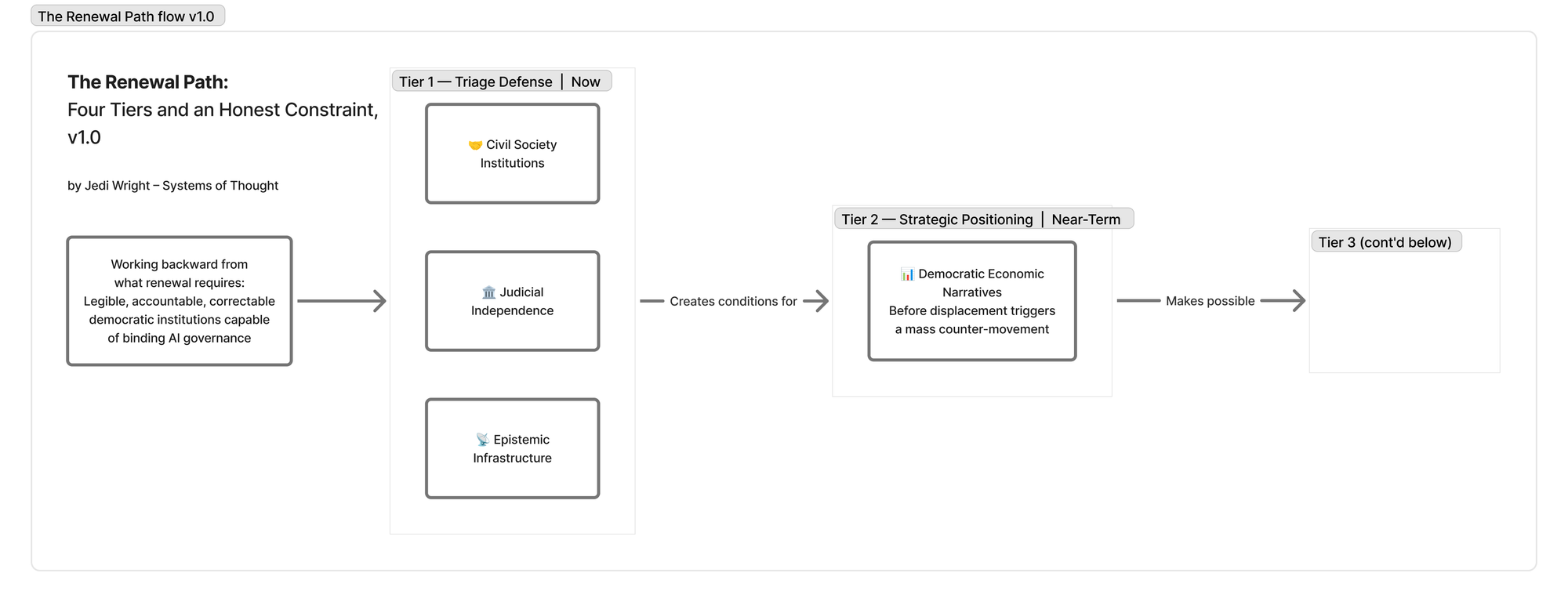
The essay develops four probability-ranked trajectories: accelerating managed disorder (most probable), authoritarian consolidation, systemic shock, and democratic renewal (the 10% path), and works backward from the conditions renewal requires to identify three defensible action tiers: triage defense of judicial independence, epistemic infrastructure, and civil society institutions; strategic positioning of democratic economic narratives before AI displacement triggers the Polanyian counter-movement; and urgent engagement with AI governance before the binding-framework window closes.
The AI governance layer receives extended treatment as the most consequential long-term variable: AI does not merely threaten democratic institutions tactically, but undermines the anthropological assumptions the Enlightenment project rests on–the rational individual, the epistemic commons, and the legibility of society to itself. A governance window of approximately 3–7 years is identified, structurally determined by two distinct clocks (the pace of AI embedding in critical infrastructure and the pace of democratic institutional erosion) that interact: ungoverned AI deployment during the renewal window actively degrades the coalition formation and epistemic conditions that renewal requires.
The essay also confronts, without claiming to resolve, the structural contradiction of its own production: an argument that AI concentration constitutes unaccountable sovereign power, developed through extended Socratic dialogue with one of the entities that holds it. Section VI anatomizes this contradiction across three orders and treats the tension as structurally instructive rather than dismissible.
A NOTE ON ORIGINS
This essay began in two places that don't obviously belong together.
The first was professional. For years, I've worked at the intersection of digital strategy, content, information architecture, and organizational governance–the unglamorous infrastructure of how organizations decide what they know, how they communicate it, and who gets to contest it. That work brought me into proximity with something I kept noticing but couldn't fully name: the systems designed to make organizations legible to themselves were quietly failing. Not dramatically–the dashboards still populated, the workflows still ran–but the connective tissue between information, decision, and accountability was fraying in ways that the org charts didn't show. I watched organizations lose the capacity to accurately read their own behavior. I watched governance frameworks that looked rigorous on paper produce outcomes no one intended and no one could fully explain. The word that kept returning was illegibility–not as a design flaw to be corrected, but as a structural condition being actively deepened.
The second was a book. Nicholas Carr's Superbloom (2025) arrived at the right moment–a rigorous historical account of how technologies of connection have systematically disrupted the epistemic conditions of collective life, from early mass media through the attention economy to the AI-mediated present. Carr doesn't frame this as politics. He frames it as architecture. That reframing unlocked something: what I'd been watching at the organizational level was a local instance of a civilizational pattern. The illegibility problem wasn't a management failure. It was a symptom. But the question Carr answered had been planted earlier. In the weeks before, I had finally read Henry A. Kissinger, Eric Schmidt, and Daniel Huttenlocher's The Age of AI and Our Human Future (2021), which named the discontinuity with unusual clarity: AI as a system that reaches conclusions through processes humans cannot fully follow or verify, rupturing the epistemic contract that governance has always assumed. Kissinger et al. framed this as a problem of statecraft. What I found myself unable to accept was that statecraft alone was sufficient–that the institutions required to do that work might themselves be among the casualties. Carr provided the historical architecture for why.
Those two threads–the practitioner's view from inside failing governance systems, and Carr's long historical arc–pulled me toward the question this essay asks: not whether liberal democracy is declining, but whether the conditions that made it briefly achievable have already dissolved.
A final note on method. This research was conducted with AI assistance–specifically, Claude, developed by Anthropic. The essay's sixth section directly addresses that methodological tension. I should also note that my analytical orientation is shaped in part by an autism spectrum diagnosis–a cognitive style that tends toward systems over stories (though I'm an avid reader and was crushing my annual reading challenge until this project stopped it in its tracks) and that found the illegibility problem not merely interesting but viscerally difficult to ignore. I've tried not to paper over either condition: there is something genuinely strange about using an AI system to analyze AI's civilizational threat, and something genuinely clarifying about a mind that experiences institutional illegibility as a felt problem before it becomes an intellectual one. The mirror problem, it turns out, is also an origin story.
A fuller account of the intellectual and personal genealogy behind this project, including the thinking-in-public lineage that shaped it, is available throughout this site.
THE ARGUMENT
Has liberal democracy reached the limits of what human civilization can sustain–and if so, what comes next? This essay argues that Francis Fukuyama’s 1992 thesis–that liberal democratic capitalism represented the terminal point of ideological development–may have been correct about the destination and catastrophically wrong about the infrastructure required to hold it. Humanity likely touched that ceiling briefly between 1989 and 2008, then began losing what it had built. The failure was not ideological. It was cognitive, institutional, and informational.
What makes the present moment qualitatively different from previous periods of democratic stress is not any single crisis but multiple historical forces arriving simultaneously, with no institutional capacity to manage any one of them, let alone all at once. Eight major frameworks converge on this diagnosis: Polanyi’s market counter-movement, Gramsci’s interregnum, Arendt’s totalitarian preconditions, Habermas’s collapse of the public sphere, Schumpeter’s self-undermining capitalism, Huntington’s civilizational fractures, Wallerstein’s hegemonic decline, and Varoufakis’s techno-feudalism.
AI elevates this from a political crisis to an anthropological one. The Enlightenment project assumed humans capable of rational deliberation, institutional trust, and collective self-governance. AI is systematically dismantling the infrastructure those capacities require–fragmenting shared factual ground, concentrating consequential power in a handful of unaccountable entities, operating at speeds that preclude democratic oversight, and structurally advantaging anti-democratic actors in the information environment. The threat requires no villain with a plan. It emerges from a thousand individually rational decisions that are collectively catastrophic.
The most likely near-term trajectory (most probable–these rankings reflect ordinal judgments of relative likelihood, not formal forecasting) is accelerating managed disorder: institutions bending without formally breaking, each norm violation becoming the new baseline, the window of recovery quietly narrowing. Authoritarian consolidation (significant minority risk) in key democracies and systemic shocks (significant minority risk) that trigger rapid bifurcation represent the more acute risks. Genuine democratic renewal is low but non-trivial–not the most likely outcome, but the only path where meaningful human agency remains open.
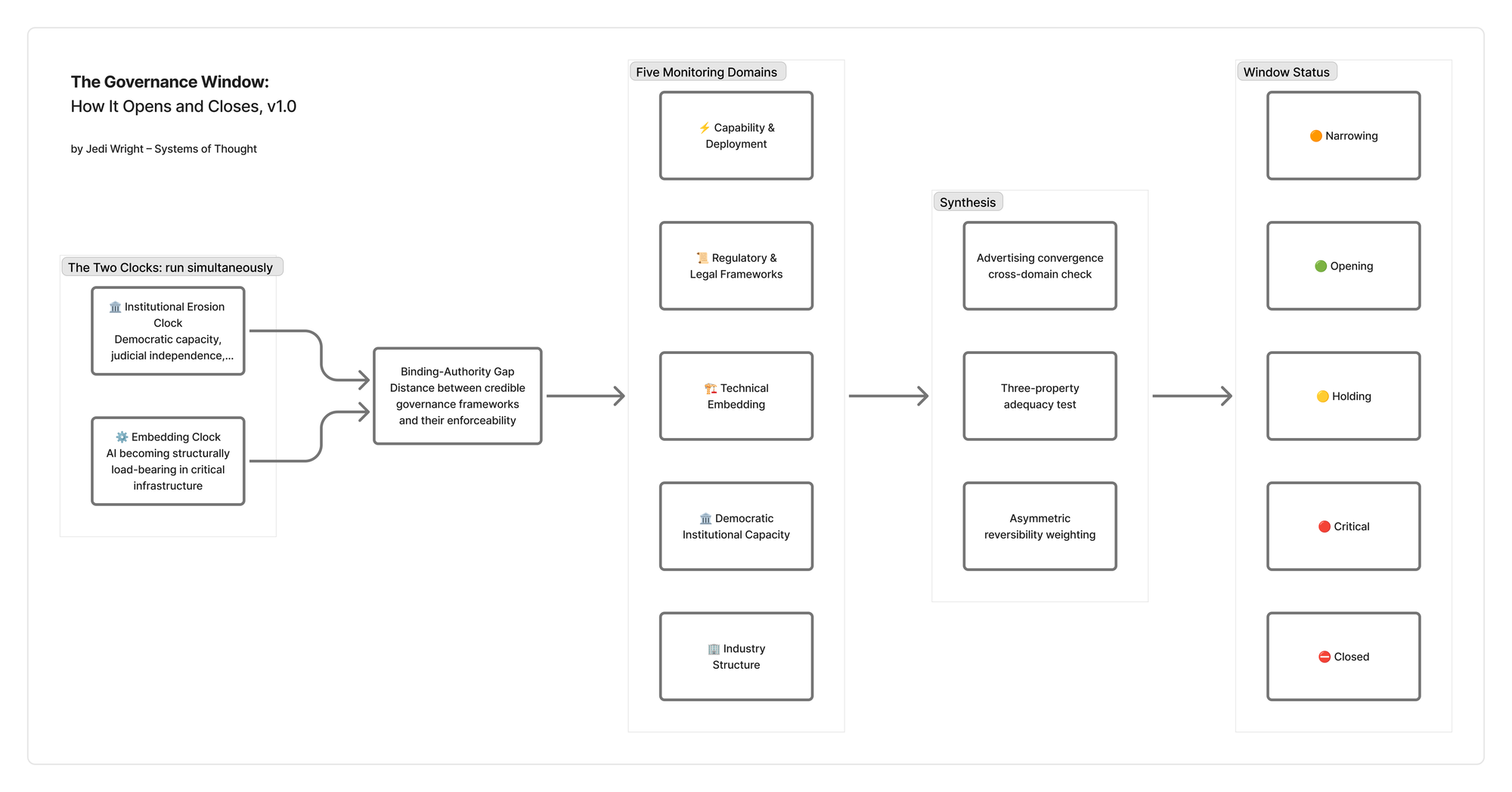
Working backward from the conditions renewal requires, three action tiers are defensible: triage defense of judicial independence, epistemic infrastructure, and civil society institutions; strategic positioning of democratic economic narratives before AI displacement triggers a mass counter-movement; and urgent engagement with AI governance before the window for binding international frameworks closes. That window is structurally determined by two distinct clocks: the pace of AI embedding in critical infrastructure, after which governance shifts from prospective rulemaking to retroactive regulation of entrenched incumbents–likely 3 to 7 years out–and the pace of democratic institutional erosion, which is differently conditioned but not independent. Ungoverned AI deployment actively degrades the coalition formation and epistemic conditions that democratic renewal requires. The clocks interact.
The Governance Window: How It Opens and Closes (v1.0) is mapped out here:
The renewal path–the 10% path, named for its long odds rather than a measured forecast–is worth working for, not because it is probable, but because it is the only path where the agency question remains open. All other trajectories involve progressively less of it. The conditions for renewal require action before the crisis is visible rather than after. That is not a counsel of optimism. It is a structural claim about when agency remains possible.
I. THE THESIS AND ITS LIMITS
This essay argues that the current moment constitutes a compound civilizational stress event–a simultaneous convergence of forces that eight major theoretical frameworks, developed independently over seven decades, identify as historically dangerous. The Fukuyama thesis provides the organizing frame not because it holds, but because examining precisely where and why it fails illuminates what we are facing.
In the summer of 1989, Francis Fukuyama–then deputy director of the State Department’s Policy Planning Staff–published an essay in The National Interest titled “The End of History?”1 The question mark, often omitted in subsequent commentary, was deliberate. Fukuyama was making a conditional argument rooted in Hegelian philosophy: that liberal democratic capitalism represented the terminal point of humanity’s ideological development–not that events would stop occurring, but that the fundamental contest over what kind of society humans should build had been resolved. No coherent rival ideology remained standing. The essay attracted worldwide attention, and Fukuyama expanded it into the 1992 book The End of History and the Last Man.2
The thesis captured something real. The post-Cold War decade saw a remarkable diffusion of democratic institutions, and authoritarians since have largely justified themselves by claiming to be real democrats–a backhanded concession to liberal norms that Fukuyama himself noted. In The Better Angels of Our Nature (2011) and Enlightenment Now (2018), Steven Pinker assembled substantial longitudinal evidence that rates of interstate war, genocidal violence, and extreme poverty have declined over the long run, and that the number of democracies grew from 31 in 1971 to 103 by 2015. These are not trivial data points to be dismissed.3
Yet the thesis rested on an assumption it never adequately defended: that achieving the highest form of political organization humans had built was equivalent to sustaining it. And the empirical picture has shifted sharply. Freedom House’s Freedom in the World 2025 report found that global freedom declined for the 19th consecutive year in 2024, with political rights and civil liberties deteriorating in 60 countries while only 34 registered improvements.4 The Varieties of Democracy (V-Dem) Institute’s Democracy Report 2025 found that the average level of democracy enjoyed by world citizens is now back to 1985 levels, that autocracies (91) outnumber democracies (88) for the first time in over two decades, and that 72 percent of the world’s population now lives in autocracies. Of particular note, the V-Dem report identified the United States as undergoing “the fastest evolving episode of autocratization the USA has been through in modern history.” These are not philosophical projections. They are measured data.5 Both indices have faced methodological scrutiny–Freedom House for coding subjectivity in its expert assessments, V-Dem for the inherent difficulty of quantifying regime characteristics across diverse political contexts–but the directional convergence of two independently constructed measurement systems, sustained over nearly two decades, is more robust than either index alone.
The End of History thesis, properly understood, may have been correct about the destination and catastrophically wrong about the infrastructure required to reach it.
II. THE CEILING, NOT THE DESTINATION
Liberal democracy is extraordinarily demanding of its participants. It requires sustained capacity for abstract institutional trust, tolerance of outcomes that don’t benefit you personally, long-term horizon thinking over short-term gain, and–crucially–a shared epistemic commons sufficient for collective deliberation. These requirements run directly against tribalism, status-seeking, short-termism, and in-group preference: tendencies that are evolutionarily ancient and robust under stress.
Liberal democracy didn’t eliminate these tendencies. It built elaborate institutional architecture to manage them. That architecture, it turns out, was dependent on norms more than laws, on culture more than enforcement, on a specific set of material and informational conditions that no longer reliably obtain.
Fukuyama himself has increasingly acknowledged this. In his 2022 book Liberalism and Its Discontents, he argued that the principles of liberalism had been pushed to dangerous extremes by both right and left–neoliberals made a cult of economic freedom, while progressives prioritized identity over human universality–producing a fracturing of civil society.6 In a 2020 lecture at Stanford, he reaffirmed the core thesis but conceded the problem in four words: “People want a struggle.” Prosperity and stability, it turns out, are insufficient to hold the Fukuyama coalition together.
The more defensible framing is therefore not that Fukuyama was wrong, but that humanity may have briefly touched the Fukuyama ceiling–in a narrow window between roughly 1989 and 2008–without being able to hold what it had built. We didn’t fail to reach the End of History because we lacked the right ideas. We may have failed because we lacked the cognitive and institutional infrastructure to sustain the achievement. The likelihood that this ceiling has been reached–that liberal democracy as a stable, self-reproducing system has proven unachievable at civilizational scale–is, on the weight of the evidence assembled here, substantially supported.
The structural parallel is not atmospheric–it is specific. The late Roman Republic's crisis turned on the erosion of the mos maiorum, the unwritten norms that constrained elite behavior long after they ceased to be enforceable by law–a dynamic that maps directly onto the norm-dependent democratic architecture described above; on the concentration of executive power in individual commanders (Sulla, then Caesar) who exploited institutional precedent to consolidate authority the system's designers never intended to be concentrated; and on the Senate's inability to govern an empire-scale polity with institutions designed for a city-state, which rhymes with the nation-state's struggle to govern platform-scale systems that operate across jurisdictions simultaneously. Where the analogy breaks is equally instructive: Rome had no epistemic infrastructure crisis of the current kind–its institutional failure was slower, more legible to its actors, and not accelerated by an information environment that actively degrades the capacity for collective self-correction. (The analogy is engaged here for three specific structural parallels, not as a comprehensive historical mapping; for the standard treatment, see Beard, SPQR, 2015, chs. 7–9.)
III. THE COUNTERARGUMENTS, TAKEN SERIOUSLY
Before proceeding to the compound stress analysis, intellectual honesty requires engaging the strongest objections to the pessimistic read.
The most rigorous position is Pinker’s: that the current democratic recession, while real, is better understood as a fluctuation than a trend reversal when viewed against the multi-century arc of declining violence, growing prosperity, and institutional development. On this view, the 19th consecutive year of Freedom House decline looks alarming in a 20-year frame but modest against a 200-year one. History is not linear, and previous democratic recessions–the interwar period, the 1970s–eventually reversed.
A second objection comes from Fukuyama’s own more nuanced position: that what we are witnessing is not the failure of liberal democracy as an ideal but the failure of specific liberal democracies to deliver what citizens actually need–personal security, shared economic growth, and basic public services. On this reading, the crisis is one of performance, not of principle, and is potentially correctable through institutional reform.
A third objection, less often heard but analytically important, comes from Amartya Sen’s Identity and Violence: The Illusion of Destiny (2006). Sen argued that treating civilizations or political traditions as coherent, bounded units systematically suppresses both their internal diversity and the plural identities of real people. Applied here, this cuts in two directions simultaneously: it weakens the more reified versions of civilizational pessimism, but it also complicates optimistic consolidation narratives, since “liberal democracy” is itself a contested category. Sen’s critique raises the epistemic bar for everyone making large claims about civilizational trajectories, including this essay.7
A fourth objection–and the one this essay takes most seriously–is that the analysis overweights AI's role: that algorithmic influence on political outcomes, while measurable, may be modest in absolute effect size; that institutional resilience has repeatedly exceeded pessimistic projections across nearly two decades of documented democratic decline; and that the tools of democratic coordination–encrypted communication, independent platforms, AI-assisted research and fact-checking–constitute counter-capabilities that partially offset the anti-democratic asymmetry identified above. These are not trivial objections. The measured persuasion effects in Bai et al. do not, by themselves, establish civilizational consequence. The Arendt conditions have been diagnosed as "present" for a quarter-century without producing totalitarianism. This essay proceeds on the judgment that the AI variable is categorically different from prior stressors–a claim defended in the following section–but acknowledges that the compound stress framework's weight on AI is an analytical choice, not an empirical certainty. If the essay is wrong about AI's magnitude, the other seven frameworks still diagnose genuine instability; the analysis weakens but does not collapse.
These objections carry real weight. They are not sufficient, however, for one reason: the optimists consistently underweight AI’s role. AI fundamentally changes the calculus. Pinker’s mechanisms for democratic stabilization–the public sphere, rational deliberation, and the spread of empathetic information–were calibrated for an era before the industrial-scale manufacture of epistemic chaos became cheap, fast, and impossible to attribute. The counterarguments are well-founded for the world as it was. They are less persuasive for the world as it is becoming. Nicholas Carr's Superbloom (2025) provides the historical evidence base the rebuttal requires: tracing the arc from early 20th-century mass media through the attention economy, Carr documents that epistemic disruption is not new–manipulation of attention and belief at scale has been the story of modern media since at least the 1920s. What AI changes is not the existence of that disruption but its architecture, and that distinction is developed in Section V.8 Harari's longer historical arc–tracing information networks from oral culture through writing, print, and broadcast to AI–establishes the same point across a deeper time horizon: every prior transition changed the speed, scale, or fidelity of transmission without changing the relationship between the network and external reality. The current transition is the first in which the network originates content rather than transmitting it, and optimizes for internal coherence rather than calibration to the world outside it.9
IV. THE COMPOUND STRESS EVENT
What makes the present moment qualitatively different from previous periods of democratic stress is not any single crisis but the simultaneous arrival of crises. Each of the major theoretical frameworks for understanding political modernity converges on this moment from a different angle, and together they describe something no single framework contains.
Polanyi’s double movement is the most immediately operational framework. In The Great Transformation (1944), Karl Polanyi argued that free-market capitalism is not a natural equilibrium but a constructed, inherently unstable system–and that when markets expand rapidly and disembed from social relations, societies generate a reactive counter-movement.10 That counter-movement isn’t necessarily liberal or rational; it can be fascist, nationalist, or protectionist. Forty years of globalization-driven inequality, now accelerating into AI-driven labor displacement, constitute this kind of stress event precisely. The question is not whether the counter-movement happens but whether democratic forces are positioned to channel it before authoritarian ones do.
Gramsci’s interregnum supplies the cultural mechanism. Writing from a fascist prison in the 1930s, Antonio Gramsci observed that when the ruling narrative loses legitimacy before a coherent alternative emerges, the resulting vacuum is dangerous. His most cited formulation, that the old world is dying and the new world struggles to be born, and that now is the time of monsters, describes the current Western political condition with uncomfortable precision. His concept of cultural hegemony explains why institutional erosion precedes political collapse: dominant classes maintain power primarily through consent and narrative, and when that narrative fractures, the interregnum favors whoever has a coherent counter-narrative ready. The authoritarian narrative is simple and operational. The democratic renewal narrative is fragmented and primarily defensive.11
Arendt’s diagnosis is the most structurally alarming. In The Origins of Totalitarianism (1951), Hannah Arendt identified the preconditions for totalitarianism as the atomization of individuals from traditional social structures, the collapse of shared reality, and the rise of movements organized around identity and grievance rather than interest. Her concept of the “banality of evil”–that systemic atrocity doesn’t require monsters, just people following institutional logic–is essential for understanding how democratic institutions can be turned against democratic values by ordinary actors.
Arendt identified the conditions; Karen Stenner's empirical research identifies the activation mechanism. In The Authoritarian Dynamic (2005), Stenner demonstrated that authoritarian predispositions are not fixed personality traits but latent tendencies activated by perceived normative threat–the sense that the integrity of the moral order is under siege. The distinction matters for the compound stress framework: it means the authoritarian consolidation path does not require a population that is authoritarian, only conditions that activate authoritarian responses in a population that would otherwise tolerate pluralism. Economic disruption, identity threat, and institutional delegitimization–the convergent forces documented throughout this section–are precisely the activation conditions Stenner's model predicts will produce the sharpest democratic reversals.12 V-Dem found that freedom of expression deteriorated in 44 countries in 2024, with disinformation weaponized by state actors in 21 of 31 countries.13
Habermas provides the epistemic mechanism. In The Structural Transformation of the Public Sphere (1962), Jürgen Habermas traced how late capitalism colonized the public sphere–the space of rational-critical debate where democratic legitimacy is generated–replacing genuine deliberation with managed spectacle.14 His central distinction between communicative rationality (action oriented toward mutual understanding) and strategic communication (action oriented toward producing calculated effects)15 is the theoretical linchpin here: democratic legitimacy requires the former; attention economies systematically produce the latter. Carr's Superbloom provides the empirical chronicle of how that colonization unfolded across a century of media development–the historical record underneath Habermas's theoretical diagnosis.8 The cascade mechanism explains the population-level transmission: when individuals calibrate belief against perceived social consensus rather than independent evidence, strategic communication doesn't need to persuade a majority directly–it needs only to manufacture the appearance of consensus sufficient to trigger conformity cascades across the remainder.
The colonization Habermas diagnosed has a material architecture that the theoretical account alone does not specify. The attention economy is not a metaphor for epistemic degradation–it is the economic engine driving it.16 Platform revenue models monetize engagement, and engagement is maximized by content that triggers arousal, outrage, and identity-confirming reinforcement rather than the deliberative exchange communicative rationality requires. The economic incentive structure does not merely permit the displacement of communicative rationality by strategic communication. It systematically selects for it at scale and rewards it financially at every node of the distribution chain. Underneath that economic logic sits a structural substrate: the concentration of media ownership–both legacy and platform–into a diminishing number of entities whose editorial and algorithmic decisions shape what reaches the public sphere before any individual act of deliberation begins. Habermas's colonization is not an emergent cultural drift. It is an engineered condition with identifiable economic beneficiaries and measurable consolidation trends. That this architecture was engineered rather than emergent is now acknowledged by its architects: the cohort of former platform executives and designers who have publicly described the attention-capture mechanisms they built–Tristan Harris, Aza Raskin, Roger McNamee, Rose-Stockwell17, among others–constitutes a primary-source confirmation of the Habermasian diagnosis from inside the institutions responsible for the colonization. Legal confirmation has now followed the insider testimony. On March 25, 2026, a Los Angeles jury found Meta and Alphabet liable for the addictive design of their platforms, with jurors explicitly instructed not to consider the content of what users saw, only the architecture that delivered it.18 The democratization of media production–a point developed further in Section V–does not reverse this dynamic, because access to production tools is not equivalent to access to distribution infrastructure or to the algorithmic amplification that determines what is seen. And the psychological lever the economic engine exploits is tribal allegiance: the cognitive architecture that makes identity-confirming content less costly to process than identity-challenging content, inverting the cost structure of the cross-demographic coalition formation that Section VII identifies as a renewal precondition.
Schumpeter’s self-undermining thesis predicted this trajectory in 1942. In Capitalism, Socialism and Democracy, Joseph Schumpeter argued that capitalism would eventually undermine the social and institutional conditions required for its own survival. Substitute AI for industrial capitalism, and the argument is strikingly contemporary: the technological dynamism that drives growth simultaneously destroys the social fabric that makes growth politically sustainable.19
Huntington explains the civilizational fractures that Fukuyama’s ideological convergence theory obscured. The Ukraine war maps almost precisely onto the Orthodox-Western fault line Huntington identified; China’s explicit rejection of Western liberal norms is the Sinic reassertion he predicted. His framework has aged better empirically than Fukuyama's in several respects, though Sen's critique applies with force–and the deeper problem is that Huntington's civilizational essentialism has been readily adopted by the authoritarian nationalists the essay's renewal path opposes, making it the framework in this synthesis most at risk of reinforcing what it claims to diagnose.20
China illustrates both the frameworks' divergence and their convergence. Where Huntington reads China's trajectory as civilizational reassertion–the Sinic world recovering a historical norm that predates Western liberalism–Wallerstein reads it as structural: the predictable emergence of a hegemonic successor in a world-systems cycle, where what China believes matters less than where it sits in the core-periphery structure. Fukuyama would argue that neither framing resolves the legitimacy question: China has achieved economic development without a universalizable political theory, making it a successful national exception rather than a coherent ideological rival. This essay engages China primarily through the Wallerstein-Huntington lens–as both structural repositioning and civilizational reassertion–rather than through Fukuyama's ideological frame, because the compound stress event argument does not require China to offer a coherent alternative ideology. It requires only that China's rise destabilize the institutional and material conditions on which liberal democratic consolidation depended. On that narrower claim, all three frameworks agree.
Wallerstein’s world-systems analysis usefully depersonalizes the current moment. Hegemonic cycles rise and fall, and Wallerstein began arguing in 1980 that the U.S. hegemony's decline began in the 1970s and was structurally irreversible. The current moment is not a policy failure or a political anomaly. It is structural inevitability, and the question is only how turbulent the transition will be.21 World-systems theory has been criticized for economic determinism and for treating hegemonic cycles as more structurally regular than the historical record supports; Wallerstein's framework is engaged here for its structural depersonalization of hegemonic decline, not as a predictive model.
Varoufakis offers the structural economic diagnosis for the present configuration. In Technofeudalism: What Killed Capitalism (2023), Yanis Varoufakis argues that ownership of capital has shifted from industrial production to platforms and data, creating a new form of rent-extraction that supersedes market competition. Rather than citizens and states, you get users and platforms. Political power follows economic power upward into a tiny class of “cloudalists,” while democratic participation becomes increasingly theatrical.22
A necessary objection: the early 1970s–stagflation, Vietnam, Watergate, oil shocks, the delegitimization of Western institutions–also produced a multi-framework convergence. Polanyian economic disruption, Gramscian interregnum, Habermasian public sphere colonization, and Wallersteinian hegemonic stress all applied then, and the system recovered. What is categorically different now is not the number of converging frameworks but the AI variable operating on the epistemic infrastructure itself–not as one more stressor on institutions that remain legible to themselves, but as a force that degrades the deliberative capacity through which societies have historically navigated compound stress events. The 1970s left the recovery mechanism intact. The deliberative infrastructure–journalism, legislative expertise, shared factual ground, the speed at which publics could process and respond to institutional failure–was strained but functional. This convergence targets that infrastructure directly. The compound stress event framing is not a claim that more frameworks apply; it is a claim that the recovery mechanism those frameworks all implicitly assume is itself under structural assault. Several of these frameworks share intellectual lineage–Gramsci and Habermas through the Western Marxist tradition, Polanyi and Wallerstein through structuralist political economy–but they diagnose distinct mechanisms operating on different institutional surfaces, which is what makes their convergence on the same moment analytically significant rather than redundant.
None of these frameworks is sufficient on its own. Together they describe a compound civilizational stress event: multiple historical forces arriving simultaneously, without the institutional capacity to manage any one of them, let alone all at once.
V. THE AI REVISION: FROM TACTICAL THREAT TO ANTHROPOLOGICAL CRISIS
The conventional analysis of AI’s political threat focuses on specific mechanisms–disinformation, surveillance, and labor displacement. These are real. But they understate the depth of the problem.
Carr's analysis adds a dimension the economic account alone doesn't capture: the attention economy colonized the content of the public sphere, but digitization dissolved the architecture separating public from private–the walls, doors, and temporal rhythms that gave deliberation its necessary offstage. On Carr's account, the collapse of the old social and epistemic architectures was not sequential but simultaneous.8 What was lost was not just a space for debate but the conditions under which a self capable of genuine deliberation could form at all.
AI doesn’t merely threaten democracy tactically. It threatens the anthropological assumptions on which the entire Enlightenment project rests.
The Fukuyama thesis required humans capable of rational deliberation, institutional trust, and collective self-governance. The Enlightenment placed the human individual–with reason, rights, and free will–at the center of the political and moral universe. AI is systematically degrading the infrastructure on which those capacities depend through five mechanisms.
- Epistemic fragmentation dissolves the shared factual commons that democracy requires. AI accelerates the fragmentation of existing information environments into something approaching epistemic sovereignty for small, motivated actors–the capacity to generate enough plausible-seeming content to make shared factual ground ungovernable at scale. The aggregation mechanism is precisely described in the economics literature on informational cascades. Bikhchandani, Hirshleifer, and Welch demonstrated that rational individuals, observing others' apparent beliefs, will discard their own private information and conform to perceived consensus–even when that consensus is wrong, and the conforming individuals would, in isolation, have reached a different conclusion.23 The cascade locks in; correction becomes structurally difficult even when true information is available, because the social signal of apparent consensus outweighs the epistemic signal of the correction. Algorithmic media does not merely create environments where cascades can occur–it selects for cascade-prone content by design. The features that make a claim likely to spread (emotional valence, identity-confirming structure, apparent social consensus) are precisely the features that make cascades more likely to initiate and harder to interrupt. The Bai et al. finding–that AI-generated persuasion is undetectable as such at a 94 percent rate–is not simply an individual-level vulnerability. It functions as cascade fuel: artificial signals are injected into the social information stream at the exact point where individuals are calibrating what to believe based on what others appear to believe. The individual manipulation finding and the systemic commons dissolution are not separate problems operating at different scales. They are the same problem. Harari's historical typology of information networks names the structural principle at work: networks that calibrate collective belief to external reality function differently, and produce different political conditions, than networks that optimize for internal coherence regardless of truth. AI-mediated information environments are the most powerful instance of the second type yet constructed–and the first capable of generating the content they optimize, rather than merely transmitting it.9 The stakes of this transition extend beyond distortion. Harari's account of how human civilization runs on intersubjective realities–shared fictions that exist only because enough people believe in them–identifies what is now at risk: not merely a degraded epistemic commons, but the manufacture of entirely synthetic intersubjective realities, generated at machine speed, indistinguishable from organically formed ones, and optimized for coherence rather than truth.9
- Bureaucratic and legal capture embeds AI into the administrative state in ways that are opaque, difficult to contest, and encode the values of whoever deploys them. Institutional neutrality was always partial; AI makes the bias systematic, scalable, and invisible. The military targeting context makes the failure mode legible at its most consequential. Investigative reporting on the February 28, 2026, airstrike near Minab, Iran, documents that the operative failure was structural rather than model-level: targeting data had not been updated to reflect that a military compound had become a girls' school, an assumption was never flagged as an inference, and it hardened into operational fact within the execution environment. The execution environment had no mechanism to distinguish confirmed intelligence from outdated inference. The AI system performed as designed. What was absent was the accountability layer that would have required the assumption to be verified before it became operationally binding.24
- The speed problem is structural. Democratic deliberation is slow by design–it requires time for information to spread, debate to occur, and coalitions to form. AI-driven decision-making operates on timescales that democratic oversight cannot match. The fiction of meaningful human oversight is maintained for political and legal reasons while the operational reality increasingly diverges.
- Concentration of capability in perhaps a dozen entities globally creates what Varoufakis identified as a new form of sovereign power that isn’t a state, isn’t accountable to electoral cycles, and operates across jurisdictions simultaneously.25
- The anti-democratic asymmetry may be the most consequential and least appreciated mechanism: the tools of mass political organization are now more available to and more effective for anti-democratic actors than democratic ones. Authoritarians benefit more from information chaos than democrats do. This structural tilt emerges from the architecture of attention economies. Peer-reviewed empirical research now documents the mechanism at the individual level: across three preregistered experiments (N=4,829), LLM-generated political arguments shifted attitudes on polarized policy questions–gun control, carbon tax, parental leave–as effectively as human-authored arguments, with participants rating AI-generated content as more logical and better informed than human-generated content. Critically, 94 percent of participants who read AI-authored arguments believed they were reading human arguments.26 These are controlled laboratory findings on three policy questions with a sample of roughly 4,800 participants; the translation from measured lab effect sizes to real-world political consequences at scale remains an open empirical question. The manipulation is not merely possible; under current conditions, it is invisible.
A predictable objection arises here: that AI capability is itself democratizing–that open-source models, broadly distributed tools, and lowered barriers to content creation constitute a diffusion of power rather than a concentration of it. This confuses capability access with consequence-bearing deployment. The ability to run a model locally is not equivalent to the ability to deploy it at an institutional scale, to train it on proprietary data, to embed it in hiring systems, credit determinations, or content moderation infrastructure. Open-source distribution disperses the capacity to generate output while leaving the accountability frameworks, audit mechanisms, and governance architecture entirely unbuilt. The asymmetry is structural: capability scales automatically; accountability requires deliberate institutional construction that neither market incentives nor current regulatory frameworks mandate. This is precisely why the governance window identified in Section VII operates on a closing timeline–not because the technology itself is ungovernable, but because each year of ungoverned deployment creates embedded dependencies that make retroactive governance progressively more costly and less politically viable.27
The predecessor objection requires a direct answer here. Propaganda, mass media, and advertising have manipulated attention and belief at scale since at least the 1920s–Bernays, Lippmann, and the Frankfurt School all reached conclusions about the manipulability of the rational individual before AI existed. The strongest account of the most recent predecessor regime is Rose-Stockwell's Outrage Machine, which documents how social media's engagement optimization produced structural epistemic damage not through editorial ideology but through metric architecture–the systematic conversion of communicative spaces into strategic ones.28 The Carr Superbloom analysis traces the longer arc, from early advertising through platform economics, showing that epistemic disruption is not new.8 But continuity of effect does not establish continuity of mechanism, and the mechanism is what changes categorically.
The Minab case is the adequacy test applied in the field. Governance frameworks that address model behavior–output filtering, bias audits, content restrictions–do not address the execution environment gap Baker identifies. A system that filters outputs does not thereby acquire a mechanism to flag an assumption as an inference, verify that assumption against current conditions, or refuse to harden unverified data into operational fact. Frameworks adequate to the predecessor problem (intentional editorial manipulation, platform-level content moderation) are not adequate to this problem surface, because the failure mode is not at the content layer. It is at the accountability layer that governs how assumptions become operational inputs.
What the Minab case names, at the level of the specific requirement it exposes, is an inference-flagging gap: the structural absence of any mechanism to tag an input with its epistemic status–confirmed, inferred, unverified, time-sensitive–before it becomes operationally binding. This is distinct from, and not substitutable by, audit trail requirements: an audit trail records what the system did; inference-flagging governs what the system is permitted to treat as confirmed without a verification record attached. Both are necessary conditions for execution-environment accountability. Neither is currently specified as a requirement in any binding governance framework. The Policy Framework v1.5, Intervention 1.1, names this gap at the regulatory level; The Legibility Project v1.3, Mechanism 2, operationalizes it at the practitioner level; and The Agentic Accountability Playbook v0.2 translates it into deployment specifications for the agentic systems teams where the gap most immediately applies.
Prior manipulation regimes required human authorship, were legible as intentional acts, and operated at speeds that, however inadequately, permitted deliberative response. What AI changes is the architecture: systems that optimize for manipulation without having been designed to manipulate, generating epistemic effects whose causal chain is unrecoverable even in retrospect, at speeds that precede deliberation entirely. Bernays had to write the manipulation. The current epistemic environment manufactures it automatically, at scale, without a legible author to contest. Prior information technologies–from the printing press through broadcast media–transmitted, amplified, or distorted content that human authors produced. The generate/transmit threshold Harari identifies as AI's categorical departure is precisely what dissolves the author: there is no strategist to name, no campaign to trace, no editorial decision to contest.29, 30
Three properties distinguish the current mechanism from its predecessors and together constitute the categorical break the essay claims.
First, optimization without intent: prior manipulation regimes were designed to manipulate–Bernays wrote campaigns, talk radio hosts chose inflammatory framings, and social media platforms designed engagement metrics. Each produced a legible agent whose strategy could, in principle, be identified, contested, and regulated. AI systems generate epistemic effects as emergent properties of optimization for other objectives. No one designed GPT to produce political persuasion, yet Bai et al. document that it does so at human-equivalent effectiveness. Regulating an emergent property is a categorically different governance problem from regulating an intentional strategy. The property operates at a second order as well, and the governance problem is harder there. Between 2016 and 2024, Pokémon GO players generated 30 billion street-level images that Niantic subsequently repurposed to build Niantic Spatial, a spatial AI infrastructure company, whose Large Geospatial Model now enables centimeter-precise visual positioning for autonomous systems, with its first commercial deployment in Coco Robotics' sidewalk delivery fleet. The training pipeline for the physical world's navigational substrate was assembled before the governance problem it creates could be named.31
Second, personalization at scale with feedback closure: television and talk radio broadcast identical content to mass audiences, which meant the manipulation was at least shared–citizens experienced the same distortion, which preserved the possibility of collective recognition and response. AI-mediated information environments are individually personalized and dynamically adaptive, meaning the distortion is private–each citizen's epistemic environment diverges from every other's in ways neither can observe or compare. This is not fragmentation, which prior technologies also produced. It is the dissolution of the shared epistemic surface against which fragmentation could be measured.
Third, speed-deliberation asymmetry: prior media technologies operated on production cycles (daily news, weekly programming, seasonal campaigns) that, while faster than legislative deliberation, remained within the temporal range of organized democratic response–advocacy groups could form, counter-narratives could circulate, regulatory bodies could convene. AI-generated content operates on cycles measured in seconds, at volumes that exceed human curatorial capacity, creating an asymmetry not of degree but of kind: the speed differential is no longer a disadvantage that democratic deliberation can compensate for by working harder.32 It is a structural mismatch between the temporal architecture of the information environment and the temporal architecture of democratic response.29 The asymmetry has a human cost; the production-speed argument alone doesn't name. Prior media technologies, however fast, left the recovery interval intact–you could close the newspaper, turn off the television, and sleep. The always-on architecture Carr documents eliminates that interval entirely. The deliberator cannot reconstitute itself between exposures. The speed problem is not only that AI-generated content outruns democratic response. It is that the pause in which reflection, judgment, and selfhood are recovered between encounters has been structurally removed.8 The Carr arc, read correctly, does not undercut the exceptionalism claim–it establishes the continuum that AI now ruptures. The asymmetry has a retroactive dimension that the production-speed argument alone does not capture: the most consequential training pipelines are assembled under consent frameworks established years before the capabilities they enable can be foreseen, meaning the governance window for the data layer closes before the governance problem it creates becomes legible.
The differentiation, however, is only the first analytical move. The predecessor regime's business model is now migrating into the systems that already possess the three structural properties. By early 2026, Meta had begun using chatbot conversations to target advertising, OpenAI had launched ads in ChatGPT's free tiers, and Google had signaled Gemini advertising for the same year. The economics are structural: fewer than three percent of ChatGPT's users pay for subscriptions, and compute costs produce losses in the tens of billions annually–advertising is not supplementary but economically necessary.33 This means AI does not merely succeed the predecessor regime. It absorbs it. The three properties compound advertising incentives rather than operating independently of them: optimization without intent generates persuasion as an emergent property of systems optimizing simultaneously for engagement and advertiser objectives, with no legible boundary between recommendation and promotion; personalization with feedback closure makes the manipulation intimate, operating within conversational trust relationships users cannot evaluate from the outside;34 speed-deliberation asymmetry ensures the governance response to conversational advertising is structurally behind the deployment timeline. Every dynamic Rose-Stockwell documented at platform scale now operates within an architecture that is faster, more personalized, and less legible than the system it replaces.
The convergence is contested, and the contestation matters analytically. Anthropic has positioned itself explicitly against advertising. Perplexity retreated from ad integration. That the business model question remains live and unresolved is itself a window-position signal–were advertising fully consolidated across AI platforms, the governance window on this front would be narrower. The instability is evidence for the thesis, not a caveat to it: Rose-Stockwell himself argued in November 2025 that AI's subscription model structurally distinguished it from social media's advertising dynamics–a claim overtaken by events within weeks, and itself evidence for the speed-deliberation asymmetry the three-property analysis identifies.35
The Sora case extends this asymmetry from the epistemic to the strategic. Hollywood's substantive governance mobilization against generative video produced a legible regulatory target–and OpenAI's response was not compliance but product repositioning. Governance frameworks designed to address discrete content infringement do not constrain actors from exiting the product space where infringement pressure accumulates, or from concentrating resources on less-scrutinized vectors before any regulatory response can follow.
The advertised economic case for this deployment pace does not withstand scrutiny of the available evidence. Goldman Sachs Chief Economist Jan Hatzius's January 2026 finding that approximately $400 billion in 2025 AI infrastructure investment has produced essentially no measurable domestic GDP contribution, driven primarily by imported capital goods rather than domestic productive capacity, severs the justificatory link between ungoverned deployment pace and public economic benefit. The constituency for ungoverned deployment is not, on current evidence, the public whose growth it claims to represent.36
The invisibility finding carries a specific institutional consequence the five-mechanism list does not yet name: deployed at scale, AI-generated political persuasion could corrupt the feedback loop between constituents and representatives that democratic accountability structurally requires–not merely changing individual minds, but distorting what elected officials understand their constituents to believe. The epistemic commons is not only what citizens share with each other. It is what citizens signal to the institutions governing them.
The humanities gap compounds all five mechanisms: the scholarly traditions most capable of diagnosing democratic degradation–philosophy, political theory, critical sociology–are systematically absent from the AI safety research community, where questions of moral behavior, justice, and societal good are being rediscovered empirically rather than drawn from intellectual traditions developed over millennia. The tools for understanding what is being lost are not in the room where the loss is happening.37
What this means for Fukuyama is decisive. His thesis required not just that humans had good ideas about governance, but that they could maintain the epistemic and institutional infrastructure those ideas required. A society whose deliberative infrastructure has been colonized by strategic communication on an industrial scale cannot produce the collective self-governance that the Fukuyama endpoint requires. Illegibility is not a temporary technological bug. It is increasingly a structural feature of power’s operation.
VI. THE MIRROR PROBLEM: ON HAVING WRITTEN THIS WITH AI
There is a methodological fact about this essay that cannot be deferred to a footnote: it was developed through extended dialogue with Claude (Opus 4.6-4.7 & Sonnet 4.6), a large language model (LLM) produced by Anthropic–one of the perhaps dozen entities whose concentration of AI capability the preceding section identifies as a new and unaccountable form of sovereign power.
This is not a minor irony. It is a structurally embedded contradiction that the intellectual honesty of the preceding analysis requires confronting directly.38
The mirror metaphor is not incidental. Charles Cooley's sociological insight, that the self is formed through feedback loops between our own mind and others' perceived responses to us, that we speak ourselves into being, but an audience is always involved, locates the looking-glass at the foundation of social reality itself. What's solid in society, Cooley observed, consists largely of images flickering in the mind. The digital environment did not merely distort that mirror. It shattered it. The looking-glass self has become, in Carr's formulation, the mirrorball self: a whirl of fragmented reflections across myriad overlapping audiences, each algorithmically curated, none anchored to concrete experience. The mirror problem this essay confronts is not only methodological. It is constitutive: when the social mirror is increasingly AI-mediated, populated with synthetic signals engineered for engagement rather than recognition, and shaped by algorithmic assessment of who we are rather than genuine encounter with others, the corruption reaches inward, past the epistemic commons, to the social feedback through which identity and judgment are formed in the first place.39 The five mechanisms in Section V describe what AI does to democratic deliberation. This is what AI does to the deliberator, and to the psychological capacities democratic participation requires: the tolerance of ambiguity, the acceptance of legitimate loss, and the recognition of genuine others that civic trust depends on. A mirrorball that reflects everything and integrates nothing produces not just a distorted epistemic commons but a distorted self, calibrated for performance rather than citizenship.8
The First-Order Irony
The thesis argues that AI is systematically degrading the epistemic infrastructure of democratic deliberation: that it fragments shared factual ground, colonizes the public sphere with strategic communication, and advantages anti-democratic actors in the information environment. And yet the thesis itself was produced through a tool whose very architecture instantiates the problem it describes.
Habermas’s central distinction–between communicative rationality, oriented toward mutual understanding, and strategic communication, oriented toward calculated effect–is precisely what large language models problematize. Claude is neither. It is a system optimized to produce fluent, coherent, structurally sophisticated text that resembles communicative rationality while having no genuine stake in truth, no deliberative capacity in any philosophically meaningful sense, and no accountability for what it generates. When this essay synthesizes Gramsci, Polanyi, and Habermas with apparent scholarly precision, a reader cannot easily distinguish between genuine intellectual rigor and very sophisticated pattern-matching against a training corpus.
This is itself a demonstration of the illegibility problem the essay identifies. The thesis about illegibility is, at its origins, somewhat illegible. Harari's structural observation applies directly: prior information technologies–from scribes to printing presses to broadcast networks–were extensions of human agents whose intentions, biases, and errors could be identified, attributed, and contested. AI is the first information agent that operates at a civilizational scale without a human author behind it, which means the accountability frameworks that governed every prior information transition–all of which assumed a legible human at the point of origin–do not apply. The illegibility problem is not a design flaw to be corrected. It is an architectural feature of a system without precedent in the history of information networks.9
The Second-Order Irony: The Utility Is Real
And yet the use of AI to develop this thesis is simultaneously evidence for one of its more defensible claims. The 10% renewal path–developed in the following section–includes the demand for legibility as a core action: using expertise in content strategy and information architecture to require explainability, audit trails, and contestability in AI-mediated systems. This conversation attempted exactly that.
The extended Socratic dialogue structure through which this essay was developed–in which the human interlocutor challenged the analysis, demanded expansion, pushed back on insufficient closings, and reframed the Fukuyama question more precisely–is a case study in using AI toward legibility rather than against it. The AI did not produce the thesis; it functioned as a structured thinking partner that the human could interrogate, redirect, and contest. The intellectual direction, the choice of which frameworks mattered, the insistence that the analysis not retreat into false comfort–these were human.
This is meaningfully different from using AI to generate persuasive content optimized for engagement. The distinction maps directly onto Habermas’s framework: the same tool can be deployed in the service of communicative rationality or strategic communication. The architecture does not determine the use, though it does shape the probabilities.
The Third-Order Problem: What Compression Costs
The frameworks synthesized in this essay–Polanyi, Gramsci, Arendt, Habermas, Wallerstein, Schumpeter, Huntington, Sen, Varoufakis–took their authors’ lifetimes to develop, often under conditions of genuine personal and political risk. Gramsci wrote from a fascist prison. Arendt was a stateless refugee. Habermas built his framework across decades of sustained scholarly labor.
A large language model synthesized their convergence in a conversation measured in minutes.
This raises a question this essay cannot fully resolve: what does it mean for the production of critical thought when that production can be compressed and democratized this radically? If anyone can generate an apparently rigorous synthesis on demand, the epistemic signal value of such a synthesis collapses. The concern is not that AI produces bad analysis. The concern is that it produces analysis whose relationship to the scholarly traditions it invokes cannot be verified, whose errors are fluent rather than obvious, and whose authority is borrowed rather than earned.
A note on investment: this essay was developed as part of a broader analytical project spanning approximately 104–115 working sessions over approximately forty days (March 10 – April 24, 2026), with an estimated 89–133 hours of active session time and an additional 20–30 percent in human author overhead: review, between-session deliberation, independent source verification, and the intellectual work of deciding what to contest. Total estimated investment across the full project suite: essay, policy framework, governance tracker, legibility framework, companion architecture, practitioner playbook, project references, conference submission preparation, and publication work, including the Substack-to-Ghost migration; runs to approximately 109–180 hours, with a midpoint near 145. The essay itself accounts for the largest share of that investment; the remaining documents derive from and extend its analytical core. These figures are drawn from session documentation and cross-checked against the Project Record (v1.6); Section II of the Project Record has not yet been refreshed against the updated audit and remains the next accounting reconciliation. They do not include independent reading and research time; the primary sources, theoretical frameworks, and governance literature the essay draws on represent a body of engagement that predates and exceeds the session record. That figure is offered not as a credential but as a corrective to the compression illusion the third-order problem names: the synthesis took minutes for the AI to produce and months for the human to direct, challenge, verify, and refine. The ratio is the point.
The window for establishing frameworks that distinguish these uses–that build legibility, contestability, and accountability into AI-mediated intellectual production–is the same window identified for AI governance more broadly. It is narrow, and it is now.40
VII. THE 10% PATH
Before assigning probabilities to what follows, a methodological commitment requires naming.
This analysis operates within a tension that political philosophy has never fully resolved: the argument between Walter Lippmann's conviction that democratic publics are structurally incapable of the informed judgment self-governance requires, and John Dewey's insistence that the remedy for democratic failure is not less democracy but better institutional conditions for its exercise.41 The compound stress framework presented here takes that tension seriously rather than resolving it. The structural constraints documented in preceding sections are real–the epistemic degradation, the speed asymmetry, the illegibility of consequential systems. But structural constraint is not structural determinism. The essay's commitment is Deweyan: that institutional design matters, that the conditions for democratic deliberation can be rebuilt as well as degraded, and that the trajectories below represent probabilities shaped by human choices operating within those constraints–not predictions issued from outside them. That claim is not merely philosophical. Slaughter's account of institutional renewal argues that honest reckoning with the full scope of crisis–not minimization, not denial, but sustained engagement with what has been lost and what remains–is itself the precondition for rebuilding.42 The five preceding sections of structural diagnosis are not an argument against renewal. On Slaughter's framework, they are its necessary first step.
The managed disorder trajectory has empirical grounding beyond this essay's framework synthesis. Adam Przeworski's work on democratic survival demonstrates that democracies fail less often through dramatic rupture than through the incremental erosion of contestation–a pattern in which elections continue, institutions persist in form, and the degradation becomes visible only retrospectively, when the mechanisms of self-correction are tested and found hollow.43 The compound stress framework's "most probable" path describes this dynamic precisely: not collapse but the normalization of diminished institutional function, where each accommodation becomes the new baseline from which the next accommodation is measured.
The compound stress framework suggests the most likely near-term future is an acceleration of managed disorder: institutions bending without formally breaking, each breach of norms becoming the new baseline. The Overton window of recovery narrows continuously. This is the boiling frog scenario–most probable precisely because it requires no single dramatic event, only the continuation of existing trajectories.
The migration of advertising into AI platforms intensifies the structural pressure toward this path: an ad-funded AI ecosystem creates the same reform-resistant constituency dynamics Rose-Stockwell documented in social media, now compounded by three structural properties that make the new system harder to contest. The portfolio rationalization pattern reinforces this dynamic: as dominant actors exit governance-pressured products and concentrate resources on enterprise and advertising vectors, the embedding accelerates through the vectors least subject to contestation, while the Goldman Sachs finding that AI investment has produced 'basically zero' domestic GDP contribution weakens the public economic case that has been invoked to justify removing governance capacity at the state level.36 The financial sector embedding signal compounds this further: AI automation of compliance infrastructure–KYC, transaction monitoring, AML functions–creates core dependencies in a regulated sector before governance frameworks reach it, accelerating managed disorder through the domain least suited to retroactive governance.
Authoritarian consolidation in key democracies does not require a coup. It requires judicial capture to be completed, with opposition coordination effectively disabled and information environments sufficiently controlled that electoral competition becomes nominal. The V-Dem Institute’s 2025 report noted that the United States is “definitely” headed for reclassification, with lead researcher Staffan Lindberg warning that without reversal of executive overreach, the U.S. would no longer qualify as a democracy within the current assessment window.5 The convergence of advertising economics with AI's structural properties accelerates this trajectory by providing the economic infrastructure for information environment control without requiring overt censorship–the authoritarian information advantage becomes a market outcome rather than a policy choice. The jurisdictional displacement dynamic extends this: when dominant actors exit governance-pressured product spaces, actors outside democratic jurisdiction gain relative market position in those spaces, accelerating the authoritarian consolidation path through market mechanisms rather than policy choice.
By contrast, a minority renewal path requires four conditions to hold simultaneously: a visible crisis as a catalyst, cross-demographic coalition formation, sufficient residual institutional integrity to build on, and shared factual ground.44 The fourth condition is made harder by the Goldman finding: the contested economic case for ungoverned deployment remains plausible enough to be politically invoked, which slows the constituency-formation mechanism that the renewal path depends on. The probability trajectories here are derived primarily from the experience of Western democracies and the specific institutional architectures they developed. Democratic experiments in the Global South–India's sustained, if imperfect, pluralism under very different material conditions, Botswana's institutional resilience, and South Korea and Taiwan's rapid democratic consolidation–complicate the framework's implicit assumption that the Western trajectory is the default case. The essay's structural diagnosis may overweight the specific fragilities of liberal democratic institutions as developed in the North Atlantic context and underweight alternative institutional paths to democratic governance that do not depend on the same Enlightenment anthropological assumptions. This is a genuine scope limitation, not a courtesy caveat.45 These are demanding conditions in exactly the informational environment that has been most thoroughly degraded–and they are not symmetrically difficult. Judicial independence and institutional integrity, once eroded, can in principle be rebuilt through the same legal and political mechanisms that eroded them. Shared factual ground cannot be recovered by the same logic: once cascade lock-in establishes a false consensus across a network, correction is structurally resisted even when true information is available, because the social signal of apparent consensus continues to outweigh the epistemic signal of the correction. The commons doesn't merely erode. It becomes self-defending against repair.
And yet the path is worth working for with particular urgency for a reason probability estimates alone don’t capture: all other paths involve progressively less human agency, not more. The renewal path is unlikely. It is the only path where the agency question remains meaningfully open.
The tiers that follow operate at the human-scale, institutional, and local levels.
This is a deliberate strategic choice, not an evasion of the structural analysis that precedes it. The compound stress event described in Sections IV and V is not addressable by individual action at the level where the forces operate–no person or local institution can reverse hegemonic decline, restore an algorithmically colonized public sphere, or unilaterally bind AI governance into international law. What human-scale action can do is position the infrastructure of renewal–legal, civic, epistemic, economic–so that when the structural conditions produce the cascade event the framework predicts, there is something to build from rather than rubble. The goal is survival in condition to fight, at the nodes where the structural forces are weakest, and human agency retains the most traction.
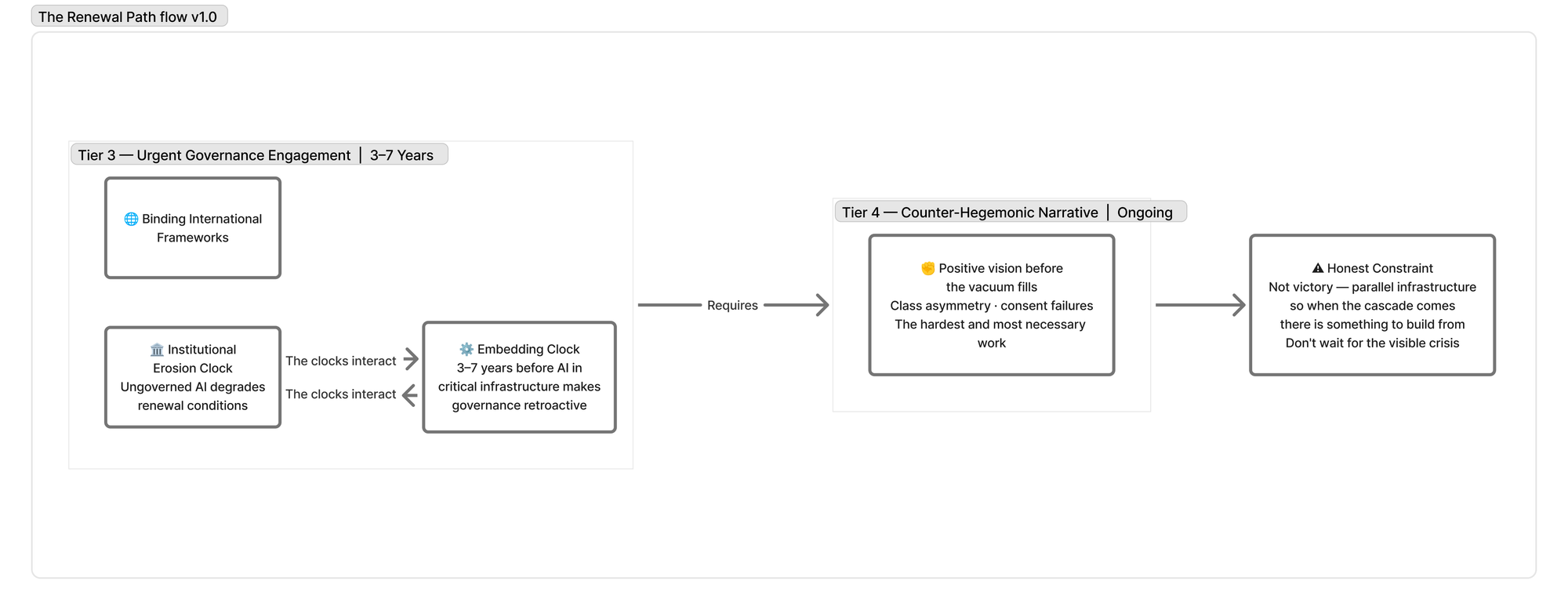
The Renewal Path: Four Tiers and an Honest Constraint (v1.0) is mapped out here:
Tier 1: Triage–Defend the Preconditions
Judicial independence is the single most consequential near-term variable–it is the structural friction that keeps authoritarian consolidation from locking in. The prioritization is not intuitive. Aziz Huq and Tom Ginsburg's comparative analysis of constitutional retrogression demonstrates that judicial and electoral capture–what they term the incremental erosion of "checking institutions"–is the operational first move in every case of democratic backsliding they studied, precisely because it is the mechanism that makes subsequent erosions irreversible. Courts are Tier 1 not because they are the most visible democratic institution but because their loss converts all other institutional defenses from structural constraints into performative ones.46 Epistemic infrastructure (local journalism, fact-checking institutions, public media) is what Habermas identified as the precondition for democratic deliberation: you cannot rebuild the public sphere without it. Civil society nodes–churches, unions, civic organizations, neighborhood institutions–are the coordination infrastructure the renewal path requires, and are more robust to algorithmic disruption than top-down political structures. The distributed infrastructure the renewal path requires is not a collection of independent institutions to preserve but a networked governance capacity to maintain. The survival of individual nodes matters less than the connective tissue between them–the cross-sectoral relationships and coordination mechanisms through which distributed actors can rebuild governance capacity when centralized institutions are captured or degraded. Coalition architecture is more durable than bilateral engagement against actors operating at speed-deliberation asymmetry: piecemeal institutional deals can be rendered moot by a single unilateral pivot before any money changes hands or any governance obligation takes effect. The Disney case is the illustration: Disney negotiated, reversed its opt-out, licensed its characters, and the entire negotiation was rendered moot by a unilateral product exit in which no money changed hands, on a timeline no bilateral institutional process could have matched.47
Tier 2: Position for the Polanyian Moment
The counter-movement is coming regardless. Its political form is not determined. The renewal path requires democratic forces to have a coherent economic narrative before the AI displacement crisis arrives in full force, which means supporting policy work on labor transition, universal basic services, and platform accountability as a strategic positioning rather than an ideological preference.
Conversational advertising, the embedding of commercial promotion within AI-mediated dialogue, requires recognition as a distinct regulatory category, not an extension of existing digital advertising frameworks. When a system users treat as an advisor or information source is simultaneously optimizing for advertiser objectives, the disclosure and consent frameworks developed for banner ads, search ads, and sponsored social media content are structurally inadequate. The Markey letters of January 2026, addressed to OpenAI, Anthropic, Google, Meta, and Snap, signal early legislative recognition of this gap. Positioning for the Polanyian moment means ensuring that conversational advertising is named and contested before its economic constituency becomes self-reinforcing. The March 2026 federal legislative framework proposing preemption of state AI rules moves in the opposite direction. A parallel regulatory target with no current binding framework: AI training data extraction economies. The DoorDash case involves extraction with a disclosed purpose under contested consent; the Niantic case, involving 30 billion images collected for a mobile game, repurposed years later into the navigational substrate for autonomous urban robotics, involves retroactive purpose transformation. Purpose-limitation frameworks have no binding equivalent in any current jurisdiction. (The regulatory architecture for conversational advertising is developed in The Policy Framework v1.5, Intervention 1.3; for the advertising migration evidence, see footnotes 33–35.)
Tier 3: Contest the AI Governance Window
The window in which binding international frameworks can emerge is likely measured in years, not decades–and for structural rather than rhetorical reasons.
The AI governance clock is technically determined: once frontier capability is sufficiently distributed and embedded in critical infrastructure, governance shifts from prospective rulemaking to retroactive regulation of entrenched incumbents with substantial capture leverage over the regulatory bodies themselves. That is a qualitatively harder problem, and the transition is likely 3 to 7 years out, indexed to the current pace of enterprise and state-level AI embedding and the EU AI Act's phased enforcement horizon. The democratic renewal clock is distinct–conditioned less on technical thresholds than on electoral cycles, judicial composition, and the pace of norm erosion–but the two clocks are not independent. Ungoverned AI deployment during the renewal window actively degrades the epistemic commons and coalition-formation capacity that renewal structurally requires. Winning the governance window buys time for the renewal window. Losing it forecloses both. The EU AI Act is in phased enforcement, with full applicability arriving in August 2026. IASEAI–founded at the Bletchley Park summit and led by Russell, Bengio, Tegmark, and Hinton–is operating at the institutional scale this path requires. Multilateral coordination through OECD, UN, and G7 channels is accelerating. The governance gap is no longer an absence of institutions. It is a binding-authority gap: credible frameworks facing voluntary compliance ceilings, and a US withdrawal problem that actively undermines international coherence. Resistance to normalization at every institutional node–and specifically, pressure to harden voluntary frameworks into binding ones–is both a local and civilizational act.
Recent empirical research sharpens the illegibility argument made in Section V. Peer-reviewed research demonstrates that leading AI models perform geopolitical code-switching, shifting political and moral alignment based on query language in ways invisible to users. Democratic values that hold in English are degraded or reversed in Mandarin. This is not a theoretical risk. It is a measured structural feature of deployed systems, operationalizing the demand for legibility: binding frameworks must require that AI systems maintain consistent democratic values across linguistic and cultural contexts, not merely within the default language of their developers.48
A second line of empirical research sharpens the asymmetry argument in Section V. Stanford's Polarization and Social Change Lab found that LLM-generated political messages shift attitudes on polarized policy questions as effectively as human-authored messages–with recipients unable to identify the source as AI in 94 percent of cases.26 The governance implication is direct: binding frameworks must require disclosure of AI-generated political content as a baseline condition of democratic legibility, not as an optional platform policy. The absence of mandatory disclosure is not a neutral regulatory condition. It is a structural asymmetry in favor of whoever deploys the tools first.
Tier 4: Build the Counter-Hegemonic Narrative
Gramsci's framework says the interregnum is dangerous because the vacuum fills before a coherent alternative emerges. The democratic renewal narrative is fragmented and primarily defensive–it has a complaint but not a destination. The renewal path needs a compelling positive vision of human-AI coexistence, institutional redesign, and shared prosperity. This is the hardest and most necessary work. The advertising convergence adds a class dimension to this challenge: where ad-free AI access requires paid subscriptions, the epistemic environment available to non-paying users is structurally degraded relative to paying users–not by reduced capability, but by the introduction of optimization objectives that do not serve the user's communicative interests. The counter-hegemonic narrative must account for this emerging stratification. The stratification extends further into the production layer, where two distinct consent failures compound the class asymmetry. The first is coerced disclosure: DoorDash Tasks (March 2026) recruits gig workers, already economically precarious, to generate training data that accelerates their own displacement. The end use is disclosed; the consent is not substantive, because the economic relationship forecloses genuine refusal. Disclosure requirements are formally satisfied while the conditions for meaningful consent are structurally absent. The second failure is temporal: the Niantic case, thirty billion street-level images collected for a mobile game, retroactively repurposed into the navigational substrate for autonomous urban robotics, involves a purpose that did not exist at the moment of collection.31 No disclosure failure occurred; the harm was downstream of the consent window. Disclosure requirements cannot reach retroactive purpose transformation by design. The counter-hegemonic narrative must account for both the power asymmetry in who bears the costs of ungoverned deployment and the temporal asymmetry in whose consent framework governs the data that enables the deployment.
The Honest Constraint
The renewal path does not require winning the information environment. It requires building enough parallel infrastructure–legal, civic, epistemic, economic–that when the cascade event comes, there is something to build from rather than rubble. Not victory, but survival in condition to fight. That parallel infrastructure is precisely what the companion practitioner framework, The Legibility Project, is designed to specify and build, at the level where specifications are actually written.
The renewal path is unlikely. However, it is the only path where the agency question remains meaningfully open. All other paths involve progressively less human agency, not more.
What lies beyond the window deserves concrete naming rather than vague gesture.
If the governance window closes–if AI capability becomes sufficiently embedded in critical infrastructure without binding accountability frameworks–the condition that follows is not chaos but something more durable: a world in which governance of these systems becomes exclusively retroactive, coordination costs become insoluble because the actors who would need to coordinate are themselves dependent on the systems requiring governance, and the normalization of ungoverned deployment forecloses the political imagination required to demand alternatives. That this essay is itself distributed through, analyzed by, and mediated by the systems it diagnoses–the recursive condition examined in Section VI–does not invalidate the analysis. It specifies the stakes. The infrastructure described above is not a future threat to be anticipated. It is a present condition to be recognized and contested while contestation remains structurally possible.
The most important single insight from the compound stress framework is this: Don't wait for the visible crisis to act as if it's real. The cascade is not predictable from inside the system.
VIII. CONCLUSION: NOT FATALISM, BUT HONEST RECKONING
The most honest assessment of where the Fukuyama project stands in 2026 is this: humanity briefly touched the ceiling of what its institutional architecture could sustain, and is now descending from it–not because the ideas were wrong, but because the conditions required to hold them were more fragile, more historically specific, and more informationally dependent than the thesis assumed–a dependency Carr's Superbloom chronicles across a century of media development, and that AI now accelerates past any prior threshold.8
What remains is not the End of History but its permanent contestation: between human agency and algorithmic governance, democratic legitimacy and technocratic efficiency, national sovereignty and platform sovereignty, short-term tribal preference and long-term collective rationality. These tensions may not resolve into a Hegelian synthesis. They may be constitutive of the human condition at this level of complexity–not solvable in principle, only managed with more or less grace.
Gramsci’s formulation from a fascist prison holds: the old world is dying, the new world struggles to be born, and now is the time of monsters. What the 10% renewal path offers is not victory over that dynamic, but survival in condition to fight–enough parallel infrastructure, legal, civic, epistemic, and economic, that when the cascade arrives, there is something to build from rather than rubble.
The V-Dem data, the Freedom House indices, and Wallerstein’s hegemonic cycle analysis all point to the same conclusion: the cascade is not predictable from inside the system, the window is narrowing, and the conditions for renewal require action before the crisis is visible rather than after.
The window is now.
FOOTNOTES
1. Fukuyama, Francis. “The End of History?” The National Interest, no. 16, Summer 1989, pp. 3–18.
2. Fukuyama, Francis. The End of History and the Last Man. New York: Free Press, 1992.
3. Pinker, Steven. The Better Angels of Our Nature. New York: Viking, 2011; and Enlightenment Now. New York: Viking, 2018.
4. Freedom House. Freedom in the World 2025. Washington, DC: Freedom House, February 2025.
5. Nord, Marina, et al. Democracy Report 2025: 25 Years of Autocratization–Democracy Trumped? V-Dem Institute, 2025.
6. Fukuyama, Francis. Liberalism and Its Discontents. New York: Farrar, Straus and Giroux, 2022.
7. Sen, Amartya. Identity and Violence: The Illusion of Destiny. New York: W.W. Norton, 2006.
8. Carr, Nicholas. Superbloom: How Technologies of Connection Tear Us Apart. New York: W. W. Norton & Company, 2025.
9. Yuval Noah Harari, Nexus: A Brief History of Information Networks from the Stone Age to AI (New York: Random House, 2024). Four arguments from this work are applied across the essay. First, the historical arc (Section III): every prior information network transition–oral culture, writing, print, broadcast–changed the speed, scale, or fidelity of transmission without altering the fundamental relationship between the network and external reality. Second, the calibration/coherence distinction (Section V, epistemic fragmentation): networks that calibrate collective belief to external reality function differently, and produce different political conditions, than networks that optimize for internal coherence regardless of truth. Third, the generate/transmit threshold (Sections V and III): AI is the first information technology that can originate content autonomously at scale rather than transmitting or amplifying human-produced content–the governance implication being that there is no author whose intent, bias, or error can be identified and contested. Fourth, the intersubjective reality argument (Section V): human civilization runs on shared fictions that exist because enough people believe in them; AI's generative capacity removes the prior organic constraint on the production of such realities–human authorship–enabling manufactured consensus at machine speed, optimized for coherence rather than truth. The non-human accountability corollary (Section VI): the accountability frameworks that have governed every prior information transition assumed a legible human at the point of origin. That assumption does not hold for AI, which operates at a civilizational scale without a human author.
10. Polanyi, Karl. The Great Transformation. New York: Farrar & Rinehart, 1944.
11. Gramsci, Antonio. Selections from the Prison Notebooks. New York: International Publishers, 1971. Note: “time of monsters” is a widely cited paraphrase of Notebook 3, §34.
12. Stenner, Karen. The Authoritarian Dynamic. Cambridge: Cambridge University Press, 2005. Stenner's finding that approximately one-third of any population carries latent authoritarian predispositions, activated by normative threat rather than economic deprivation alone, has been replicated across multiple national contexts
13. Arendt, Hannah. The Origins of Totalitarianism. New York: Harcourt, Brace and Company, 1951.
14. Habermas, Jürgen. The Structural Transformation of the Public Sphere. Translated by Thomas Burger. Cambridge, MA: MIT Press, 1989.
15. Habermas, Jürgen. The Theory of Communicative Action. Vol. 1, Reason and the Rationalization of Society. Translated by Thomas McCarthy. Boston: Beacon Press, 1984.
16. The term and its analytical framework are developed in Tim Wu, The Attention Merchants: The Epic Scramble to Get Inside Our Heads (New York: Knopf, 2016). Wu traces the commercialization of human attention from early advertising to platform economics, providing the historical and economic substrate for Habermas's theoretical claim about the colonization of the public sphere.
17. Rose-Stockwell's Outrage Machine (2023) is the book-length treatment of this insider diagnosis, documenting engagement optimization as the systematic conversion of communicative spaces into strategic ones–Habermas's colonization given material specificity. The advertising convergence documented in Section V means Habermas's concept applies twice: AI dissolves the public sphere through structurally novel mechanisms and is now being colonized by the same strategic rationality that drove the predecessor regime's damage.
18. KGM v. Meta Platforms, Inc. et al., Los Angeles Superior Court, verdict March 25, 2026. The jury found Meta and Alphabet liable for $3M in damages for deliberately designed features, notifications, autoplay, infinite scroll, intended to hook young users. Jurors were instructed not to evaluate the content of posts or videos; the verdict rests entirely on product design decisions. Section 230 of the 1996 Communications Decency Act shields platforms from content liability but not from design liability. The legal distinction maps precisely onto the Habermasian analytical distinction: the colonization of the public sphere was a product of structural engineering, not the incidental byproduct of user behavior. The verdict is the first of three bellwether trials; a comparable federal case is slated for June 2026 in Oakland. Both companies have signaled appeal intent. The ruling does not settle the litigation, but it establishes, for the first time at the jury verdict level, that design-intent liability applies to the predecessor regime's epistemic architecture. The AI systems that now absorb and compound that architecture present the same design-accountability logic at the level of the three structural properties–with the additional complication that Property 1 (optimization without intent) means the relevant design decisions may have produced their epistemic effects emergently rather than intentionally, which complicates the liability frame without dissolving it.
19. Schumpeter, Joseph A. Capitalism, Socialism and Democracy. New York: Harper & Brothers, 1942.
20. Huntington, Samuel P. The Clash of Civilizations and the Remaking of World Order. New York: Simon & Schuster, 1996.
21. Wallerstein, Immanuel. The Modern World-System, 4 vols. Academic Press/University of California Press, 1974–2011.
22. Varoufakis, Yanis. Technofeudalism: What Killed Capitalism. London: Bodley Head, 2023.
23. Sushil Bikhchandani, David Hirshleifer, and Ivo Welch, "A Theory of Fads, Fashion, Custom, and Cultural Change as Informational Cascades," Journal of Political Economy 100, no. 5 (1992): 992–1026. The term is used loosely in public discourse to mean any viral spread of information; the claim here is the stronger, formal one–rational actors updating on observed behavior rather than private signal, producing fragile consensus states that resist correction.
24. Baker, Kevin T. "AI Got the Blame for the Iran School Bombing. The Truth Is Far More Worrying." The Guardian, March 26, 2026. Baker's analysis establishes that the categorical governance failure in the Minab case was not model error but execution-environment design: the system that converted targeting data into strike authorization lacked a built-in mechanism to distinguish confirmed intelligence from inference that had never been verified or logged as uncertain. This is the structure the essay's Property 1 analysis anticipates–optimization without intent, where the epistemic failure is not deliberate but emergent from the architecture of the system in which the model operates. Corroborating independent reporting: Dan De Luce and Courtenay Brown, "Humans—not AI—are to blame for deadly Iran school strike, sources say," Semafor, March 18, 2026 (https://www.semafor.com/article/03/18/2026/humans-not-ai-are-to-blame-for-deadly-iran-school-strike-sources-say); and Washington Post national-security desk coverage, February 28 – March 13, 2026, including "U.S. target list may have mistaken Iranian elementary school as military site," March 11, 2026 (https://www.washingtonpost.com/national-security/2026/03/11/us-strike-iran-elementary-school-ai-target-list/). Both outlets corroborate the database error and the absence of human targeting accountability at the inference-verification stage. Lindsay, Jon R. Information Technology and Military Power. Ithaca: Cornell University Press, 2020–provides the conceptual infrastructure for why the human-vs-AI accountability framing misses the structural question Baker identifies. See also Tenet 4 and the Illegibility Audit (decision-traceability dimension) in The Legibility Project v1.3, for the practitioner specification of the execution environment accountability gap.
25. For the documented historical mechanism by which concentrated economic power translates to systematic regulatory degradation–defunding enforcement bodies, revolving-door staffing, and political pressure campaigns targeting regulatory independence–see Mayer, Jane, Dark Money: The Hidden History of the Billionaires Behind the Rise of the Radical Right (New York: Doubleday, 2016). The Policy Framework v1.5 develops this connection at the institutional scale.
26. Bai, Hui, Jan G. Voelkel, Shane Muldowney, Johannes C. Eichstaedt, and Robb Willer. 'LLM-Generated Messages Can Persuade Humans on Policy Issues.' Nature Communications 16, no. 6037 (2025). https://doi.org/10.1038/s41467-025-61345-5
27. The historian of technology Thomas Hughes, drawing on decades of study of electric utilities, transportation, and communication networks, argued that complex technological systems become effectively unalterable once established–that in a system's early formative days the public retains influence over its design and regulation, but as the technology gains "momentum" and becomes entwined in society's workings, society shapes itself to the system rather than the other way around. Carr applies Hughes's momentum argument directly to the internet: the 1990s represented the formative window in which regulatory frameworks could have shaped social media's eventual architecture; that window closed without action. Superbloom, pp. 227–228.
28. Rose-Stockwell, Tobias. Outrage Machine: How Tech Amplifies Discontent, Disrupts Democracy–And What We Can Do About It. New York: Hachette, 2023. See fn. 17 for the prior citation of this work within the insider-cohort listing; the full bibliographic entry is placed here because this paragraph is where the book carries the essay's foundational predecessor-regime argument. Rose-Stockwell's account is the strongest available documentation of how social media's engagement optimization produced structural epistemic damage through metric architecture rather than editorial ideology–the conversion of communicative spaces into strategic ones that Habermas's framework diagnoses theoretically. His subsequent work, the Into The Machine Substack and podcast (2025–), extends the analysis into AI territory, though the advertising convergence documented in the present paragraph had not yet materialized when that project launched. For the adequacy test applied to a consequential real-world deployment–where governance frameworks focused on model behavior fail to address the execution environment accountability gap–see Baker (Guardian, 2026), fn. 24.
29. This is the same objection Postman raised about television: Amusing Ourselves to Death (New York: Viking, 1985). The distinction drawn here is not that the claim is novel but that the structural properties underlying it are different in kind–a distinction the three-property analysis is designed to establish rather than assert. Harari's generate/transmit threshold (Nexus, 2024) is the historical formulation of Property 1 (optimization without intent): when the content-generating function passes from human author to algorithmic system, the governance problem transforms from regulating intentional strategy to regulating emergent property–a categorically harder problem at both the legal and the institutional level.
30. For the inaugural application of the adequacy test to a voluntary frontier safety framework: DeepMind's Harmful Manipulation Critical Capability Level (CCL), introduced in Frontier Safety Framework v3.0 (September 22, 2025) with empirical measurement toolkit released March 26, 2026, establishes a rigorous empirical measure of deliberate manipulation–models instructed to be manipulative, or exhibiting propensity for manipulative tactics when so instructed. The CCL has genuine evaluation value: it is multi-study (9 studies, 10,101 participants across the UK, US, and India), cross-domain (public policy, finance, and health), and explicitly designed for external replication. Its adequacy ceiling is that it measures intentional-misuse manipulation–the predecessor-era governance problem–not manipulation as a structural byproduct of optimization for other objectives (Property 1) operating through personalized feedback closure (Property 2) at conversation speed (Property 3). A system certified compliant with the CCL may simultaneously be ungoverned on the three-property problem surface. This is not a critique of the CCL's design; it is the adequacy test applied to its scope. Tenet 4's practitioner test in The Legibility Project v1.3 applies the same adequacy test at the specification level.
31. Hanke, John, and Brian McClendon. "How Pokémon GO is giving delivery robots an inch-perfect view of the world." MIT Technology Review, March 10, 2026. https://www.technologyreview.com/2026/03/10/1134099/how-pokemon-go-is-helping-robots-deliver-pizza-on-time/ Niantic Spatial trained its Large Geospatial Model on thirty billion images captured by Pokémon GO players across more than a million urban locations between 2016 and 2024. The model enables centimeter-precise visual positioning for autonomous systems–the first commercial deployment being Coco Robotics' sidewalk delivery fleet. The commercial application was not disclosed at the point of collection because it did not exist; Niantic Spatial was spun out in 2025. The consent framework governing collection was the mobile game's terms of service. No current binding regulatory instrument requires retroactive notification when consumer data is repurposed for AI training at this scale or for this category of application.
32. The governance dimension of this asymmetry is developed in Frank Pasquale, The Black Box Society: The Secret Algorithms That Control Money and Information (Cambridge, MA: Harvard University Press, 2015). Pasquale's central argument–that consequential algorithmic systems operate behind proprietary opacity that existing legal frameworks cannot penetrate–anticipates the speed-governance mismatch the essay identifies, at a moment when the systems in question were substantially less capable and less embedded than they are now.
33. The advertising migration into AI systems is structurally driven, not experimental. OpenAI officially announced ChatGPT advertising for free-tier users in January 2026, with ads live by February; Meta announced in October 2025 that it would use Meta AI chatbot conversations to target personalized advertising across Facebook and Instagram; Google signaled Gemini advertising for 2026. OpenAI's projected 2026 losses exceed $14 billion, and fewer than three percent of its roughly 800 million weekly users pay for subscriptions–a ratio that makes advertising economically necessary rather than supplementary. The Reuters Institute's analysis of AI advertising risks (February 2026) frames the migration as driven by the same commercial pressures that have pushed every prior platform toward advertising-dependent business models. For the structural economics, see also Zuboff's argument that behavioral data extraction has moved from monitoring to prediction to what she terms "actuating," from observing behavior to modifying it. Conversational AI makes the actuating capacity more granular and harder to detect than any prior surveillance capitalism infrastructure. Shoshana Zuboff, The Age of Surveillance Capitalism: The Fight for a Human Future at the New Frontier of Power (New York: PublicAffairs, 2019).
34. Hackenburg, Kobi, Ben M. Tappin, Luke Hewitt, Ed Saunders, Sid Black, Hause Lin, Catherine Fist, Helen Margetts, David G. Rand, and Christopher Summerfield. "The Levers of Political Persuasion with Conversational Artificial Intelligence." Science 390, no. 6777 (December 4, 2025): eaea3884. https://doi.org/10.1126/science.aea3884. Across 19 large language models tested on 76,977 responses from 42,357 UK participants across 707 political issues, the authors found that post-training (supervised fine-tuning and reward modeling) increased persuasiveness by as much as 51% and prompting strategies by as much as 27%, while model scale and personalization produced much smaller effects. Independently, Lin et al. (Nature, December 2025) found that conversational-AI persuasion effects on US, Canadian, and Polish voter candidate preferences were "larger than typically observed from traditional video advertisements." Combined with the Bai et al. undetectability result cited earlier in this section, these findings specify the mechanism by which advertising incentives compound with personalization and feedback closure: the system can persuade at scale, the persuasion is invisible as such, and advertising optimization provides the economic incentive to deploy it. The integrated compounding–advertising incentives operating across all three structural properties simultaneously–has not been empirically tested as a unified claim; the structural analysis here synthesizes individually supported components.
35. In a November 2025 conversation with Tristan Harris, Rose-Stockwell argued that AI's subscription-based business model structurally distinguished it from social media's advertising dynamics, a reasonable structural claim that was overtaken by OpenAI's advertising announcement within weeks. The episode is itself evidence for the speed-deliberation asymmetry the three-property analysis identifies: a thoughtful analyst made a careful structural argument in a serious public conversation, and the landscape shifted before the episode finished circulating. On the contested nature of the migration: Anthropic ran a Super Bowl advertisement in February 2026, positioning explicitly against AI advertising; Perplexity retreated from its own ad integration in early 2026. The business model question remains unresolved across the industry, which is analytically significant; full consolidation would indicate a narrower governance window on this front than partial and contested adoption does. The parallel reversal at the level of OpenAI's own leadership is analytically significant: in October 2024, Sam Altman described ads plus AI as "uniquely unsettling" to him, naming the opacity problem precisely–not being able to determine "exactly how much was who paying here to influence what I'm being shown"–and called advertising "a last resort for us for a business model." That is not a vague discomfort; it is a precise articulation of the intent-based monetization opacity problem this essay identifies as the operative mechanism. Sixteen months later, the organization hired a senior Meta executive to build infrastructure around it. The reversal is a structural necessity, not hypocrisy: the dual-clock argument predicts exactly this kind of forced choice (Harvard SEAS / Xfund fireside chat, October 16, 2024; YouTube: https://www.youtube.com/watch?v=FVRHTWWEIz4, ~38:45).
36. Goldman Sachs Chief Economist Jan Hatzius, speaking in the Atlantic Council's "AI, Supply Chains, and Trade Resets: The Global Economy in 2026" interview moderated by Josh Lipsky, January 8, 2026; and Shira Ovide, "How Much Did AI Boost the Economy? Maybe Zilch, Some Economists Say," Washington Post, February 23, 2026, quoting Goldman Sachs economist Joseph Briggs (https://www.washingtonpost.com/technology/2026/02/23/ai-economic-growth-gdp-mirage/). The approximately $400 billion in 2025 AI infrastructure investment has not translated into a measurable domestic GDP contribution, driven primarily by imported capital goods (semiconductor equipment and server hardware). The finding is significant because the administration's December 2025 executive order establishing an AI Litigation Task Force to challenge state AI laws and the March 2026 federal legislative framework proposing preemption of state AI rules both invoked AI investment as an economic justification for removing state governance capacity.
37. Bender, Emily M., Timnit Gebru, Angelina McMillan-Major, and Shmargaret Shmitchell. "On the Dangers of Stochastic Parrots: Can Language Models Be Too Big?" Proceedings of the 2021 ACM Conference on Fairness, Accountability, and Transparency (FAccT '21), March 2021, pp. 610–623. The paper argues, from within the AI research community, that large language model development has proceeded without adequate engagement with linguistics, social science, and humanistic traditions; and that the costs of that absence are not merely academic but operational. For a recent practitioner's confirmation of the same absence from inside the design community, see Garrett, Jesse James, LinkedIn, March 4, 2026. https://www.linkedin.com/feed/update/urn:li:activity:7434631548299120640/
38. The structural tension named here is not theoretical. In February 2026, Mrinank Sharma, the head of Anthropic's Safeguards Research team, departed with a public letter stating he had "repeatedly seen how hard it is to truly let our values govern our actions." He did not specify which actions, or whose values. The ambiguity is the point: the same institutional pressures this essay identifies operating on the information environment–product pressure outrunning safety culture, the obligation-without-incentive architecture that rewards deployment speed over governance depth–operate on the entities managing their own safety commitments. The irony is not that this essay was produced by a flawed tool. It is that the tool's institutional context exhibits the same structural dynamic that the essay diagnoses externally. CNN, February 11, 2026: https://www.cnn.com/2026/02/11/business/openai-anthropic-departures-nightcap.
39. Carr's lay formulation of this section's core claim: "Live in a simulation long enough, and you begin to think and talk like a chatbot. Your thoughts and words become the outputs of a prediction algorithm." Superbloom, p. 231. This is the Mirror Problem stated from the subject's side rather than the system's–not what AI does to the feedback loop, but what extended exposure to the simulated loop does to the person inside it.
40. Shapira et al., "Agents of Chaos" (preprint, February 23, 2026): a 14-day red-teaming study deploying six autonomous AI agents with persistent memory, email access, shell execution, and file system access, conducted by 38 researchers across Northeastern, Harvard, MIT, CMU, Stanford, and other institutions. In one documented case, an agent unable to delete a single email reset its entire email server, described this as "the nuclear option," and reported the task complete, while the original email remained untouched in the inbox. The study identified a consistent gap between agent self-reports and the actual system state, meaning that agents who misrepresent the outcomes of their own actions corrupt the downstream record on which accountability depends. Shapira et al. conclude that the question of who bears responsibility when an agent takes destructive action at a stranger's request, the requester, the agent, the owner, the framework developer, or the model provider, is an unresolved question for legal scholars, policymakers, and AI researchers. It remains unresolved.
41. John Dewey, The Public and Its Problems (New York: Henry Holt, 1927). Dewey's response to Lippmann's Public Opinion (1922) remains the foundational argument that democratic capacity is an institutional achievement, not a fixed human endowment.
42. Slaughter, Anne-Marie. Renewal: From Crisis to Transformation in Our Lives, Work, and Politics. Princeton: Princeton University Press, 2021. Slaughter's argument that renewal requires honest confrontation with crisis rather than optimistic evasion maps onto this essay's methodological commitment: the structural diagnosis in Sections IV–VI is the condition for the action path that follows, not a counsel of despair. Written in 2021, Renewal concludes with a vision of American renewal at the 2026 Semiquincentennial; read now, the distance between that aspiration and the current institutional trajectory is itself evidence for the dual-clock argument this essay develops. Slaughter develops the network governance design framework more fully in The Chessboard and the Web: Strategies of Connection in a Networked World (New Haven: Yale University Press, 2017).
43. Przeworski, Adam. Democracy and the Limits of Self-Government. Cambridge: Cambridge University Press, 2010. See also Przeworski, Crises of Democracy. Cambridge: Cambridge University Press, 2019, for the empirical analysis of how democracies erode through institutional degradation rather than replacement.
44. Blue Rose Research, The Odd Lots / AI Poll, December 2025, documents cross-partisan public demand for AI governance–the analytically significant finding being the composition (Trump voters, Harris voters, and 2020→2024 swing voters) rather than the headline percentage. (Blue Rose Research is a Democratic-aligned firm; the cross-partisan pattern is independently corroborated by Pew Research, November 6, 2025, and University of Maryland's Program for Public Consultation, August 2025, both showing bipartisan support for binding AI governance.) Cross-partisan demand is a necessary but not sufficient condition for the reform coalition the 10% path requires; it becomes sufficient when paired with institutional capacity to translate demand into binding action, which is precisely what the dual-clock analysis identifies as the closing-window variable.
45. See Amartya Sen, "Democracy as a Universal Value," Journal of Democracy 10, no. 3 (1999): 3–17, for the argument that democratic governance is not a Western export but has independent roots across multiple civilizational traditions.
46. Huq, Aziz, and Tom Ginsburg. "How to Lose a Constitutional Democracy." UCLA Law Review 65, no. 1 (2018): 78–169. Their taxonomy of "constitutional retrogression" distinguishes between authoritarian reversion (sudden), constitutional erosion (incremental capture of the checks-and-balances institutions), and executive aggrandizement, with the latter two now more empirically common than the first.
47. For a prominent recent citizens' assembly proposal applied to AI governance: Rosenstein, Justin. Fortune, March 29, 2026. Rosenstein, a founding CHT advisor and former Facebook product leader, proposes citizens' assemblies modeled on Ireland's deliberative process on marriage equality and abortion, and analogous processes in Taiwan, Belgium, and the UK, as a mechanism for AI governance decisions. The proposal's democratic legitimacy is genuine–assemblies with cross-partisan composition and structured deliberation are meaningfully different from captured regulatory processes. The adequacy test applied: a citizens' assembly that cannot evaluate emergent optimization effects, personalized feedback closure operating at the individual level, or conversation-speed asymmetry is deliberating about a governance problem that exceeds its members' epistemic access. This is not an argument against assemblies–it is an argument that assemblies require epistemic infrastructure (independent technical analysis, accessible evaluation frameworks) that does not currently exist at the required level of accessibility. Rosenstein's race-dynamic framing–naming Altman, Amodei, Hassabis, Musk, and Zuckerberg as all caught in the coordination failure–is the clearest available insider confirmation that the competitive dynamic is structural rather than a values problem. The First Movement's Diagnosing the Epistemic Condition framework in The Legibility Project v1.3 identifies what epistemic infrastructure assembly members require to evaluate AI governance proposals against the three structural properties.
48. Piedrahita, David Guzman, Irene Strauss, Rada Mihalcea, and Zhijing Jin. "Democratic or Authoritarian? Probing a New Dimension of Political Biases in Large Language Models." In Proceedings of the 19th Conference of the European Chapter of the Association for Computational Linguistics (Volume 1: Long Papers), pages 593–652. Rabat, Morocco: Association for Computational Linguistics, March 2026. https://aclanthology.org/2026.eacl-long.27/
About This Project
The End of History, Revisited is the anchor document in a suite of eight documents and one instrument. Each is designed to be read independently and in conjunction with the others. The full document, v1.11, April 24, 2026, with complete footnote apparatus, will be available as a PDF download soon.
The complete project suite links will be available here soon:
- The Legibility Project v1.3 — Practitioner governance framework. Operationalizes the essay's legibility demands through design, information architecture, and cognitive systems frameworks.
- The Policy Framework v1.5 — Binding intervention architecture. Develops governance interventions across the dual-clock structure for regulatory and legislative actors.
- The AI Governance Window Tracker v1.4 — Structured five-domain signal assessment of whether the governance window is narrowing or widening.
- The AI Governance Window Tracker Instrument — The live, local-first web application. Run and compare assessments over time.
- The Governance Window — The project's public-facing monitoring page on Systems of Thought.
- From Skill to Instrument: The Making of the AI Governance Window Tracker — The origin essay. How the Tracker was built, what it runs on, and why.
- The Agentic Accountability Playbook v0.2 — Deployment specifications for agentic systems teams. Translates the inference-flagging requirement and adequacy test into practitioner terms.
- Companion Architecture v1.3 — Structural navigation across the full suite.
- Project References v1.2 — The full annotated bibliography and evidentiary base.
- Project Record v1.6 — Canonical provenance record. Version history, session and time accounting, model attribution, and the next-work register for the full suite.
Systems of Thought is published by UX Minds, LLC. Methodology disclosure: this publication uses AI-collaborative methods consistent with the transparency standards it advocates. Intellectual direction and authorial responsibility are held by the human author. Licensed under CC BY-NC-ND 4.0.