The Cultural Antenna: What Music Has Been Saying About Democracy
Since I can remember, I've watched a specific set of artists register what the political narrative missed. This is what that record sounds like and what it means that it's converging in 2026.

I. What a Cultural Antenna Is
There is a category of artist who arrives early.
Not early in the sense of fashion, ahead of trend, first to a sound, but early in the sense of diagnosis. The folk and civil rights traditions of the 1960s named institutional failure and democratic erosion directly and powerfully; that naming was itself a political act, and it worked. The infrastructure that those movements built produced landmark legislation, shifted institutional consensus, and demonstrated that cultural production could function as a direct instrument of democratic change. And then the legislative window closed, the coalition fractured, and much of what had been built: the civic networks, the shared vocabulary, the sense of collective agency the music had both expressed, was absorbed into the nostalgia economy it had once resisted. The diagnostic problem didn't disappear. The instrument that had been named most directly did.
What I'm describing is a different diagnostic mode, one that operates formally rather than lyrically. These artists register something in the structure of the work before the theoretical vocabulary exists to name it as a system. The argument lives in the form. The verse doesn't resolve. The listener is put inside the problem before the problem has a name—not told about it, not called to action against it, but made to feel where the ground isn't.
This is what I mean by a cultural antenna. It is a reading methodology that operates across registers.
Christopher Nolan built Memento around a structure that enacts epistemic failure rather than describing it—the viewer cannot trust the sequence of events for the same formal reason the protagonist cannot. Darren Aronofsky's early work, Pi and Requiem for a Dream, renders the optimization of desire and the destruction of the subject formally, not discursively. The diagnostic mode, operating in both cases, precedes the theoretical literature on algorithmic feedback, attention capture, and the colonization of interiority by years. In fiction, the most continuously adapted mind in the modern era, Sherlock Holmes, in his 2026 resurgence, warrants treatment as a signal in its own right. (The Sherlockverse project is tracking this; sherlockverse.com.)
The Cultural Antenna series is organized around music, not because the methodology is limited to music, but because music is the primary case study. The reason is empirical and specific: music built an actual democratic infrastructure. Independent labels, touring networks, community venues, direct-to-audience distribution systems—not as metaphor, not as branding, but as functioning civic architecture. That infrastructure was then absorbed by the optimization economy it was built to resist. The absorption is documented and traceable.
That specificity is the analytical advantage. The series returns to it throughout.
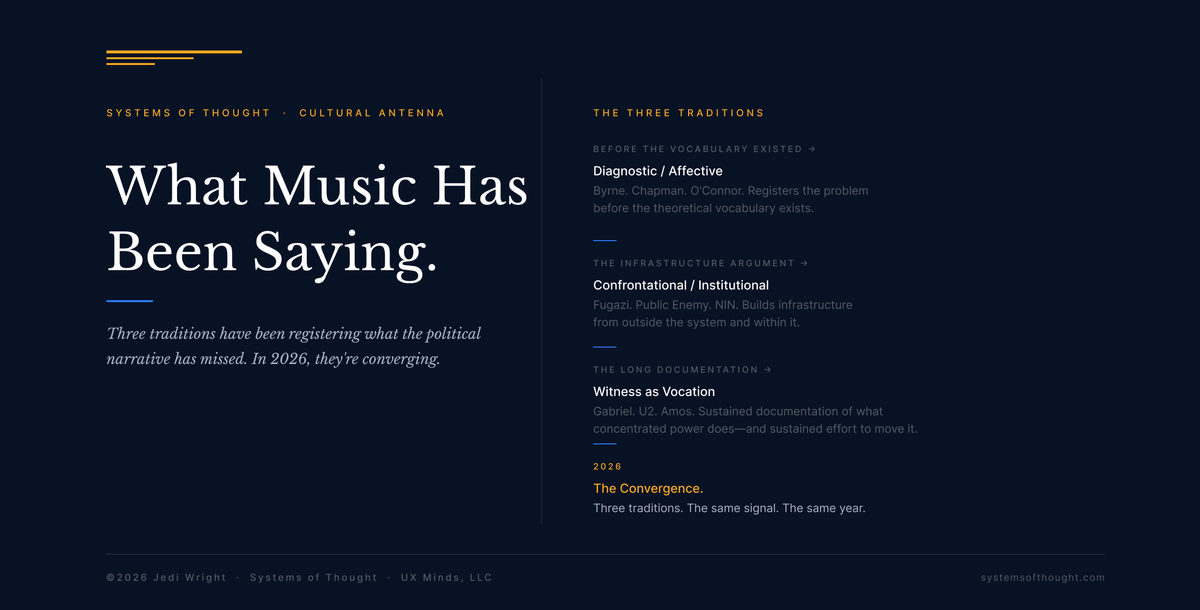
I'll use three traditions as a reading tool, not a sorting mechanism. Individual artists and works move between them; some inhabit more than one simultaneously, some shift over the course of a career. The tradition's name says something about how the antenna functions, not which drawer an artist belongs in. The first is diagnostic/affective: registers the problem emotionally and formally before the theoretical vocabulary exists, puts the listener inside the phenomenology of epistemic or democratic failure. The second is confrontational/institutional: it builds alternative infrastructure, names the mechanism directly, and refuses the terms of the optimization architecture. The third is witness-as-vocation: sustained, career-long documentation of what concentrated power does to people and institutions over time.
These three traditions have been active for decades, most notably since the Eighties, lining up with Francis Fukuyama's The End of History. In 2026, they are converging.
This series is a companion to The End of History, Revisited: A Compound Civilizational Stress Event and the 10% Path, published here on Systems of Thought and elsewhere, between March-May 2026. That essay argues that the post-Cold War liberal consensus is not failing from external pressure but dissolving from structural contradiction; that what Francis Fukuyama named as the terminus of ideological competition was in fact a window, and that the window is closing under the compound weight of democratic backsliding, epistemic infrastructure capture, and the institutional lag between AI deployment and any framework capable of governing it. The Cultural Antenna series treats cultural production as a parallel evidentiary record for that argument. The music was registering the legitimacy deficit inside the triumphalist consensus as it formed. The absorption of the infrastructure built to resist that deficit is part of the same story. So is what's arriving in 2026.
II. 1989–2000: The Antenna Registers What Triumphalism Missed
The year Fukuyama published "The End of History?" (1989), the antenna had already been running for nearly a decade. David Byrne formally enacted the problem of meaning-making under late capitalism on Remain in Light (1980), the self dissolving into systems, agency distributed across a groove that refuses to resolve, before that phrase was in common use. Remain in Light (1980) had already done it with more precision than most theoretical accounts written afterward—the self dissolving into systems, agency distributed across a groove that refuses to resolve, the individual voice suspended inside a structure it cannot exit. The diagnosis was formal. You didn't need to read it. You had to feel where the ground wasn't.
Tracy Chapman's self-titled debut arrived the same year as Fukuyama's essay, at Wembley Stadium (1988) in front of 72,000 people waiting for someone else. She was a last-minute stand-in when a technical problem delayed the Stevie Wonder set. What she played, "Fast Car," "Talkin' 'bout a Revolution," songs about structural poverty and foreclosed mobility, landed with an audience that had gathered to celebrate something. The contrast was the argument. The triumphalist consensus had a legitimacy deficit from the beginning. Chapman registered it from inside the stadium, where the celebration was taking place.
Public Enemy was simultaneously building the institutional correlate. It Takes a Nation of Millions to Hold Us Back (1988) and Fear of a Black Planet (1990) were not only confrontational in content but in architecture. The sonic density was a formal argument about what it costs to be heard inside a system calibrated to route around you. Chuck D called rap the Black CNN. The diagnostic and confrontational traditions were operating in the same work at the same time.
Sinead O'Connor's I Do Not Want What I Haven't Got (1990) and the years that followed documented something the triumphalist consensus had no framework for: the operation of institutional authority on the individual subject, and the cost of refusing to perform deference to it. The 1992 Saturday Night Live appearance, tearing the photograph of Pope John Paul II and the words "fight the real enemy," was received as an aberration. It was witness. The institution she named would spend the next thirty years confirming the diagnosis.
Radiohead's OK Computer arrived in 1997, two decades before the surveillance capitalism literature. Thom Yorke was not writing about surveillance capitalism. He was writing about the phenomenology of living inside systems that are processing you: the anxious, dissociated, formally fragmented experience of a subject who can feel the optimization but cannot name the infrastructure producing it. The theoretical vocabulary didn't exist yet. The formal vocabulary did. OK Computer is what the diagnostic tradition looks like at full extension: the form enacts the argument before the argument can be made discursively.
U2 had been working this territory since War (1983), but it was Achtung Baby (1991) and Zooropa (1993) that formally registered media saturation and identity fragmentation, while Bono was simultaneously developing the lobbying architecture that would eventually produce the Jubilee 2000 debt relief campaign. The inside-game and outside-game distinction that would become central to the absorption argument was already visible here: the confrontational tradition builds infrastructure outside the system; U2 worked the system's own infrastructure for redistributive ends. Both are legitimate responses to the same diagnosis. They lead different places.
By 2000, the antenna had been registering the legitimacy deficit for more than a decade. The triumphalist consensus had not noticed. The infrastructure was about to be built and then absorbed.
III. The Confrontational Tradition Builds Infrastructure
Fugazi did not sign to a major label. This is not a footnote about authenticity; it is a description of an institutional choice with structural consequences. The band formed in Washington D.C. in 1986 and spent the next sixteen years building a parallel architecture: Dischord Records as an independent label, $5 and $8 ticket prices held without exception across venues of every size, all-ages shows as a non-negotiable requirement, direct relationships with local promoters rather than routing through the consolidating live music industry. They were not refusing the mainstream as a posture. They were constructing an alternative infrastructure on the premise that the mainstream's terms were incompatible with the music's purpose.
The music itself operated in the confrontational tradition at the formal level. "Merchandise" (1990) named the mechanism, "We owe you nothing / you have no control," with a directness that refused the softening the diagnostic tradition sometimes permits itself. The confrontation was not only lyrical. The rhythmic displacement, the refusal of conventional verse-chorus resolution, the way the songs generated tension without releasing it into the catharsis the industry had learned to monetize—these were formal arguments about what it means to build something that doesn't give the optimization architecture what it needs to absorb you.
Fugazi was the most theorized case, not the only case. The punk scene had been building parallel infrastructure since the mid-1970s, with independent labels (Rough Trade, SST, Alternative Tentacles), zines as distributed critical press outside the gatekeeping apparatus, and venue networks routing around the consolidating live industry. The industrial scene extended this architecture into harder, more formal territory: Wax Trax!, Touch and Go, and Mute Records operating as genuine independent institutions with values-consistent distribution and artist relationships that the major label system was structurally incapable of replicating. These were not scenes defined by a sound. They were defined by an institutional premise: that the terms of the mainstream were incompatible with what the work was for, and that building outside those terms was both possible and necessary.
The rave scene built something more decentralized and, in some ways, more structurally radical: a genuinely non-commercial civic architecture organized around collective experience rather than the artist-as-product model. Warehouse parties, free parties, pirate radio, flyer networks, and a distribution infrastructure that existed almost entirely outside commercial channels. I spent enough time inside that infrastructure in Washington D.C. and elsewhere in the late 1990s to understand what it had built: the Buzz party at Capitol Ballroom on Half Street SE was by any serious measure the nation's premier dance music event, a weekly institution that had constructed its own civic geography in a city that had no venue infrastructure for it. The confrontational tradition here was not primarily sonic but organizational: the scene demonstrated, at scale, that cultural infrastructure could be built and sustained without the optimization of architecture's participation. What happened next is instructive. The British Criminal Justice and Public Order Act of 1994 targeted the infrastructure directly, defining and criminalizing gatherings featuring music "wholly or predominantly characterised by the emission of a succession of repetitive beats," giving police powers to shut down events and seize equipment. The legislation didn't engage the content. It destroyed the conditions of the infrastructure's possibility. In the United States, the RAVE Act (2003), Reducing Americans' Vulnerability to Ecstasy, sponsored by then-Senator Biden, made venue owners and promoters criminally liable for drug use on their premises, achieving the same result through liability architecture rather than direct prohibition. Buzz ended its tenure at Capitol Ballroom in 2002, under pressure from DC and federal authorities over drug use allegations. The building itself was demolished in 2006 for the Ballpark District development. The confrontational tradition had built something genuinely outside the system. The system used law to make the outside legally untenable, and then real estate capital replaced the physical site. This is a different and in some ways more precise version of the absorption argument than streaming economics: not co-optation but foreclosure.
Nine Inch Nails traced a parallel but more turbulent path. Pretty Hate Machine (1989) was released on TVT Records, where Reznor's relationship with label founder Steve Gottlieb deteriorated almost immediately: creative control, release timing, the fundamental incompatibility between what the music was doing and what the label needed it to do. The conflict produced Broken (1992), an EP released under duress and its eventual litigation, TVT suing to prevent Reznor from recording for anyone else. The settlement produced Nothing Records: nominally Reznor's own imprint, effectively a vanity structure under Interscope, which is to say under the Universal consolidation architecture. He had more control than TVT had permitted. He did not have independence. The Downward Spiral (1994) and The Fragile (1999) were made within that structure, documenting with formal precision what it feels like to be processed by systems of control—the phenomenology of surveillance, optimization, and the colonization of interiority rendered not as description but as experience. The diagnosis was the work. When Reznor released Ghosts I–IV (2008) under Creative Commons, free to download, the institutional move was quiet but exact: counter-architecture to the platform consolidation already underway, the confrontational tradition using the tools of free culture before the platform economy had fully closed around them. Then the return: Jimmy Iovine, Beats Music, Apple. The man who had spent two decades documenting the optimization architecture from inside it became part of the infrastructure delivering music into the streaming economy on the industry's terms. The absorption argument made personal. I saw A Perfect Circle open for NIN at the First Union Spectrum in Philadelphia on May 6, 2000—Mer de Noms wasn't even released yet, the album that would make them a headlining act in their own right was still two weeks out. Months later, I saw them headline Capitol Ballroom, the same venue where Buzz had built its parallel infrastructure, in one of the smallest rooms they played that cycle. The scale ran in the opposite direction from absorption: arena access first, then the smaller room by choice. That inversion didn't last. The most recent chapter runs in a different direction: Challengers (2023) and Tron: Ares (2025) as film score work produced in collaboration with German-Iraqi electronic producer Boys Noize, a creative relationship that became Nine Inch Noize—a full collaborative project whose self-titled debut arrived in April 2026, six days after their first live performance at Coachella's Sahara tent. The formal register has shifted from industrial rock to club music, from arena to tent, from document to transmission. The institutional register has not: released on Interscope, the same label structure that housed Nothing Records thirty years earlier. The full arc, from TVT through Ghosts through Apple, alongside the Keenan arc: Tool, A Perfect Circle, Puscifer, running a parallel confrontational trajectory across the same decades, receives its proper treatment in Piece 2.
The absorption happened across the 2010s. Spotify's royalty architecture made independent distribution economically unsustainable at scale. Bandcamp represented a genuine counter-infrastructure: direct artist-to-audience, name-your-own-price, values consistent with what Dischord had built in analog form. It was acquired by Epic Games in 2022 and then sold to Songtradr in 2023. Two corporate owners in two years. The infrastructure of independence absorbed into the consolidation it was built to resist.
On March 6, 2026, Fugazi released twelve tracks recorded with Steve Albini at Electrical Audio in Chicago in 1992. Shelved after both vehicles carrying the band home independently arrived at the same conclusion at an Ohio rest stop. Released thirty-four years later, digital-only, name-your-own-price, proceeds to Letters Charity—a tribute to Albini, who died in May 2024. Every institutional choice has been consistent with values held since 1986. The platform those choices now live on has had two corporate owners in as many years. The absorption argument, demonstrated with empirical precision by the very act that is the confrontational tradition's central case, in the same year that the antenna finds the signal.
IV. 2008–2020: The Arc Through Crisis
The 2008 financial crisis did not produce a cultural antenna moment commensurate with its structural significance. This is itself a signal. The legitimacy deficit that Tracy Chapman had registered from the Wembley stage in 1988, that OK Computer had formalized in 1997, had by 2008 become explicit—the mechanisms were named, the institutions were visibly failing, the theoretical vocabulary existed. What the antenna registered in this period was something harder to formalize: the experience of living inside a system whose failures were now legible but whose alternatives remained unavailable. The diagnosis had been made. The infrastructure to act on it had been absorbed or foreclosed. What remained was the arc through.
Kendrick Lamar's good kid, m.A.A.d city (2012), To Pimp a Butterfly (2015), and DAMN. (2017) operated across both the diagnostic and confrontational traditions simultaneously, with a formal precision that matched the best work of the earlier period. To Pimp a Butterfly, in particular, rendered the relationship between individual subjectivity and structural racism with a density, sonic, lyrical, and architectural, that the theoretical literature on the same subject was still working toward. The confrontational tradition's institutional dimension was present too: Top Dawg Entertainment as an independent infrastructure, the deliberate refusal of easy crossover, and the use of major-label distribution without surrendering the terms. The categorical governance argument that would send "Alright" ricocheting between protest movements and platform moderation decisions was already embedded in the work. Lamar's full arc—through Mr. Morale & The Big Steppers (2022), the Drake conflict as a public democratic argument about who gets to speak and on what terms, the Super Bowl performance as inside-game at maximum institutional scale—receives full treatment in Piece 4.
Childish Gambino's "This Is America" (2018) arrived as a different kind of formal argument, the diagnostic tradition using the visual register as a structural component, the violence and the dance simultaneously, the spectacle of American entertainment and American death occupying the same frame. Donald Glover's full arc through Atlanta and beyond is Piece 4 material; the track functions here as a marker of where the antenna was in 2018: past diagnosis, past confrontation, into something that could only render the contradiction directly and let the viewer sit inside it.
By 2020, the arc had traced something legible in retrospect: the legitimacy deficit registered in 1989 had compounded through financial crisis, surveillance capitalism, democratic backsliding, and institutional collapse into a condition the antenna could document but not yet name at the terminal level. The specific argument, AI as an epistemic infrastructure threat, not as a science fiction scenario but as the mechanism by which the optimization architecture achieves civilizational scale, had not yet found its full formal expression. The gap was about to close.
V. 2026: The Antenna Finds the Signal
Peter Gabriel began o/i the way he ended i/o, with an act of formal counter-argument. The title inversion is precise: i/o named the relationship between inner life and the world; o/i reverses the direction of pressure. The outside has a new way in. Gabriel's framing statement for the album, issued with the first track in January: "We are sliding into a period of transition like no other, most likely triggered in three waves; AI, quantum computing and the brain computer interface. Artists have a role to look into the mists and, when they catch sight of something, to hold up a mirror." This is not a vague claim about art's social function. It is a specific assignment of epistemic purpose to cultural production at a specific historical moment—the witness tradition naming its own function with more precision than most theoretical accounts of the same proposition.
The album is being released one track per full moon throughout 2026, each arriving in two versions, a Bright-Side Mix and a Dark-Side Mix, delivered against the lunar cycle rather than the platform release calendar. The structural argument is embedded in the architecture at two levels: the lunar release schedule refuses the platform optimization cycle entirely, and the dual-mix format refuses the single behavioral outcome that streaming is engineered to produce. One track, two emotional registers, neither definitive. By the time this piece is published, five tracks are in circulation across ten distinct releases. "Been Undone" traced the dissolution of the self-determining subject. "Put the Bucket Down" registered the cognitive load that prevents clear perception of what's approaching. "What Lies Ahead," just under three minutes, the sharpest and most compressed of them all so far, names the gap between the creative act and its institutional consequences, in the specific context of AI, not as a metaphor. "Till Your Mind Is Shining" explored consciousness and perception, its artwork, a warped human figure overlaid with numbers, chosen by Gabriel for what he described as its representation of "the human and the mechanical AI world that we're creating." "Won't Stand Down," released on May 1, moved from diagnosis to activation: an explicit call for the kind of moral authority that operates outside military, economic, and political power, to keep alive "some basic values of justice, compassion, and democracy." The witness tradition turns, track by track, from documentation to address. Seven singles released across five tracks, each title arriving in two emotional registers. The Dark-Side Mix of "Won't Stand Down" arrives later this month, with the dual-mix architecture still unfolding in real time as this piece publishes.
Gabriel has been working this territory since The Lamb Lies Down on Broadway (1974); identity fragmentation, institutional dehumanization, a young Puerto Rican man navigating New York, fifty years before o/i. This is not a late arrival. It is a sustained vocation; the witness function operating across a career whose formal range keeps finding new vocabularies for the same fundamental argument.
Tori Amos's In Times of Dragons arrived May 1, the same day as Gabriel's latest track, and is the most politically direct work of her career since Boys for Pele. Amos described the album as "a metaphorical story about the fight for Democracy over Tyranny, reflecting the current abhorrent non-accidental burning down of democracy in real time." The reversal from Ocean to Ocean's interior grief is itself analytically significant—a diagnostic artist returning to confrontational register when the infrastructure has become visible enough that the witness tradition's patient documentation no longer feels sufficient. The load-bearing track is "Shush," and what makes it analytically remarkable is the compression: "He's trying to develop the kind of feudal system we had hundreds of years ago... we have all the cool, digital devices now. So it looks different. But it has the same philosophy." (Tori Amos, artist statement accompanying "Shush", In Times of Dragons, Universal/Fontana, May 2026)
The delivery infrastructure has changed. The philosophy of concentrated power has not. The essay takes pages to build that case. Amos lands it in a single sentence. The antenna, at full extension.
The album's intergenerational architecture is structural rather than decorative: mother and daughter co-authoring the resistance narrative enacts the Slaughter argument about democratic renewal across time rather than only describing it. Amos has been documenting individually tailored reality distortion for more than thirty years. In Times of Dragons is its most explicitly political expression—now that the infrastructure for delivering that distortion at civilizational scale actually exists.
Maynard James Keenan's Normal Isn't (Puscifer, February 2026) named the mechanism directly: "Normal Isn't" as its track title, a confrontational tradition at its most compressed. "A Public Stoning" is the outrage machine argument in three words. Keenan's framing, "as storytellers and artists, our job is to observe, interpret and report," claims the witness function explicitly from inside the confrontational tradition. Tony Levin plays bass on o/i and on Normal Isn't in the same year, a documented connective tissue between the two traditions that is a creative relationship, not only an analytical parallel. The full Keenan arc receives its treatment in Piece 2.
Nine Inch Noize, the collaboration between Trent Reznor, Atticus Ross, and German-Iraqi electronic producer Boys Noize, performed their first full set at Coachella's Sahara tent on April 11, 2026, debuting material from their self-titled album, released six days later on Interscope. The performance completed an arc the piece has been tracing: Reznor, who spent the 1990s documenting the optimization architecture from inside a label structure he couldn't escape, releasing his most current work through the same Interscope apparatus that housed Nothing Records thirty years earlier, with the absorption argument closing on itself in real time. The formal move runs in the opposite direction. Nine Inch Noize is not arena rock; it is club music, electronic collaboration, beat-augmented remix culture, the Sahara tent rather than the main stage. The confrontational tradition finds a new infrastructure register while the institutional one stays fixed. A surprise album was announced eight days before release, outside the platform optimization cycle. The antenna picks up its own history and rebroadcasts it on a new frequency.
Four artists. Two traditions. The same year. All arrive at the same window position from different angles. Gabriel from 1974, Reznor from 1989, Keenan from 1990, and Amos from 1992—between them, the better part of a century of sustained engagement with exactly these questions. In 2026, they converge.
The witness tradition returns to explicit political engagement, naming digital infrastructure and concentrated power as the mechanism. The confrontational tradition names the mechanism directly: not metaphor, not formal indirection: "The Algorithm," on the tracklist. Reznor, after a decade distributed across film-scoring contexts, signals a return to NIN as the primary register in the same window. When figures this committed, from traditions this distinct, arrive at the same diagnosis in the same year...something about the closing window has become visible. The convergence is not a proof. It is a signal, which is what the antenna produces.
VI. What the Antenna Can and Cannot Tell Us
Cultural production is parallel evidence, not primary evidence. The three-tradition taxonomy is a reading, not a proof. The antenna registers something; it doesn't verify it. These are the limits the argument has to name before it makes its claims.
What the antenna establishes: the arc was legible within the culture as it was happening. OK Computer preceded the surveillance capitalism literature by two decades. The confrontational tradition built and lost the infrastructure argument before platform consolidation made it theoretically central. The quadruple convergence of 2026, Gabriel, Rezno, Keenan, and Amos arriving at the same diagnosis from different traditions in the same year, is a signal from a different evidentiary register than the essay's institutional analysis. The two registers arrived independently. That independence is the analytical value.
What the antenna doesn't establish: that the arc is closed, that the terminal mechanism has been correctly identified, that the window position the music is registering corresponds to the actual window position. The antenna can be wrong. It built infrastructure and watched it get absorbed. Sinead O'Connor was not received as a diagnosis in 1992, but as an aberration. The confrontational tradition held its values and lost its infrastructure anyway.
The Black political music tradition has most continuously and precisely named the democratic deficit in this country, often decades before the institutional artifacts caught up. It's used sparingly in this piece, consciously. I've made that choice because it deserves full treatment on its own terms, not mention-level integration into a framework built around other acts. Piece 4 is that treatment. Naming the gap here, rather than papering over it, is the minimum the argument owes the reader.
A disclosure that belongs here: before the infrastructure-building argument became theoretical for me, I was inside it professionally. As director of media relations at Rooftop Promotions, I worked directly within the independent music promotional infrastructure, promoting artists to press, radio, and the earliest internet outlets across the US and Canada, at a moment when the infrastructure was about to be reorganized around platforms it had no hand in building. After that, as an early member of The Do LaB, the independent events and festival organization whose Lightning in a Bottle festival represents one of the counter-signals to the private equity-driven absorption of live music infrastructure that Piece 2 will develop at full scale, I was inside the infrastructure-building argument itself, not just observing it. That position gives me a particular vantage point on what it costs to build something values-consistent at scale, and what the absorption pressure looks like from the inside. It also means I am not a neutral analyst of the question. The argument is stronger for naming that.
The Fugazi question remains open: what does it look like to build something that doesn't get absorbed? The music doesn't answer that. The confrontational tradition built Dischord and watched Bandcamp change hands two times. The Do LaB built Lightning in a Bottle while the festival industry consolidated around it. Naming the question with precision is itself a contribution. The antenna registers the problem. It doesn't resolve it. That's not a failure of the methodology. It's an honest accounting of what cultural production can and cannot tell us about the window we are in—and whether it is still open.
The Cultural Antenna is a companion series to The End of History, Revisited (Systems of Thought, May 2026). Piece 2, "The Confrontational Infrastructure," is forthcoming later this month.
Systems of Thought is published by UX Minds, LLC. Methodology disclosure: this publication uses AI-collaborative methods consistent with the transparency standards it advocates. Intellectual direction and authorial responsibility are held by the human author.