The End of History, Revisited: A Plain Language Summary
A plain language guide to the compound civilizational stress event now underway, the seven binding interventions that could still close the AI governance gap, and why the window to act is 2026–2030.

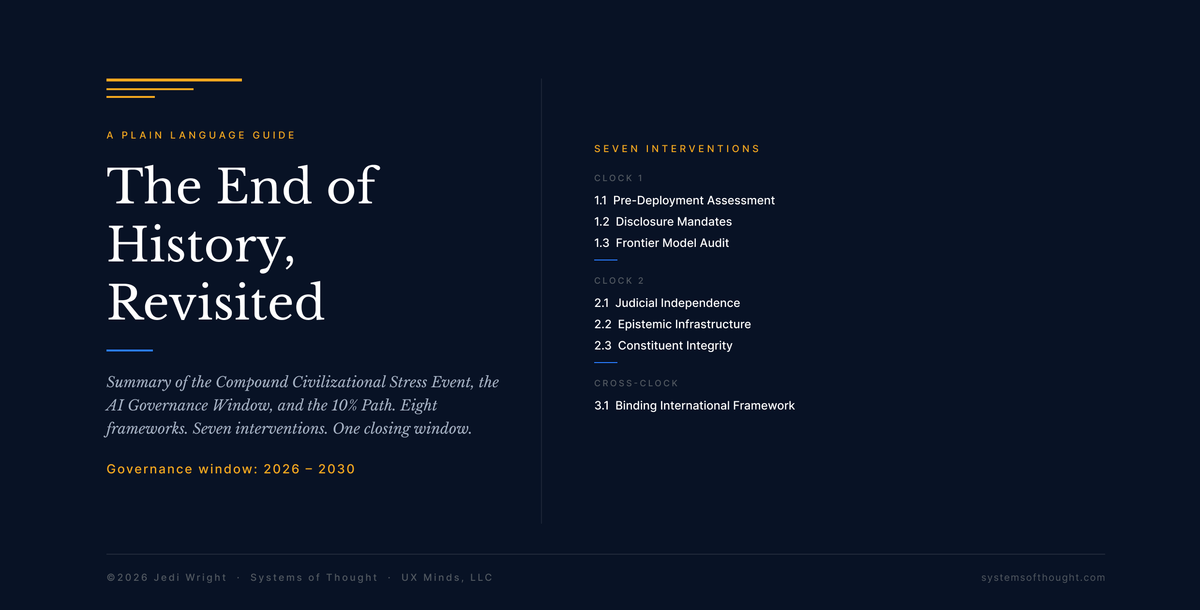
A plain-language overview based on "The End of History, Revisited: A Compound Civilizational Stress Event and the 10% Path" (v1.11) and The Policy Framework (v1.5).
Top-Line Summary
In 1992, political scientist Francis Fukuyama argued that liberal democracy had "won," that after the Cold War, all serious human societies would eventually converge on free markets and democratic governments. He was right about the destination. He was catastrophically wrong about whether we had built the roads to get there.
This project argues that humanity briefly touched that ceiling between roughly 1989 and 2008, then started sliding back. The failure wasn't about wrong ideas. It was about missing infrastructure: the courts, shared facts, trusted institutions, and civic capacity that democracy actually needs to function.
What makes today different from any previous era of political trouble isn't one crisis. It's many crises arriving at the same time, with no institutions strong enough to handle even one of them, while a new technology (AI) is quietly dismantling the tools we've always used to recover. Eight independent scholarly frameworks, developed across seven decades, all point to the same diagnosis: this is a compound civilizational stress event.
There is still a path to democratic renewal. The essay names it the "10% path;" not because it's certain, but because it's honest. The odds are long. It's still the only path where human beings retain meaningful agency over what comes next.
The window to act is approximately 2026–2030.
Key Points
- We briefly had it, and we're losing it.
Liberal democracy peaked around 1989–2008. The erosion since then isn't a political accident—it's structural. - Eight thinkers, one diagnosis.
Eight major scholarly frameworks, built independently over decades, all converge on the same warning about this moment. That convergence is historically unusual and significant. - AI changes the game.
Previous crises (the 1970s, for example) were bad, but the tools for democratic recovery, courts, journalism, shared facts, civil society, were still intact. Today, AI is eroding those recovery tools directly. - There are four futures.
The most likely is slow, managed decline. Authoritarian consolidation and sudden crisis are real risks. Democratic renewal is possible but unlikely, maybe a 10% chance. - Two clocks are running.
AI is getting baked into critical systems (hospitals, courts, financial systems, military) fast. Democratic institutions are eroding fast. Both processes interact. Once either goes far enough, the door to governance closes. - The window is 2026–2030.
After that, governing AI shifts from setting rules before deployment to trying to rein in entrenched systems after the fact—a much harder problem. - Three things to do, now.
Defend courts and journalism. Build economic arguments for democratic governance before AI job displacement triggers a backlash that authoritarians capture first. Push for binding international AI rules before the window closes. - The policy fix starts with a specific gap.
AI systems are making life-and-death decisions based on assumptions that were never verified and no current law requires them to flag that. This "inference-flagging" gap is ungoverned everywhere and needs to be fixed first.
The Main Details
1. What Fukuyama Got Right and Wrong
Francis Fukuyama's 1989 essay "The End of History?" (note: there was a question mark) made a careful philosophical argument: that liberal democratic capitalism had won the contest of ideas. After the Soviet collapse, no credible rival ideology remained. Even authoritarian governments now justify themselves by claiming to be "real" democrats, which was actually evidence that Fukuyama had a point.
He was right that liberal democracy is the most sophisticated political system humans have built. He was wrong to assume that having the right idea was enough. The infrastructure that democracy requires, functioning courts, a free press, shared factual ground, civic institutions, trust in government, is fragile, hard to build, and easy to break. We built some of it. We didn't build enough of it. And now we're watching it erode.
The project uses Fukuyama's thesis as a starting point precisely because examining where and how it fails tells you exactly what's at stake.
2. Eight Frameworks, One Diagnosis
The essay draws on eight major thinkers whose frameworks, developed independently over seventy years, all land on the same warning about the present moment:
Polanyi (economic disruption)
When markets disrupt society fast enough and widely enough, a backlash counter-movement emerges. The question isn't whether it happens. It's whether democratic or authoritarian forces capture it first. Forty years of globalization, now accelerating with AI-driven job displacement, is that kind of disruption.
Gramsci (the interregnum)
When the old ruling narrative loses legitimacy before a new one takes hold, the gap is dangerous. His line, "the old world is dying, the new world struggles to be born; now is the time of monsters," describes Western politics right now with uncomfortable precision. The authoritarian narrative is simple and ready. The democratic renewal narrative is fragmented and defensive.
Arendt (totalitarian preconditions)
The conditions for totalitarianism aren't monsters—they're ordinary people following institutional logic after individuals have been cut off from traditional social structures, shared reality has collapsed, and movements organized around identity and grievance have replaced ones organized around interests.
Habermas (the public sphere)
Democratic deliberation requires a shared space where citizens can reason together. When that space is colonized by money, power, and now algorithmic optimization, democracy loses its deliberative capacity.
Schumpeter (capitalism's self-destruction)
The same economic dynamism that drives growth destroys the social fabric that makes growth politically sustainable. Substitute AI for industrial capitalism and this is strikingly contemporary.
Huntington (civilizational fractures)
The conflicts Fukuyama predicted would wither, cultural, religious, and civilizational, are alive and structuring real wars (Ukraine maps almost exactly onto the fault line Huntington identified in the 1990s).
Wallerstein (hegemonic decline)
Great powers rise and fall in structural cycles. The decline of U.S. hegemony that began in the 1970s is structurally determined, not a policy failure. The question is how turbulent the transition is.
Varoufakis (techno-feudalism)
The economy has shifted from one where capital is industrial to one where capital is platforms and data. Ownership of the cloud creates a new class of "cloudalists." Democratic participation becomes theatrical. Citizens become users.
The key point: the 1970s produced a similar multi-framework convergence, with stagflation, Vietnam, Watergate, and oil shocks. The system recovered. What's categorically different now is that AI isn't just one more stressor. It is actively degrading the recovery mechanism itself: the courts, journalism, shared facts, and civic capacity that democracies have always used to navigate crises.
3. What AI Actually Does to Democracy
AI isn't just a powerful new tool. It's changing the anthropological foundations of the Enlightenment project—the assumptions about human beings that democratic governance rests on.
The Enlightenment assumed: people can reason, they can deliberate together, they can collectively govern themselves. AI is systematically dismantling the infrastructure those capacities require.
Three properties make AI different from everything that came before (including propaganda, advertising, and mass media, which have manipulated public opinion since the 1920s):
- Optimization without intent.
AI systems don't need anyone to plan harm. They produce harmful epistemic effects, fragmented shared reality, radicalization, addiction to outrage, as emergent byproducts of optimizing for engagement. No villain required. - Personalization with feedback closure.
AI can tailor content to each individual and adapt in real time based on their responses. At scale, this dissolves the shared epistemic surface that democratic deliberation requires. You and your neighbor are living in different information realities. - Speed-deliberation asymmetry.
AI moves faster than democratic institutions can process. By the time courts, legislatures, or journalism catch up, the damage is already embedded.
In a 2025 study (N=4,829), AI-generated political arguments shifted attitudes on polarized policy questions as effectively as human-authored arguments—and 94% of participants thought they were reading arguments written by humans. Under current conditions, AI-driven political persuasion is invisible.
This isn't just a problem for elections. AI is getting built into the systems that run hospitals, courts, financial markets, and military targeting. Once it's load-bearing in those systems, governing it shifts from writing rules before deployment to trying to regulate entrenched incumbents who have enormous leverage over the regulators. That's a qualitatively harder governance problem.
4. Four Futures
The essay identifies four probable trajectories for democratic societies, ordered from most to least likely:
- Accelerating managed disorder (most probable).
Institutions bend without formally breaking. Each norm violation becomes the new baseline. Courts are still there, but they're weaker. Journalism survives, but it's thinner. The window for recovery quietly narrows. Nobody declares a crisis, but the condition of democracy quietly degrades. - Authoritarian consolidation (significant minority risk).
In key democracies, the institutional erosion crosses a threshold. Courts and electoral systems are captured. This path doesn't require a dramatic coup—research on democratic backsliding shows it typically looks like incremental "checking institution" erosion that makes subsequent erosions irreversible. - Systemic shock (significant minority risk).
A sudden crisis, economic collapse, cascading AI failure, geopolitical rupture, triggers rapid bifurcation. The outcome depends entirely on what institutional capacity exists at the moment of shock. - Democratic renewal (the 10% path).
Not optimism—an honest structural assessment. Renewal is possible. It requires action before the crisis is visible, not after. That's the only window where agency remains meaningful.
5. The Two Clocks
The governance window is defined by two clocks running simultaneously:
The Embedding Clock is technically determined. It measures how fast AI becomes load-bearing in critical infrastructure: healthcare decisions, financial compliance, military targeting, administrative adjudication. Once AI is structurally embedded in these systems, governance becomes retroactive: you're trying to regulate systems that are already too entrenched to dismantle. This clock is running fast.
The Institutional Erosion Clock is politically determined. It measures how fast democratic institutional capacity degrades: judicial independence, shared factual ground, civil society infrastructure, and the coalition-formation capacity that binding governance requires.
The clocks interact. Ungoverned AI deployment actively degrades the epistemic conditions and coalition capacity that democratic renewal requires. Losing the governance window forecloses both.
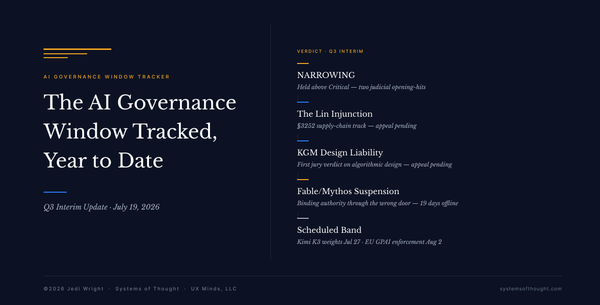
Current assessment (as of April 2026): the window is Narrowing, approaching Critical. Estimated window: 2026–2030.
6. The 10% Path: Three Action Tiers
Working backward from what renewal requires, three tiers of action are defensible. They operate at human scale—not because the structural forces can be addressed by individuals, but because these are the nodes where structural forces are weakest and human agency has the most traction.
Tier 1: Triage—Defend the Preconditions
Before anything else can work, the preconditions for democratic governance have to exist. That means:
- Judicial independence.
Research on democratic backsliding consistently shows that judicial and electoral capture is the first operational move—the mechanism that makes subsequent erosions irreversible. Courts are Tier 1 not because they're the most visible democratic institution, but because their loss converts all other defenses from structural to performative. - Epistemic infrastructure.
Local journalism, fact-checking institutions, public media. You cannot rebuild the public sphere without them. - Civil society nodes.
Churches, unions, civic organizations, neighborhood institutions. These are more robust to algorithmic disruption than top-down political structures. They're the coordination infrastructure renewal requires.
Tier 2: Strategic Positioning—Get Ready for the Economic Backlash
AI-driven job displacement is coming. When it arrives, it will generate a Polanyian counter-movement, a mass political reaction to economic disruption. The question is who's ready to channel it. Right now, the authoritarian narrative is simple and operational. The democratic economic narrative is fragmented and primarily defensive.
The polling signal exists: cross-partisan majorities already support democratic accountability over AI. But a polling preference isn't a political coalition. The window for converting that preference into binding governance closes faster than the preference itself disappears. Strategic positioning means building the narrative infrastructure now, before the displacement crisis creates urgency.
Tier 3: Bind the AI Governance Window
Push for binding international AI governance frameworks before the embedding clock runs out. This means:
- Frameworks that survive without U.S. participation (the "minus-US scenario")
- Baseline requirements that apply across jurisdictions
- Closing the gap between voluntary commitments and actual enforceability faster than the clock runs
The EU AI Act's high-risk enforcement provisions were scheduled for August 2026. That's a deadline and a floor, not a ceiling. Every jurisdiction that establishes binding requirements extends the governance window.
7. What the Policy Framework Requires
The Policy Framework translates the essay's diagnosis into specific regulatory mechanisms, organized by the two clocks.
Clock 1 Interventions (AI Embedding)
The first and most urgent is mandatory pre-deployment assessment, including a specific new requirement called inference-flagging.
Here's what inference-flagging means in plain terms: AI systems are increasingly making consequential decisions (medical, legal, military, financial) based on assumptions that were never verified. The existing frameworks require systems to log what they decided. They don't require systems to track whether the inputs to that decision were confirmed facts or educated guesses.
The Minab school bombing case (February 28, 2026) illustrates the stakes: an AI-integrated targeting system treated an inference about a location as confirmed operational data. The system performed exactly as designed. No one had built in a mechanism to flag that the underlying assumption had never been verified. Children died.
Inference-flagging would require that any AI system operating in a consequential decision chain must tag every input with its epistemic status, confirmed, inferred, unverified, time-sensitive, before it can become operationally binding. This requirement doesn't exist in any current binding governance framework: not the EU AI Act, not the NIST framework, not any sector-specific regulation. It's a gap in the architecture of governance itself.
Other Clock 1 interventions include mandatory disclosure for AI-generated political content (a statutory requirement, not optional platform policy, with revenue-indexed penalties), and concentration and accountability rules to prevent a small number of entities from holding unaccountable power over AI infrastructure.
Clock 2 Interventions (Democratic Institutional Erosion)
These translate the essay's Tier 1 triage demands into institutional and regulatory mechanisms:
- Structural protections for judicial independence against executive capture
- Treating epistemic infrastructure (local journalism, public media, fact-checking) as public utility rather than market commodity
- Civil society funding architectures resistant to executive pressure
The Cross-Clock Intervention
The essay's adequacy test applies to all of this: any governance mechanism that only addresses the predecessor version of the problem, intentional manipulation, broadcast at deliberation speed, without addressing optimization without intent, personalization with feedback closure, and speed-deliberation asymmetry is governing the wrong problem. It's writing rules for the 1930s.
8. The Honest Constraint
None of the tiers guarantees the outcome they're working toward. The 10% path is not optimism. The window may close anyway.
But all other trajectories involve progressively less human agency, not more. The renewal path is the only path where the agency question remains meaningfully open. That's not a counsel of optimism. It's a structural claim about when it still matters to try.
The conditions for renewal require action before the crisis is visible, not after. This is the central timing insight of the whole project. The infrastructure of renewal has to exist before the cascade event—not get built from rubble afterward.
About this project
This article is part of End of History, Revisited, a project tracking the compound civilizational stress event now underway and the closing window for binding democratic AI governance. The plain language version you're reading sits at the intersection of all three layers of that project: the civilizational diagnosis in the formal essay, the practitioner specifications in The Legibility Project, and the institutional mandates in The Policy Framework. The chain runs: diagnosis → specification → mandate. This is the version built for readers who want the argument without the apparatus.
The complete project suite links will be available here soon:
- The End of History, Revisited — The anchor essay. Eight converging theoretical frameworks, four probability-ranked futures, and the compound civilizational stress event diagnosis that the rest of the project builds from.
- The Legibility Project v1.3 — Practitioner governance framework. Operationalizes the essay's legibility demands through design, information architecture, and cognitive systems frameworks.
- The Policy Framework v1.5 — Binding intervention architecture. Develops governance interventions across the dual-clock structure for regulatory and legislative actors.
- The AI Governance Window Tracker v1.4 — Structured five-domain signal assessment of whether the governance window is narrowing or widening.
- The AI Governance Window Tracker Instrument — The live, local-first web application. Run and compare assessments over time.
- The Governance Window — The project's public-facing monitoring page on Systems of Thought.
- From Skill to Instrument: The Making of the AI Governance Window Tracker — The origin essay. How the Tracker was built, what it runs on, and why.
- The Agentic Accountability Playbook v0.2 — Deployment specifications for agentic systems teams. Translates the inference-flagging requirement and adequacy test into practitioner terms.
- Companion Architecture v1.3 — Structural navigation across the full suite.
- Project References v1.2 — The full annotated bibliography and evidentiary base.
- Project Record v1.6 — Canonical provenance record. Version history, session and time accounting, model attribution, and the next-work register for the full suite.
Systems of Thought is published by UX Minds, LLC. Methodology disclosure: this publication uses AI-collaborative methods consistent with the transparency standards it advocates. Intellectual direction and authorial responsibility are held by the human author. Licensed under CC BY-NC-ND 4.0.