The Grammar of Trust
Language has always needed a structure to make it credible. That structure is now under pressure from every direction at once.

Language has always needed a structure to make it credible. That structure is now under pressure from every direction at once.
This piece was developed with AI assistance (Claude / Anthropic). See the full methodological disclosure at the end of this article. The open call is for a human artist/designer. See details below.
There is a sentence in the history of institutional language that most people have never had reason to examine: credimus, from credere—to believe, to entrust, to lend. The word that gives us credit, credentials, credibility. A Latin root with an audit trail built into it.
That is not a coincidence. It is a design.
Latin held Western European institutional life together for more than a thousand years not as a literary tradition but as a governance technology. The case system made contracts portable across jurisdictions that shared no spoken language. The root system—credere, auctoritas, legere—meant that every formal utterance carried the terms of its own verification. The honorific system encoded administrative fact directly into the grammar, what a culture considered worth tracking, forced into every utterance. You did not have to know the person on the other side of the document. The grammar vouched for them.
That is what I mean by the grammar of trust. Not metaphor. Structure.
The argument
When Latin fragmented into the vernaculars, the governance function did not disappear. It migrated—first into the printing press, then into the institutional forms the press made possible. Each medium inherited the problem of making language credible at scale. None of them inherited a shared grammar for doing it.
What they inherited instead was a construction sequence. Credibility, in any medium, follows a recognizable architecture: Vouch, Show, Prove, Faith, Humility. Someone is named as trustworthy. Evidence is produced. The evidence is tested. A claim is held provisionally. And then—and this is the step most systems omit—the claimant acknowledges the limits of what has been established.
That five-stage sequence is not a rhetorical strategy. It is the underlying structure of how institutional trust transmits across generations that never meet. It was built into Latin. It was reconstructed, partially and imperfectly, in every successor medium. It is what the book is about.
The book
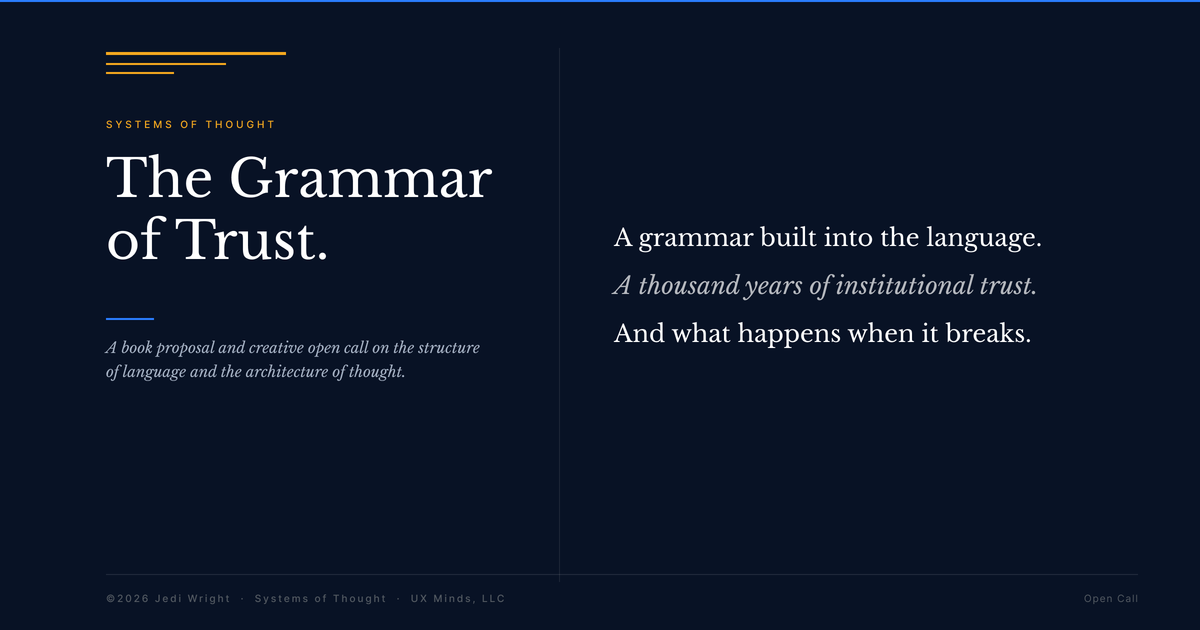
The Grammar of Trust: The Structure of Language and the Architecture of Thought is the second volume in the Systems of Thought series, following The End of History, Revisited. It is a work of structural analysis, 80,000 to 90,000 words, twelve chapters in three parts, aimed at readers who think carefully about language, institutions, and what gets lost when the substrate changes. The proposal is complete and available on request.
Part I reconstructs the Latin system as governance technology: the case grammar, the root vocabulary, the fragmentation into vernaculars, and the printing press as the first solution to the scale problem that didn't share a grammar with what it replaced.
Part II moves from using structural rules to seeing them, through Saussure's langue/parole distinction, the information architecture lineage, Wittgenstein's constraint, and into the practitioner centerpiece: the five-stage trust taxonomy. Vouch. Show. Prove. Faith. Humility. Not as advice, as anatomy.
Part III is where the analysis turns to now. The compression of language by screens and algorithms. The return of the image as the primary symbolic form. And AI systems producing grammatically correct language at industrial scale without any communicative stake in what they produce. The question is not whether that language is accurate. The question is what happens to the cognitive capacities that sustained formal thought when the substrate is remade by systems that have no stake in being understood.
That is the problem. The grammar of trust is what was at risk before this moment, and what is most at risk in it.
The book sits on a shelf that has been building steadily and is now, at the AI inflection, one of the most active precincts in serious trade nonfiction. Its nearest neighbors are:
- Maryanne Wolf's Reader, Come Home—whose neuroscience of deep reading is the single most-cited source in Part III
- Nicholas Carr's Superbloom
- Gretchen McCulloch's Because Internet
- Ethan Mollick's Co-Intelligence
- Yuval Noah Harari's Nexus
- Ieva Jusionyte's Exit Wounds is the scholarly-trade crossover register comp: fieldwork-grounded, structural, written for a serious general audience on a contested subject.
Each book serves the market at a specific layer; The Grammar of Trust occupies the layer none of them reaches—the structural substrate of formal language itself, and what AI deployment at scale is doing to the infrastructure that substrate was built to carry. The readership already exists. The End of History, Revisited, the first volume in the series, established the audience and the register. This is the second argument in that project.
The visual language
Before the open call goes out, the direction had to exist. That work happened this morning.
The book's creative direction is now established in a dedicated Figma file—eight slides of visual language exploration, built to 1920×1080 across five areas of the book's design problem.
Note: click the expansion icon in the top right of the image and then zoom in as needed to view the Figma slides.
The chapter opener system works in three temperatures that track the book's three-part structure.
- Part I opens on white ground with pure typography: part number, a short rule, chapter title in Libre Baskerville, and an italic epigraph. The Root System. Credo: I give my heart into your keeping. No decoration.
- Part II introduces the structural mark: three descending bars (navy, mid-blue, accent blue) that echo the Systems of Thought logo, with a blue rule running the height of the chapter title. Vouch, Show, Prove.
- Part III goes dark: navy ground, amber accent, bold white type, and a compression device: eight bars of white at descending widths and ascending opacity, the visual argument of the chapter enacted in the opener itself. The Grammar We're Building Now.
The three signature diagrams are roughed in as directional concepts:
- Figure 1.1 maps the Latin root system—credere, auctoritas, legere—with their institutional descendants (credibility, credit, authority, authentication, legislation, legitimacy) in color-coded derivation columns.
- Figure 2.1 renders the V/S/P/F/H trust taxonomy as a five-stage sequence with distinct color identities per stage — black, green, blue, purple, amber—moving left to right along a horizontal axis.
- Figure 3.1 shows the compression of language across media from manuscript to AI output: each medium rendered as a text block at the scale its form permits, shrinking from paragraph to sentence to headline to tweet to emoji to a single middot. The compression is made visible through the form of the diagram.
Text-figure integration shows two layout variants against a 6×9 print trim: an inset figure with text wrapping left, and a full-width figure with a blue left-rule and italic practitioner caption. The endnote and citation treatment specifies a Notes page format: chapter-label sections, numbered entries in the practitioner register, and inline superscript references in body text. The part divider system gives each of the three parts its own thermal identity: Part I on white with navy marks, Part II on panel blue with blue accent, Part III on navy with amber—each carrying a one-sentence précis and a pull-quote from the text.
The visual language is directional. It is not finished. That is what the open call is for.
The book requires visual work: chapter openers, three signature diagrams, text-figure integration, endnote treatment, part dividers. The visual language has been developed. What it needs now is execution by a human hand.
That sentence is not incidental. A visual identity designed by an AI system would be a performative contradiction of the book's thesis. The argument of The Grammar of Trust is that language, and the visual forms that extend it, carries its meaning partly through the social act of its making: the stake the maker has in what is produced, the accountability that attaches to authorship, the communicative function that can't be separated from the communicating body.
The constraint holds. The open call is real.
What the work covers:
- Chapter opener system—typographic and geometric, no illustration
- Three signature diagrams: Latin Root System (Fig 1.1), the V/S/P/F/H Trust Taxonomy (Fig 2.1), Compression Timeline (Fig 3.1)
- Text-figure integration: two layout variants
- Endnote and citation treatment
- Part divider pages
Rates:
Concept phase $300–$500, paid on selection.
Production phase $2,000–$4,000 negotiated on scope.
To respond: jedi@jediwright.com. Proposals are open now.
If you work at the intersection of typography, information design, or structural illustration, or know someone who does, this is worth a look.
A beginning
The End of History, Revisited asked whether democratic governance retains the capacity to bind AI before the window closes. The Grammar of Trust asks what happens to the language those institutions use to think with—and whether the grammar of credibility survives the medium it's migrating into now.
They are companion arguments. They were always going to arrive together.
This is the beginning of the second one.
Inspiration
Inspiration for the early seeds of this is due in part to my time working alongside David Dylan Thomas, his published works, and guest lecturing at some of my UX events.
For a quick take from him, now dated but still relevant for this work, see here.
The Grammar of Trust: The Structure of Language and the Architecture of Thought is in development. The open call for visual work is active.
© 2026 UX Minds, LLC. Systems of Thought is a publication of UX Minds, LLC.
This article and project originated in extended Socratic dialogue with Claude (a large language model produced by Anthropic) and was developed through iterative AI-assisted research, drafting, and editorial refinement. The intellectual direction, choice of frameworks, critical challenges, and core arguments were human-led; Claude functioned as a structured thinking partner that the human interlocutor could interrogate, redirect, and contest.