
AI Governance
The AI Governance Window in Q3 2026: Narrowing by a Thin Margin
Q3 2026 produced the strongest opening record the tracker has logged, and its heaviest evidence of lost control. The window is still narrowing, but only just.
AI Governance
Q3 2026 produced the strongest opening record the tracker has logged, and its heaviest evidence of lost control. The window is still narrowing, but only just.
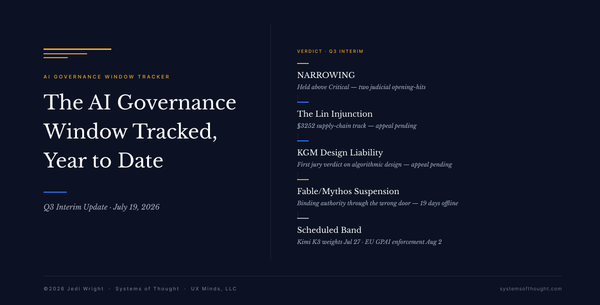
AI Governance
The AI governance tracker moved from Critical to Narrowing between May and June. That's not a sign things got better. It's a sign the instrument was wrong, and I rebuilt it. Seven months of AI governance: preemption, Fable/Mythos, WAICO, Kimi K3, told through a YTD diagram.
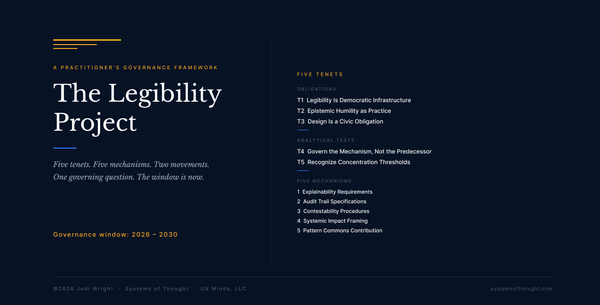
The Legibility Project
The infrastructure of democratic renewal is built in specifications and design systems—by practitioners making decisions that will preserve or foreclose democratic legibility at scale. Five tenets. Five mechanisms. One question: are you making the system legible, or the illegibility more elegant?
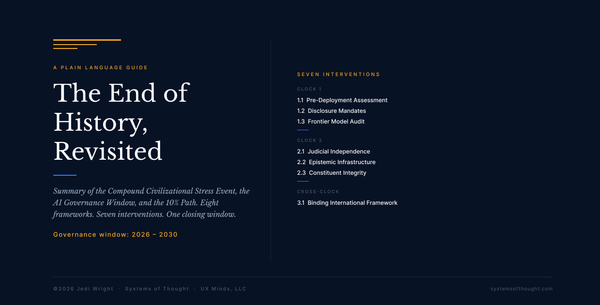
End of History, Revisited
A plain language guide to the compound civilizational stress event now underway, the seven binding interventions that could still close the AI governance gap, and why the window to act is 2026–2030.
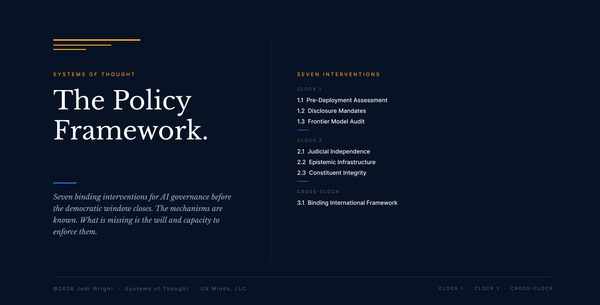
End of History, Revisited
The binding-authority gap is widening. The mechanisms are known. What is missing is not knowledge but political will, and the window is measured in years, not decades.
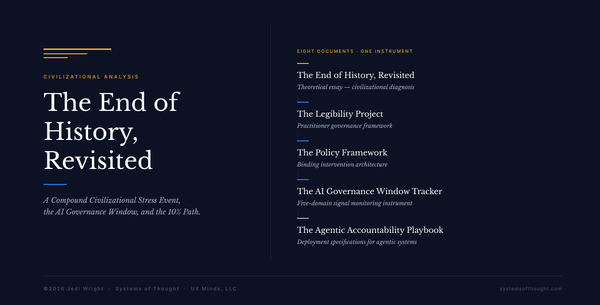
End of History, Revisited
A Compound Civilizational Stress Event, the AI Governance Window, and the 10% Path. The full article with footnotes runs approximately 17,000 words.

AI Governance
How a SKILL.md file became a public instrument in 31 days—the codebase behind it, the 2004 source code that's still foundational, and the closing AI governance window.

End of History, Revisited
Seven interventions, three requirements, one window–all here now.