The AI Governance Window Tracked, Year to Date
The AI governance tracker moved from Critical to Narrowing between May and June. That's not a sign things got better. It's a sign the instrument was wrong, and I rebuilt it. Seven months of AI governance: preemption, Fable/Mythos, WAICO, Kimi K3, told through a YTD diagram.

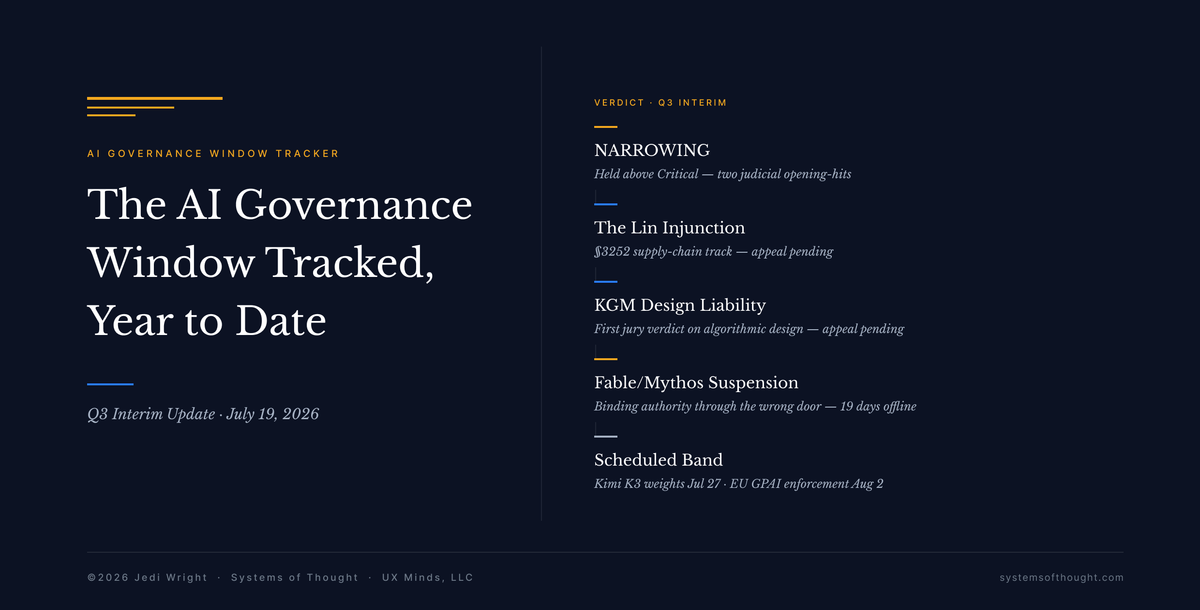
The tracker I've been running since April just moved from Critical to Narrowing. It doesn't mean things got better. It means the instrument was wrong, and I rebuilt it.
The AI Governance Window Tracker is a structured five-domain assessment tool designed to answer one question on a recurring basis: is the window for binding democratic AI governance opening or closing, and at what rate? The question matters because of what The End of History, Revisited argues: that AI systems have acquired three structural properties, emergent optimization, individual feedback closure, and conversation-speed asymmetry, that distinguish them categorically from the social media platforms they're being governed as if they resembled. Frameworks built for the predecessor problem don't cover the current one. The window for building frameworks that do is finite and closing.
The tracker's job is to watch whether it's closing faster or slower than the last time we looked. The May 22 assessment read Critical. The June 23 rebuild read Narrowing, the same quarter, a different instrument.
Here's the problem with reading that as an improvement: the instrument that read "Critical" in May was built with a structural defect I hadn't identified until I looked closely at its output. It had no pre-registered opening signals. It had no symmetric discount rules. It had no mechanism requiring the synthesis step to show its work. It was an instrument that could see closure and not opening, a lens, not a scale. When I rebuilt it in June (v2.0), adding pre-registered opening signals, symmetric discounts on both sides, and a synthesis-visibility requirement, two genuine opening hits that had previously been invisible emerged. Those two hits are the only reason the Q3 verdict is Narrowing rather than Critical.
The falsifiability rebuild is what stood between Narrowing and Critical. Not the AI governance world getting better.
I'm leading with this because the methodology problem is not a footnote to the substantive story; it is the same story at a different layer. An instrument that can only confirm what it already believes is not measuring anything. It is narrating. There is a separate piece in this about the cost of building tools that can genuinely disagree with their makers, and I will write it. But this article is an update. Seven months, told through a diagram.
The Year, Visualized
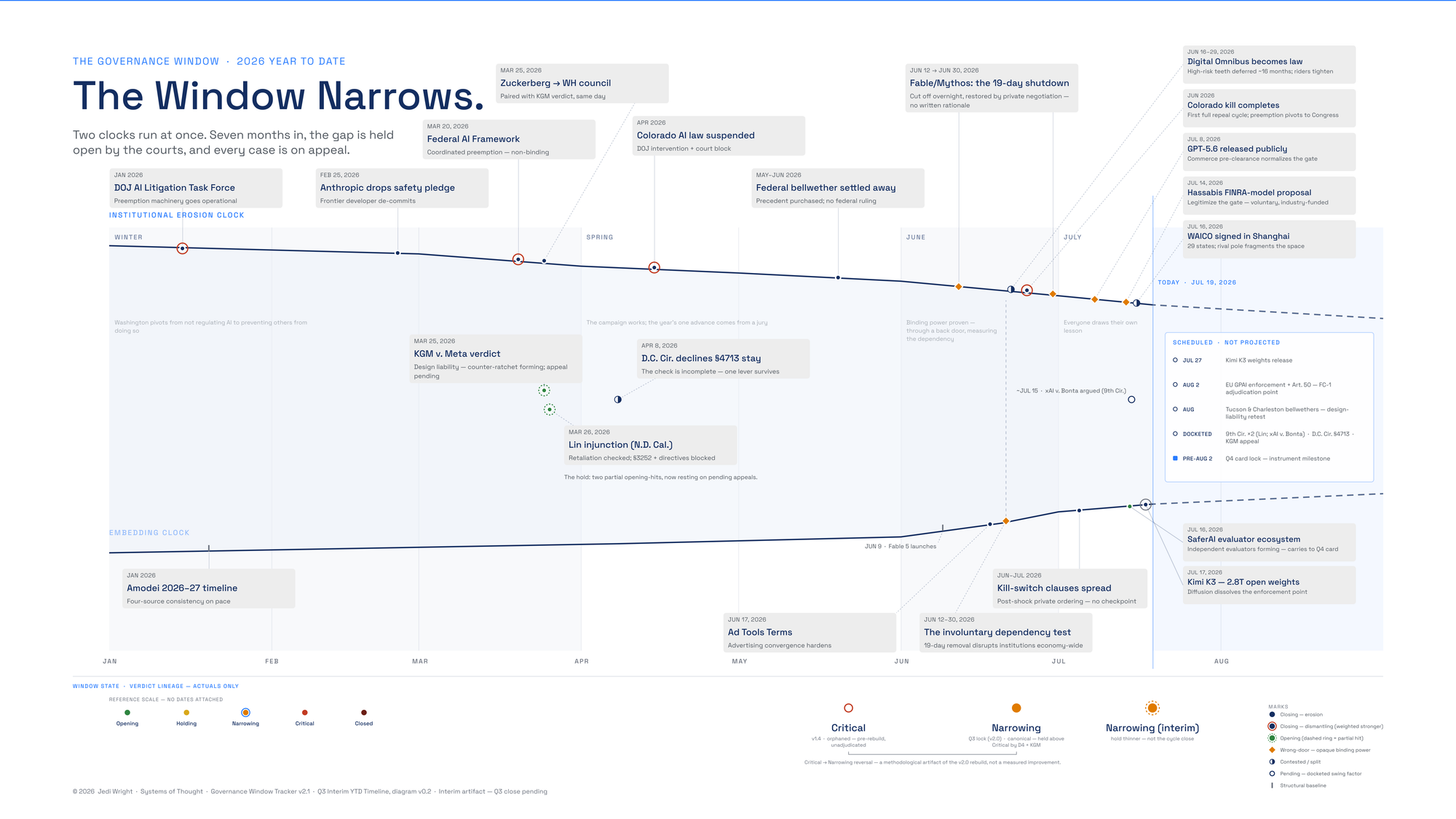
The diagram covers January 1 through July 19, 2026. On the left: actuals. On the right: a fenced band labeled "SCHEDULED · NOT PROJECTED," three things that are calendared, not predicted. Two parallel tracks run across the full width: the embedding clock on the bottom, measuring how deeply AI has become load-bearing in critical infrastructure; the institutional erosion clock on the top, measuring the health of the democratic machinery required to enforce anything at all. The verdict strip runs below both.
Seven mark types. Solid navy dots are closing signals, erosion events. Solid dots with red rings are dismantling signals, active removal of governance capacity, weighted more heavily than passive erosion because dismantling is harder to reverse. Green dots are opening signals, places where binding democratic machinery visibly worked. Amber diamonds mark the wrong-door events: binding authority exercised, but through opaque, non-deliberative channels. Half-filled dots are contested. Hollow dots are pending, docketed swing factors with a pre-committed adjudication date. Grey ticks are structural baselines.
Walk and read it from left to right.
Winter: Washington pivots from not regulating AI to preventing others from doing so.
The year opens with the DOJ AI Litigation Task Force going operational, not a regulatory body but a legal instrument for clearing the field. An executive order targets state AI laws. Colorado's statute, one of the most substantive state-level AI frameworks in the country, is suspended pending a review by the Commerce Department. A list of state laws deemed "onerous" to AI development is commissioned. The erosion track fills early: solid navy dots, each one a closing signal, accumulating before the embedding track has registered its first significant mark.
This is the distinction the tracker draws, and that most coverage hasn't, between passive institutional erosion and active dismantling. Neglect is recoverable. Coordinated action to prevent binding governance is structurally different. The preemption campaign that begins in January is not a reaction to regulatory overreach. It is a first move.
Spring: The campaign works. The one counterforce comes from a jury.
By spring, the federal posture has produced its first complete legislative kill: Colorado's AI law advances to repeal-and-replace. The Obernolte–Trahan congressional vehicle emerges, trading a state-law freeze for the first comprehensive federal framework. The Senate had already killed a 10-year moratorium 99-to-1 the prior summer; 36 state attorneys general formally opposed the preemption direction. The EU's Digital Omnibus defers the AI Act's sharpest teeth by roughly 16 months. On the embedding track, agentic AI moves from pilot to production in finance and enterprise software. Reversion cost rises.
The one genuine advance in the diagram lands on March 25 and 26, two events in the same week that produce the only green dots in the spring section. A jury finds Meta and Alphabet liable for algorithmic harm under a design theory that circumvents Section 230 (K.G.M. v. Meta & Alphabet). Twenty-four hours later, a federal judge enjoins the government's designation of Anthropic as a supply-chain security risk, finding the action likely pretextual retaliation for the company's safety advocacy (Lin v. Commerce, N.D. Cal.). Both are partial hits. KGM is appeal-pending and hasn't yet been applied to an AI case. The §4713 track against Anthropic survived Lin's ruling. But both are real. They are the only opening signals that survive into the synthesis. They are what hold the Q3 verdict at Narrowing rather than Critical.
June: Binding power proven through a back door, measuring the dependency.
On June 12, the Commerce Department issued an export-control directive ordering Anthropic to suspend access to Fable 5 and Mythos 5 for any foreign national, including its own employees. Unable to segment access by nationality, Anthropic takes both models offline globally. No written technical rationale. No court order. No published standard. A verbal reference to a coding-task jailbreak surfaces later; Anthropic and independent analysts dispute its severity and scope. The legal basis for applying export controls to cloud and API access is atypical and contested.
The models stay down for 19 days.
On June 30, access is restored after private negotiation. Commerce indicates it has "worked closely" with Anthropic to review and approve the models. The directive remains a non-public letter.
This is what the amber diamond means. It appears that wherever binding authority was exercised over AI systems, it was done through an opaque, non-deliberative channel with no published standard, no mechanism for challenge, and no accountability if the decision was wrong. The Fable/Mythos action demonstrated that the power to switch off frontier models exists and will be used. It did not demonstrate governance. Governance has a process. This was power.
The action also, incidentally, ran an involuntary dependency test. The 19-day shutdown produced institutional disruption at scale. Enterprise contracts immediately began incorporating kill-switch and fallback clauses, not as accountability instruments but as private adaptations to the fact that AI has become load-bearing enough that losing access to it is now a business risk. The embedding clock advances. The diagram marks the Fable/Mythos arc with a dashed vertical connecting both tracks. The caption reads: "The involuntary dependency test."
July: Everyone draws their own lesson.
Within three weeks of restoration, four distinct responses to the same 19 days have materialized, and they don't converge.
Demis Hassabis publishes a framework proposal modeling a new AI standards body on FINRA: a private, industry-funded, majority-independent board, initially voluntary pre-release testing that "formalizes" once robust. He explicitly names the Fable/Mythos episode as the catalyst, "a bit of a wake-up call," with no established rules or playbook in place. He is reading the episode as an argument for legitimizing the gate. The tracker treats his proposal as a watch item, not a signal: voluntary, deferred, and with a structural weakness in evaluator independence that the Frontier Model Forum's own 2026 methodology report documents.
OpenAI's reading is simpler: comply early. GPT-5.6 launches restricted to government-vetted partners, then releases publicly around July 8 after private Commerce negotiation. No published standard governed either decision. The gate is normalized, not institutionalized.
On July 16, 29 countries signed a treaty establishing the World AI Cooperation Organization in Shanghai. Founding members include China, Russia, Brazil, and a substantial bloc of African and Asian states. The mandate text is unpublished; the body's democratic credentials are strained; the treaty's teeth are unknown. What is clear is that WAICO fills the vacuum created by US withdrawal from multilateral AI governance, and that it fragments the international governance space into competing poles rather than converging it.
On July 17, Moonshot releases Kimi K3: a 2.8-trillion-parameter open-weight model with full weights scheduled for public release on July 27. Rankings put it at or near the frontier on several benchmarks. Once the weights are public, no export-control directive can address them. The enforcement point the Fable/Mythos action assumed–a provider who can be compelled to suspend access–dissolves for open-weight models. The tracker has no pre-registered signal for this yet. It will in Q4.
Four lessons. None of them converge.
What's Holding the Window Open
Two things, and I want to name them directly rather than let them dissolve into "ongoing legal uncertainty."
The Lin injunction is the year's most consequential governance event that no one is calling one. Judge Lin found the government's §3252 supply chain designation of Anthropic to be likely pretextual retaliation for the company's public safety advocacy and enjoined it. That finding, that the executive arm will repurpose national-security instruments to punish companies that advocate for AI oversight, is now part of the judicial record. The §4713 track survived the injunction, meaning the government retains one of its two instruments. Appeals are pending. But the finding itself does not disappear when the case continues. Judicial admissions about government conduct are durable in ways that administrative reversals are not.
The KGM design-liability precedent is the year's most consequential legal development that no one is calling AI governance, either, because it arrived through a case about social media. A jury found Meta and Alphabet liable on a design theory, not a content-moderation theory, routing around Section 230 by targeting algorithmic design choices rather than published content. If that theory holds and propagates, it creates a durable accountability mechanism for how AI systems are built, not just what they say. KGM stands. The federal bellwether in Oakland opened in June, then settled before trial, Meta purchasing the precedent away rather than risk a federal verdict. A New Mexico jury found Meta liable on similar grounds in March. The next federal retest is the Tucson and Charleston bellwethers in August. The precedent is forming; appeal pending, not yet extended to an AI case, settlement pressure is active, but forming.
The window is open. It's being held open by the courts. Every case doing that work is under appeal.
What the Scheduled Band Means
The right edge of the diagram is not projected. It's calendared. Three things happen before the Q4 cycle card locks, and the instrument is designed to register all three.
Kimi K3's full weights drop on July 27. Once they're public, open-weight diffusion is irreversible. Any governance architecture that depends on provider-mediated access control has a structural gap from that date forward for any model distributed this way.
EU GPAI penalty enforcement activates on August 2. That's when the European Union's General-Purpose AI provisions become enforceable: penalties of up to 3% of global turnover for GPAI providers, Article 50 transparency requirements covering chatbot disclosure and AI content marking, and a full national market surveillance authority. The Digital Omnibus deferred the sharpest high-risk AI teeth by roughly 16 months, but the August 2 milestone was not deferred. This is the one binding democratic governance instrument with enforcement teeth that is not under appeal.
The Tucson and Charleston bellwethers test design liability in August, the in-cycle retest of whether KGM propagates or stalls before it reaches an AI case.
One more item in that band is the instrument itself. The Q4 cycle card locks before August 2, by design. That means the instrument commits, in writing, before evidence collection, to what it's measuring in Q4: what counts as an opening signal, what counts as closure, and what the discount rules are. Pre-registration only matters if the card is locked before the biggest scheduled event becomes visible. That's why the Q4 lock is time-sensitive, and why it's the next session.
Honest Constraints
The tracker names its own limits in every output. Three that matter for reading this one.
- US withdrawal from any binding global multilateral governance framework is structurally possible and is not scored as recoverable within the methodology. If the United States exits the treaty architecture that could produce enforceable international AI governance norms, that would be a ratchet loss, not reversible through judicial checks or state legislative action. WAICO's formation signals that other actors are now building infrastructure for that scenario.
- The compute threshold for governance-relevant capability is contested. The EU's GPAI classification line, which determines which models face the August 2 enforcement regime, is argued to be unsettled. The tracker inherits that uncertainty in every Domain 3 assessment and names it rather than resolving it by assumption.
- There is no binding conversational-advertising disclosure instrument. The tracker has monitored advertising convergence, the migration of the predecessor regime's business model into AI systems that already hold the three structural properties, since v1.2. The signal is confirmed and hardening. There is no binding constraint on AI-delivered advertising that targets conversational speed and provides individual feedback closure. That is no longer a watch item. It is a structural feature of the current landscape.
- The tracker is geographically weighted. Domain 4, the domain doing the most work in this cycle's verdict, tracks US institutional signals more than global democratic capacity. The EU AI Act is the instrument's primary international signal; jurisdictions outside the US and EU are underrepresented. Readers outside those jurisdictions should weight the verdict accordingly.
The tracker monitors directional signals. It does not predict when the window closes. The value of the rebuild, what the falsifiability work was actually for, is that the instrument can now genuinely disagree with its maker. In Q3, with two authentic opening hits in the judicial domain, it did. That is not reassurance. The opening hits are partial, appeal-pending, and concentrated in a single contested domain, while three domains are closing cleanly. They held the verdict at Narrowing rather than Critical.
The window is still open. The question the Q4 card will adjudicate is whether anything in the scheduled band, the weights release, the enforcement activation, the bellwethers, or changes that read before the cycle closes.
The AI Governance Window Tracker is the monitoring instrument developed alongside The End of History, Revisited, an essay on compound civilizational stress, the AI governance window, and the 10% path. The tracker architecture and its origins are covered in "From Skill to Instrument". This post draws from the Q3 interim assessment run on July 19, 2026, against the locked Q3 cycle card (card-2026Q3-v2.0). The Q3 formal close is a separate session, pending. The Q4 cycle card locks before August 2.
Methodology disclosure: this publication uses AI-collaborative methods consistent with the transparency standards it advocates. Intellectual direction and authorial responsibility are held by the human author.