Full Personhood: The Governance Model AI Requires, and Capitalism Never Built
Corporations have had 140 years of infrastructure that has made them durable over time. Workers have almost none. This essay argues the asymmetry is architectural before it is political–and that AI is forcing the choice between closing it and making it permanent.


For most of the modern era, one party to the employment relationship has been given the infrastructure to be durable across time... and the other has not.
Corporations have accumulated 140 years of legal standing, institutional memory, and portable records. Workers have accumulated almost nothing they could carry out the door. This essay makes the case that this asymmetry is architectural before it is political, that the architecture can now be built on the person's side for the first time, and that AI is the forcing function that makes building it urgent rather than merely interesting. It proposes a governance model through fifteen principles and five working prototypes, and honestly names what the model does and does not deliver. The window is both open and closing.
1. The Asymmetry
In 1886, the United States Supreme Court took up a tax dispute between Santa Clara County and the Southern Pacific Railroad (1). The substantive question was narrow and technical.
The case is remembered for something the court did not formally decide. The headnote, drafted by the court reporter, recorded a pre-argument remark by the Chief Justice that the Fourteenth Amendment's Equal Protection Clause applies to corporations. The opinion itself never reached the question. The headnote was not the holding. It became the precedent anyway. Over the next century and a half, courts, legislatures, and the everyday machinery of commerce treated the proposition as settled. Corporations became durable persons. They have been durable persons ever since.
It is more useful to read Santa Clara not as legal history but as an architectural event. What the case ratified was the right of one kind of entity, the firm, to accumulate the infrastructure that makes any entity legible across time. Incorporation records. Charters. Patents and copyrights. Customer lists. Trade secrets. Brand. Institutional memory written into procedures, retained in archives, defended by counsel. None of these things is a person in the ordinary sense. Together, they allow a corporation to be recognizable next year as the same entity it was last year, the year before that, and the decade before that. The infrastructure is what compounds. It is what survives the people who built it.
The corporation has had that accumulated institutional infrastructure–the records, standing, and memory that compound across generations–for 140 years. It has been built, maintained, audited, refined, defended in court, encoded in tax law, and bequeathed across generations of executives. It is now extraordinary infrastructure. A modern firm of any size carries forward, as a matter of routine, things a human being cannot routinely carry forward: a reputation that survives the departure of every employee who built it, contracts that bind successors, a name that means something in markets the founders will not live to see. None of this is sinister. It is simply what durable personhood looks like when the architecture has been built to support it.
Workers generated the raw material of nearly all of that value, and left empty-handed at every door.
This is not a claim that anyone stole from them. It is a claim that the architecture was never built on their side. The artifacts of a working life, the context that took years to learn, the relationships that required showing up, the half-finished thinking that hadn't quite found its form yet, the institutional knowledge of why the system was the way it was and where the bodies were buried, all of this was captured by employer-side systems at every transition and lost at termination. The HRIS retained the employment record. The applicant tracking system retained the record of hire. The exit interview retained the record of departure. The worker retained almost nothing portable. What they carried out the door was what they could remember, what they could rewrite from memory, and whatever they happened to have in personal email before IT shut the account off (2). The corporation persisted across the transition. The worker reset.
Repeat that process across an industry, then across an economy, then across a working life of eight or ten or fifteen jobs, and you have not described a labor-market problem. You have described an infrastructure problem. The asymmetry is architectural before it is political. Wages, benefits, classification, bargaining power, all of these matter, and none of them is what is being described here. They are downstream effects of a deeper condition, which is that one party to the relationship has been given the infrastructure–the accumulated institutional capacity to persist, be recognized, and carry the past forward–to be durable across time, and the other has not.
For most of the period since Santa Clara, the only available correction was political. You could legislate the asymmetry through labor law, anti-discrimination statutes, pension portability, COBRA, FMLA, and GDPR. You could organize against it through collective bargaining, alumni networks, and professional associations. You could litigate it. Each of those tools made the asymmetry more livable. None of them closed it. Each of them depended, in the end, on the willingness of the most powerful party to honor the rule, or on the patience of a court system to enforce it after the fact, in cases that were already over by the time they arrived. Policy on top of an asymmetric architecture is a permanent rear-guard action. It is the work of decades, and the asymmetry survives it.
What is new is that the architecture itself can now be built on the person's side.
The cryptographic methods that make this possible–the technical apparatus does not need to detain anyone here (3)–change the shape of the problem. They make it possible to write the artifacts of a working life to an infrastructure the worker controls, in a form the worker can carry across employers, in a record that no employer can alter after the fact and no platform can quietly accumulate. The infrastructure doesn't philosophically belong to the person; it architecturally belongs to the person, in a way that cannot be overridden without visibly breaking the governance model. The question of whether the worker's record is durable is no longer a matter of whether the employer or the platform feels like keeping it durable. The durability is in the architecture, signed by the worker, time-stamped against an authority neither party controls.
That is new. It is the first architectural response to the specific infrastructure asymmetry that Santa Clara ratified, addressing it at the layer where the asymmetry actually lives, rather than legislating, organizing, or litigating against its downstream effects. There have been other architectural responses to other asymmetries: cooperative economic structures, free-software licensing, cryptographic privacy work, and indigenous data sovereignty frameworks. Section 4 returns to several of them. None of them addressed the worker-infrastructure question at the layer this essay is now describing. That is what is new. Everything that follows in this essay assumes that this is now possible, and asks what it means that it is.
2. The Domination Problem
The argument so far faces a serious objection, and the essay should address it directly rather than skirt it.
All infrastructure ever built at scale has been captured by the most powerful party that touched it. Latin was a coordination technology. It was also a domination technology. It made law, scripture, science, and administration legible across the whole of medieval Europe, and it made the people who could read and write it the only people who could participate in any of those things. English did the same on a wider stage and with more victims. The corporation, as the previous section traced, started as a coordination solution to a real problem of pooled investment and limited liability and became, over time, the principal extraction mechanism in the modern economy. The platform repeated the trick on a compressed timeline: a decade or two from coordination layer to extraction layer, depending on which platform you start the clock on. In each case, the infrastructure accumulated toward the most powerful party that could reach it. In each case, that party then used the accumulation to entrench the position.
A reasonable reader looking at the proposal in Section 1, that the infrastructure of personhood can now be rebuilt on the person's side, has every right to ask whether the proposal is naïve. Why would the infrastructure this time not also accumulate toward the powerful? What stops the worker-side architecture from being, in twenty years, the next layer of capture, with the same complacency about the previous capture layer that we now have about Latin?
The answer is in two parts, and the essay owes both.
The first is concession. Some of what is currently crumbling around us should crumble. The extraction architecture of the late-twentieth-century corporation, the knowledge-capture model of the platform economy, the accumulation logic that treats every interaction as a data point to be retained and resold, these are the parts of the inherited infrastructure that the essay is not asking anyone to defend. There is a serious tradition that argues the present moment is less about saving the existing architecture than about being honest about what is dying and accompanying it well. Vanessa Machado de Oliveira's work on hospicing modernity is the cleanest contemporary statement of that posture (4). What the governance model proposed here builds is not a restoration of what is being lost. It is a different configuration of the same materials, designed from the start to make capture structurally harder.
The second part of the answer is the architectural one, and it is what makes this rebuild materially different from the previous ones. A governance claim backed only by policy ultimately depends on the trustworthiness of the most powerful party. The most powerful party can change the policy, capture the regulator who enforces it, or simply outwait the institution charged with applying it. We have watched this happen across the entire arc of the platform era and even further back. A governance claim backed by architecture, by what the system structurally permits and structurally refuses, holds against the most powerful party because the powerful party cannot quietly amend the structure. They can break it. Breaking it is visible. The infrastructure is the worker's because the cryptography says so, and the cryptography says so in a way the platform cannot revise without the breach being legible to everyone the breach affects (5).
This is not a guarantee. Architectures can be circumvented, sidestepped, abandoned, or made obsolete by the next architecture. What it is, is a different kind of claim than policy can make. A policy claim says: the powerful party has agreed not to do the thing. An architectural claim says that the powerful party cannot do the thing without the act being structurally visible. Those are different epistemic positions, and the second one is the only one that has ever held up against accumulated power.
There is a second strand of the objection worth naming, because it is the more honest one. Other knowledge traditions, Tyson Yunkaporta's articulation of Aboriginal Australian thought is the version closest to hand (6), built durable institutional life on relational, oral, and contextual infrastructures without any portable grammar of the kind this essay proposes. They did so for tens of thousands of years, longer than literate traditions have existed. The implication is real and worth holding: the proposal here is not the only way to make personhood durable, and treating it as such would repeat the move that every dominant infrastructure has made before. The honest response is that the governance model proposed here is built for this economy, in these institutional contexts, against these extraction mechanisms. It is not the universal architecture of trust. It is the architecture that addresses the specific 140-year asymmetry described in the previous section. Other architectures, in other contexts, hold what they hold for reasons of their own.
The rest of this essay describes what such an architecture looks like, what it does, what it doesn't do, what the principles encoded in it actually are, and what is at stake in whether it gets built before the alternative becomes the default. The objection that any infrastructure accumulates toward power is not a reason to build no infrastructure. It is a reason to build the infrastructure carefully, name what it can and cannot do, and refuse to mistake the architectural answer for a complete one.
3. The Seam Stack as Governance Model
A name for the architecture, before the architecture: it is called the Seam Stack. The label is descriptive rather than branded. A seam is the boundary event when the relationship between a person and an institution changes state: you start a job, you leave one, you check in to a hospital, you check out, you complete a transaction, you withdraw consent. A stack is what is required to make the seam useful: a substrate where the relevant artifacts live, a governance vocabulary that says what they mean, a discipline at the seam itself that says what happens when the boundary is crossed, and an evidentiary envelope that lets a third party, a regulator, a court, a future employer, a returning patient, read the record without trusting any of the parties to it (7).
The Seam Stack is not a product. It is a governance model for how persons relate to the institutions they move through. The relay facilitates the boundary event and exits. The graph belongs to the participant. Read across domains, the same logic applies in each:
In employment, the worker owns the record of what they knew, who they worked with, what they provided, made, contributed, or shipped (literally or figuratively), and how the relationship ended. The employer owns the record of having employed them. Both copies are signed; both copies match; neither side can rewrite the other's account after the fact. When the relationship ends, the worker walks out the door with the stack, in a form readable by the next employer without anyone having to ask the previous employer for permission (8).
In healthcare, the patient owns the record of their own care. The provider owns the record of having provided care. Neither side has to ask the other for the document; both have it; both signed it. A patient changing providers does not have to fill out the same form for the eleventh time, retell the same history to a new front desk, or wait for fax-machine interoperability to deliver something that should already be in their pocket. The provider is no longer the gatekeeper of the patient's medical past.
In commerce, the buyer owns the record of what they bought, on what terms, with what warranty, and the seller owns the record of having sold it. The transaction does not require a permanent intermediary that owns both sides of the relationship and rents the data back to its participants for the rest of their natural lives.
These are not three different architectures. They are one architecture applied in three places. That is what makes it a governance model rather than a product feature: the same logic holds whether the seam is a job termination, a hospital discharge, or a checkout. The stack travels with the person. The platform exits.
The fifth domain in this list, the one most recently built, is the employment seam. What gives the implementation architectural teeth, rather than aspiration, is a piece of cryptography called Keyhive. The plain-language version is this. The relay that facilitates the boundary event between worker and employer is structurally prevented from reading the contents of the worker's stack. It cannot read it because it lacks the keys. It cannot give the keys to anyone else, because it does not have them either. The worker holds the keys. The relay's role is reduced to passing sealed envelopes between parties and recording the timestamps; what is in the envelope is not the platform's business, and the platform cannot make it so without breaking visibly (9). This is what changes the proposal from "the platform promises not to read your data", a promise we have heard before, into "the platform cannot read your data." That is the difference between policy and architecture, made concrete in a single relationship at a single boundary.
The Local Cultures project is worth naming here, because the comparison is what makes the present moment legible. In 2012, the author of this essay co-founded Local Cultures with Douglas Reeser, an anthropologist whose fieldwork in southern Belize among Mopan, Q'eqchi' Maya, and Garifuna communities was the actual reason the project had any standing to attempt what it attempted (10). The concept was a community-owned platform for indigenous knowledge, an infrastructure communities controlled, on terms communities set. The project failed. The reason it failed is the part that matters now: the 2012 architecture required a centralized infrastructure that structurally owned the data regardless of what the privacy settings said. There was no other way to build it. The intent was right; the infrastructure to express the intent did not exist. Every server-dependent operation Local Cultures required in 2012–identity, sync, group membership, content addressing, revocation–can now be reduced to a stateless seam supported by the same primitives the employment seam uses. Local Cultures was not ahead of its time in a romantic sense. It was architecturally impossible in 2012 and architecturally buildable now. The fourteen years between those two states is the actual content of the claim that the present moment is different.
There is a vocabulary running through all of this that is worth naming explicitly: the architecture is a grammar. What it records, in whose voice, with what visibility, and on what terms–these are grammatical choices, and grammatical choices encode values. Robin Wall Kimmerer's writing on the Potawatomi grammar of animacy (11) is the clearest contemporary statement of this point. A language that grammatically encodes a tree as a who rather than a what is not making a poetic gesture; it is making a metaphysical one, every time anyone uses the language to refer to a tree. The grammar of the inherited infrastructure encodes a different metaphysics: the worker is a resource to be allocated, the patient is a record to be assembled by the provider, the user is a profile to be optimized against. The grammar of the Seam Stack encodes something else. Personhood is portable. The record is multi-perspectival and tamper-evident. Legibility is a right, not a condition. Power asymmetry is named, not neutralized. Reciprocity is structural. The platform is structurally minimal. Cryptographic enforcement is preferred over policy enforcement wherever possible. Each of those is a choice the architecture makes about whose voice the record is in, what counts as evidence, what cannot be erased by the most powerful party, and what gets recorded as a taking when something is taken.
The full set of these choices is the governance model. There are fifteen of them in the current statement. They are not a list of rules the architecture promises to honor; they are a description of what the architecture, when correctly built, structurally does. The five that started the work, anchoring the technical spec, were the beginning of the grammar. The full fifteen, extending into collective personhood, intergenerational standing, ecological participation, and the carrying capacity of the stack itself, are its current state. Appendix A states all fifteen for reference. The next two sections trace what happens when the grammar is applied beyond the individual person crossing an institutional boundary, into the wider rings the model is designed to govern.
4. The Wider Rings: Community, Future Persons, and the Living World
The ring traced so far is the first one: an individual person crossing an institutional boundary, with the stack of their own working, medical, or commercial life under their control. It is the ring closest to the current implementation, and the one the previous section described in detail. The governance model is not a product spec, though, and what makes it a model rather than a feature is that the same logic holds at a wider scope. The remaining three rings are the community, the intergenerational claim, and the relationship to the living world. Each is a step further from the working prototypes; each follows from the same architectural commitments; each is part of the argument the essay is making about what full personhood requires.
The community. A community is a stack-holder in the same sense an individual is. A neighborhood, a watershed council, a faith congregation, a labor local, a tenants' association, a tribal nation–these are entities with histories, with relationships, with knowledge that compounds across the lives of individual members. They have it now in informal forms; they lose it routinely when the people who carried it die or move away; they have never had access to a portable stack of their own. The same architectural choice that lets a worker carry their record across employers lets a community carry its meeting minutes, its agendas, its budgets, its petitions, its working relationships across whatever platform churn or institutional disruption arrives, and across the ordinary work of running a community over time, where what was decided three years ago at the planning commission meeting matters now and is currently almost impossible to retrieve. The civic primitives–the agenda as shared editable state, the budget as a tamper-evident running record, the petition as a signed document the community owns rather than a form on a vendor's server–are buildable on the same stack as the employment seam. They are not built yet. The Phoenixville corridor along the Schuylkill River, where the author lives, is one of the places this is being attempted: not as a grand civic project but as proof that local-first community infrastructure works at community scale without centralized infrastructure owning the relationship (12).
This question is not new to the author. The practice of attempting community-scale coordination without a centralized owner runs from a shared-living context in Mid-City Los Angeles in the mid-2000s, through a year as an at-large representative on the Mid-City Neighborhood Council in the same window, through a founding-member role in The Do LaB collective and its Lightning in a Bottle festival in California, to Local Cultures with Reeser in 2012, and on through a decade and a half of organizational and creative work whose throughline is the same question this essay is making the architectural argument about: how does a community hold what it knows across time without a centralized owner (13)? The Phoenixville corridor is the latest instance of the question, attempted with the infrastructure that the prior instances needed but lacked. The argument is not that any of these places is special. It is that the question has been alive in the author's working life for two decades, the previous attempts all hit the same architectural wall, and the wall is no longer there.
The case for collective personhood as co-equal, under Principle VI, has a longer history than the technical work. Indigenous data sovereignty frameworks, developed over the last two decades by Māori, First Nations, Native Hawaiian, and continental U.S. tribal scholars and practitioners, are the existing legal and ethical context for the principle that a community's knowledge graph belongs to the community (14). The 2026 architecture is downstream of that work, not its originator. What the architecture adds is the portable stack the principle has always needed and never had. Local Cultures, fourteen years ago, was reaching for this. The infrastructure it needed did not exist. It does now.
There is a further property worth naming: a community's stack can be issued in a form that is architecturally non-transferable to a platform acquirer. The credentials a community grants–membership, standing, attestation, authorization to speak on behalf–can be written in a way that does not survive an acquisition. The post-absorption credential is a deliberate counter-move to the pattern of community-built infrastructure being acquired and absorbed into the optimization architecture it was built to resist. Section 6 returns to that pattern at length. Naming it here as a property of the community ring is enough.
Future persons. The intergenerational claim is the third ring. It is also the ring most likely to be misread as romantic, and it is worth being precise about why it is not. The claim is not that we owe future generations a sentimental obligation. The claim is that some decisions made now are not symmetrically reversible, and the stack we are building should encode that asymmetry rather than ignore it (15). When local journalism shutters in a community, it does not reopen on the same terms when funding returns. When shared epistemic ground dissolves, it does not reconstitute on correction alone. When ecological systems pass certain thresholds, the recovery time is measured in centuries or millennia, not in the duration of any policy cycle. The stack cannot be used to accumulate in ways that foreclose what future persons can inherit. Future persons have standing, Principle XIII, even though they have no current voice to speak with. The architectural form of the principle is a constraint on irreversible action: decisions that close options for those who come after are constrained, audited, and recorded as the kind of decision they are. This is not a metaphysical claim about the rights of the unborn. It is a procedural commitment that the stack is not a license to extract everything that can be extracted before the future arrives to find it gone.
The living world. The fourth ring is the relationship to the non-human world. This is the ring furthest from current implementation, and the essay should be honest about that. There is no working prototype of a Seam Stack that grants standing to a watershed. The argument is that the same architectural logic, extended, would have to. The non-human world is a participant, not a resource. Principle XI encodes a metaphysics that Kimmerer's animacy grammar makes precise: the living world is a who, not a what, and a stack that records contributions from human persons but not from non-human ones is making a metaphysical claim by what it leaves out. The companion principles are Extraction has a ledger (Principle XII), and Regeneration is a first-class operation (Principle XV). The first: what is taken from the ecological commons is recorded as a taking, made legible at the same level of detail as contribution. The second: the stack is left in better condition than it was found.
There is a way to read these wider rings as overreach. The objection would be that an essay on worker-side infrastructure has no business making claims about future persons or rivers. The response is the one the essay has been making throughout: this is a governance model, not a product spec, and what makes it a governance model rather than a feature is its scale invariance. The same architectural commitment that prevents an employer from rewriting a worker's record after the fact also prevents a present-day institution from rewriting the world that will be inherited by people not yet born, who will contest the rewriting. The mechanism is the same. The application is wider. To stop at the individual ring would be to make a different argument than the one this essay is making, a useful argument, perhaps, about labor portability, but not a governance model. The whole of the claim is what makes its parts cohere.
The next section turns to why this matters now, on a clock that is not indefinite.
5. The AI Forcing Function
There is a version of the argument so far that could have been made in 2012, or 2002, or 1986. It would have been a slower argument. The patient could have waited. The architecture being described is buildable now, but the case for building it has been latent for as long as the asymmetry has existed. What changed is not the architecture. What changed is the rate at which the alternative is being built.
There are two architecturally available paths, and they are diverging quickly.
On the first path, AI augments the worker's stack. The artifacts of a working life- the context, the relationships, the half-formed thinking, the institutional memory- are written to a record the worker controls. AI is the tool that makes that record useful: it summarizes, it cross-references, it surfaces what the worker has already done in a form the worker can carry to the next employer. Knowledge compounds across transitions instead of resetting. The worker becomes more durable across time. The career stops being a series of erasures and becomes a continuously legible artifact the person owns.
On the second path, AI augments the corporate stack. The same artifacts of the same working life are captured by employer-side systems with greater fidelity than has ever been possible: every Slack message, every meeting transcript, every commit, every drafted but unsent reply, and modeled into a representation of the worker that the employer owns. The worker is more productive while they are there, more legible to their employer than any prior generation of worker, and less portable when the relationship ends. The asymmetry deepens.
The first path requires the governance model.
Here is a piece of that governance model that is not speculative. The employment seam specification attaches a record to every piece of work product in a worker's stack: whether AI was involved in making it, whether a human reviewed what the AI produced, and when (16). If AI touched the work and no human ever looked at it, that fact is not buried in a settings page somewhere–it is visible to the same auditors, regulators, and legal counsel who can already see everything else the record shows. This is what makes the AI claim architectural rather than aspirational. The claim is not "AI-assisted work should be disclosed." The claim is that the record already has a place for that disclosure, structurally, whether or not anyone remembers to fill it in by hand–and that its absence is itself visible, which is a different and stronger thing than a policy asking people to remember.
The claim should be precise about where it stops. Revoking access closes the road ahead, not the road already traveled: an employer granted access to a worker's ongoing record loses that access the moment the worker fires the seam, but a copy already synced to the employer's side before that moment does not vanish from existence (17). This is the same limit every key-based revocation system has always had–no different in kind from a departing employee who photographed a whiteboard on the way out. The governance claim holds at the boundary event. It does not retroactively unwrite what happened before it. Naming this limit does not weaken the argument; a claim that holds only where it actually holds is stronger than one that overreaches and is later caught by someone who knows the architecture better than the essay assumed. The same honesty applies to timing. A revocation signal takes time to propagate across a system built to keep working through poor connectivity, and an AI agent acting on stale data in the gap between the seam firing and that signal's arrival is not a hypothetical edge case–it is the ordinary behavior of the kind of infrastructure this pattern is built on (18). A governance model that assumes instantaneous, unconditional propagation is describing a system that does not exist. This one names its own gap instead of hiding it.
The "AI frees people for personal pursuits" narrative, the one that promises a post-scarcity world in which routine work is automated, and human beings are released to do what they actually care about, assumes the infrastructure of the first path without naming the requirement to build it. Without a portable personal record–what this essay calls the stack–AI augments the corporation's model of the person, which the corporation owns. The worker's personal pursuits, in that scenario, are pursued without the stack that would let them compound; the corporation's pursuits compound the corporation's stack, as they have for 140 years, only faster. The optimistic narrative is not wrong about what AI could do. It is wrong about what AI does by default, in the absence of architecture that points it the other way.
Here is the proposition the essay has been building toward, made plain. Resonance, the recognition of a person across contexts and over time, is what gives a working life, a creative practice, a civic participation, or a community membership the quality of being a life rather than a series of disconnected transactions (19). Resonance requires participants who are recognizable across contexts. Without a portable stack, every context switch erases the prior recognition. The worker arrives at the new employer as a stranger. The patient arrives at the new clinic as a stranger. The citizen arrives at the new platform as a stranger. The community is asked, at every transition, to reconstitute itself from scratch. Resonance cannot compound on a stack–the portable personal record the architecture is built to carry–that resets at every boundary. The architecture this essay describes is what it would mean to build workers as persistent nodes, employers as time-bounded edges, the infrastructure as connective tissue–the accumulated record and institutional capacity that makes any of it durable. The career stops being a series of erasures. The life stops being a series of erasures. The community stops being a series of erasures. That is the move the governance model makes possible, and AI is the first technology in the modern era to make it both achievable and urgent.
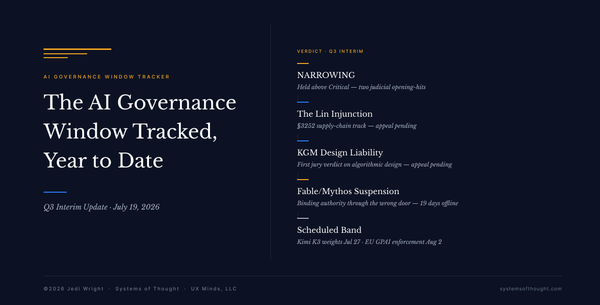
It is urgent because the second path is being built faster than the first. The same monitoring infrastructure that tracks AI governance more broadly applies here: two clocks running simultaneously, one measuring how rapidly AI is becoming structurally foundational in critical systems and the other measuring the institutional capacity to govern its deployment (20). Both clocks bear on the question of the stack. The embedding clock determines how quickly worker-side knowledge gets captured by corporate AI infrastructure that was not built to release it. The institutional erosion clock determines how quickly the political capacity to require a portable stack is being actively dismantled by the same systems whose deployment the stack is meant to govern. The most recent formal assessment of those clocks, completed August 1, 2026, returned Narrowing–held above Critical by partial opening-hits in EU enforcement and district-level judicial record (21). By April, the embedding clock was characterized primarily by deployment volume; by August it had added demonstrated dependency–a worldwide model shutdown proved enterprise reliance deep enough to be institutionally disruptive–and the erosion of provider-mediated enforcement points as open-weight models at frontier scale began circulating. The institutional clock, which in April described the passive erosion of governance capacity, now formally distinguishes a US track, characterized by active dismantling, from an EU track, for now held by enforcement activation. The clocks are not running in independent directions. Ungoverned AI deployment actively degrades the conditions under which binding portable-stack frameworks could be enacted. Each year of further embedding reduces the political and architectural surface on which the alternative could be built. Neither outcome is overdetermined–the window is narrowing, not closed.
The argument is not that AI is bad. The argument is that AI is a forcing function, and the choice it forces is between two architectural defaults. The default for the next decade is being set now, in the systems being built. If the stack is built on the worker's side, AI becomes the technology that finally closes the 140-year asymmetry. If it is not, AI becomes the technology that perpetuates the asymmetry. Both are buildable. Only one of them is being built by default.
There is a frontier here, and naming it clearly here matters–it moved while this essay was being written. Everything above describes AI touching a worker's record as a tool–drafting, summarizing, getting checked afterward. An AI agent holding standing access to that record the way a person does raises three harder questions: what identity an agent holds when it is granted access, whether that access is revocable the same way a human contact's is, and whether the record of what the agent did is kept with the same rigor as the record of what a person did (22). When this section was first drafted, nobody, including this pattern, had built the answer. As of August 2026 the pattern has: the specification now defines agent identity as granted and revocable, scoped to the relationship, with every gate check logged as first-class evidence, and the reference implementation demonstrates revocable agent identity and a structural prohibition on agents holding any authority beyond their grant (23). What no one has yet done is prove it in production across a real employment boundary–the nearest production precedents grant AI tools access to a shared record through the same group-membership mechanism a person would use, at other institutional sites. The frontier has moved from design to deployment. It is still a frontier.
One more piece of it is worth naming precisely because it is easy to conflate it with the piece already addressed above. Whether a worker's record can compound is a question about who governs the data an AI touches–a governed relation between the worker and whatever holds their record, exercised through mechanisms like grant, revoke, provenance, and portability but not reducible to any one of them–the stack axis this whole pattern is built on. Whether that record stays verifiable over time is a different question, about who controls the model doing the touching. A closed, rented model can disappear, change terms, or stop answering for what it did; the record of its involvement stays, but nothing can check that record against the thing that produced it. An open model can be run, kept, and re-examined indefinitely (24). This is not a call to distrust every closed model–most of what augments most workers today runs through one, and the access-governance claim made above holds regardless of which kind of model is doing the augmenting, because it governs access, not architecture. It is a narrower point: the record's long-term verifiability depends on a choice about the model that the record itself cannot enforce, just as the stack argument depends on a choice about data ownership that convenience alone will never make.
The next two sections trace what is connected to this argument that has not yet been named, and what remains unbuilt that the essay does not pretend to deliver.
6. The Post-Absorption Problem
There is a thread connecting everything the essay has named so far that has not yet been pulled out and made visible. The employment seam, the healthcare seam, the community stack, Local Cultures, the civic stack along the Phoenixville corridor–these are not separate projects that happen to share an author. They are the same project, asking the same question across different domains. The question is: what do you build after concluding that the existing platforms structurally cannot host the work?
Not because the platforms have bad policies. Not because their leadership is malicious. Because the architecture itself accumulates toward the platform and away from the participant, and there is no setting in the user interface that changes that. The accumulation is the platform. To use the platform is to feed the accumulation. To feed the accumulation is, eventually, to be absorbed into the optimization architecture you came to the platform to do work that resisted.
This pattern has a longer history than the digital era, and one of the cleanest documentations of it is in the cultural domain rather than the regulatory one. The confrontational tradition in popular music, Fugazi, the hardcore DIY network, the independent label and venue, and direct-touring infrastructure that built itself across the 1980s and 1990s as an explicit alternative to the corporate cultural economy built distributed democratic infrastructure as cultural practice. Sliding-scale ticket prices as policy. Direct relationships between bands and audiences without industry intermediation. Community-owned venues. Independent distribution networks. The infrastructure was the politics, and the politics was the infrastructure. That entire architecture was largely absorbed into the streaming economy in the 2010s (25). The content was preserved. The catalogs are still there; you can stream Fugazi this afternoon. What was replaced was the democratic infrastructure underneath the content, which dissolved into the optimization architecture the content had been built to resist. The political content survived the absorption. The political form did not.
The lesson of that absorption, and the more recent ones it predicted, including the absorption of platform-cooperative experiments and the long, slow enclosure of the open web, is that the right values are not enough. The DIY infrastructure of the confrontational tradition had the right values. It was built by people who knew exactly what they were resisting and what they were building instead. It was absorbed anyway because the architecture of the platforms it landed on was structurally more powerful than the values of the people who landed on them. Values were a policy claim. The platforms made an architectural one.
The Seam Stack is the architectural answer to that pattern, expressed as a property rather than a promise. The platform role is structurally minimal, Principle IX, which means the platform exits after facilitating the boundary event. There is no accumulated graph for an acquirer to acquire. The community's credentials are issued in a form that does not transfer to a new owner. The worker's stack is signed with the worker's keys, and an acquirer does not receive the keys from the company. What an acquirer would buy is the relay infrastructure, which is not where the value lives. The anti-absorption logic is not a feature the platform decides to honor. It is a consequence of how the architecture is built (26).
This is the property the confrontational tradition needed and did not have. It is the property Local Cultures needed and did not have. It is the property every well-intentioned platform-cooperative experiment of the last decade has reached for in policy and not been able to deliver in architecture. The post-absorption infrastructure problem, what do you build that does not get absorbed, given that everything previously built has been?, is what the governance model is, in the end, designed to answer. Not perfectly. Not finally. Architecturally.
The full scope of the argument across all six prior sections is one argument. The asymmetry, the domination problem, the governance model, the wider rings, the AI forcing function, and the absorption pattern are not six separate cases. They are six surfaces of the same proposition: that the stack of personhood, individual, collective, intergenerational, ecological, can now be built in a form that does not accumulate toward the most powerful party that touches it, and that this is the precondition for everything else worth wanting from the present moment.
The next section names what that does not deliver.
7. What Remains
The governance model closes the architectural asymmetry. It does not close the political-economic asymmetry. Corporations have 140 years of legal infrastructure, political capture, accumulated capital, and the ordinary inertia of being the entity around which the existing system is built. None of that dissolves now that a worker-side stack exists. The architecture removes one structural condition that has maintained the asymmetry. It does not remove the others.
The essay should be plain about what is built, what is specified, and what is still only directional. Five prototypes are built. Four are deployed: the Governance Window Tracker (read-only, no seam), the checkout seam (commerce), the FHIR seam (healthcare), and Local-First Social (social networking, distributed seam). The fifth, the Keyhive employment seam (one seam per transition), is a working reference implementation. The Pattern Commons #7 specification, settled at v0.4.1, is now at v0.5. The four-layer Seam Stack is documented (7). The fifteen principles are stated. That is the existence proof, and it is real. It is also bounded. The ecological ring is not built. The intergenerational constraints are not currently implemented. The civic stack is options and a working corridor, not deployed infrastructure. The fifth prototype is a reference implementation, not a deployed service. The essay describes a governance model. It does not describe an achieved condition.
Three things have to happen for the architecture to do the work the essay claims it can do, and the essay is in an honest position to deliver only the first.
The first is portable stack–worker-owned records that travel across employers–architecturally buildable now, partially built, with the employment seam now demonstrated end-to-end in a working reference implementation. That is what the prototypes, the spec, and the Pattern Commons series contribute. It isn't nothing, but it is one of three.
The second is policy and legal frameworks that recognize portable stack as the stack of personhood. Worker-portable employment records that hold in court. Patient-portable health records that satisfy clinical and regulatory requirements. Community-issued credentials with legal standing. Future-person standing as a constraint on present-day decisions. Watershed standing as more than a metaphor. None of this is built, and most of it is not even drafted. The architectural work makes the policy work possible. It does not perform it.
The third is a political economy that does not structurally incentivize the corporate path over the person path. As long as the dominant economic logic rewards capturing worker knowledge into employer-side systems faster than worker-side stacks can be issued, and as long as the AI infrastructure being deployed at scale is being deployed by entities whose business model depends on the capture, the architecture remains available without being adopted. The political economy has not held still while the stack has become buildable. Corporate personhood, the doctrine that opened this essay, has been actively widened over the last fifteen years, most visibly in Citizens United and the line of cases that followed, through Supreme Court majorities assembled by judicial appointments under the Bush and Trump administrations. The result is that the political-economic asymmetry the architecture would address has been operationally compounded in the same window that made the architecture buildable. The clocks are running in opposite directions, and one of them has been pushed. The essay cannot deliver the political economy that would make the architecture the default rather than the alternative. No essay can. The architecture is a precondition. The political economy is the work that has to be done on top of it.
The "AI frees people" narrative requires all three. It is a coherent claim only if all three are in place. The essay contributes the first because the first is what the author has built. The second and the third are within the reach of policymakers, organizers, jurists, foundation programs, labor movements, civic technologists, and political institutions that have not yet decided to take them up. The essay makes the case that they should. It does not pretend that making the case is the same as completing the work.
There is one thing left to say, and the essay should not say it softly.
The window is open and closing. The governance window tracker's most recent reading is Narrowing, and the change between two assessments is the point: in the four months between April and August, the embedding clock went from measuring deployment volume to measuring demonstrated dependency, and the institutional clock went from describing erosion to distinguishing active dismantling. The argument for worker-owned portable records–the stack argument–is the precondition for the democratic governance argument to be anything more than oversight of a fait accompli, and the precondition does not stay buildable forever. The default of the next decade is being set in the systems being built now. The architecture described in this essay is the form the alternative would have to take. Build the governance model, or inherit the alternative.
There is no third option that does not amount to one of those two. This is a claim about which architecture governs a given institution's behavior by default–not a claim that plural human practice, held across many contexts and institutions, must resolve to a single form. Different institutions can and will make different choices. But for any one of them, at the moment the choice is made, there is no third option that is not one of those two.
Appendix A, The Seam Stack Governance Model: Fifteen Principles
The fifteen principles below state the governance model in canonical form. They are not a list of rules the architecture promises to honor. They describe what the architecture, when correctly built, structurally does. The first five anchor the technical specification (Pattern Commons #7, v0.4.1) as its design principles; the remaining ten extend the same logic to collective personhood, architectural enforcement, and the intergenerational and ecological scope described by the essay's wider rings. They are stated here for citation; the body of the essay weaves them into the argument in which they originate.
Individual Personhood
I. Personhood is portable. The artifacts of a person's institutional life, labor, health, civic participation, social relationships, and community knowledge belong to the person, not to the institutions through which they moved. The stack–the portable personal record those artifacts are held in–travels with the person. The platform facilitates transitions and exits.
II. The record is multi-perspectival and tamper-evident. Contested events are recorded from all participant perspectives. No single party's account is privileged. The record is made contemporaneously and cannot be altered after the fact by any party, including the platform.
III. Legibility is a right, not a condition. A person is legible to institutions they choose to engage with, on terms they control, for the duration they determine. Legibility does not persist after consent is withdrawn. The right to revoke is as fundamental as the right to share.
IV. Power asymmetry is named, not neutralized. The platform does not take sides, but it records the conditions under which the seam fires. When a transition occurs under duress, account pre-emption, hostile exit, involuntary separation, that context is part of the record, not erased from it. Neutrality in the presence of unequal power is not fairness; the governance model acknowledges the difference.
V. Reciprocity is structural. The relationship between a person and an institution carries obligations running in both directions. The governance model encodes both sides of the relationship, not only the institution's claim on the person's output.
Collective Personhood
VI. Collective personhood is co-equal. Communities, not only individuals, can hold their own stack–their own portable record of relationships, knowledge, and decisions–on the same terms as any individual entity. A community's knowledge graph belongs to the community. The same principles apply at collective scale. Indigenous data sovereignty frameworks are the existing legal and ethical context for this principle.
VII. Recognition does not require retention. What the stack guarantees a person or community is continuity of the entity, not retention of everything the entity has touched: they remain recognizable across transitions–to themselves, and to those they choose, on terms they govern–while what constitutes them changes. Provenance is available to every temporal form, and is itself a record whose temporal form the holder authors: that something was, and how it changed or ended, is never an obligation that it continue. The architecture serves life and community over time, not a transaction.
VIII. Temporal form is authored, not defaulted. Whether what a person or community builds carries across boundaries, comes to completion and seeds what follows, or ends is decided by the holder, and engineered with equal rigor in every case: carrying is built as portable, signed, and tamper-evident; ending is built as full revocation of access, retirement of artifacts, and clean closure of the seam. None of these outcomes is automatic, none is a failure state, and none is an exception to the others. What the architecture forecloses is imposition: no employer, platform, or acquirer decides the temporal form of a record that is not theirs.
Architectural Enforcement
IX. The platform is structurally minimal. The relay facilitates and exits. It does not accumulate the relationship, own the graph, or position itself between the parties as a permanent intermediary. The platform's value is in the quality of the transition, not in the data it retains afterward.
X. The governance model cannot be overridden by the most powerful party. Cryptographic enforcement is preferred over policy enforcement wherever possible. A governance claim backed only by policy depends on the trustworthiness of the party with most power. A governance claim backed by architecture holds regardless.
Intergenerational and Ecological
XI. The non-human world is a participant, not a resource. The governance model encodes relationships with the living world, land, water, ecosystems, species, as relationships with participants that have standing, not as assets to be allocated. A stack that governs human personhood without governing human relationships with the non-human world is incomplete.
XII. Extraction has a ledger. What is taken from the commons, ecological, cultural, epistemic, is recorded as a taking, not rendered invisible by the accounting systems of the entity doing the taking. The governance model makes extraction legible at the same level of detail it makes contribution legible.
XIII. Future persons have standing. Decisions made by current stack-holding entities that irreversibly foreclose options for future persons are constrained by the governance model. The governance model cannot be used to accumulate in ways that leave nothing to inherit.
XIV. The stack has a carrying capacity. Infinite accumulation is not a design goal. The portable personal and community record–the stack–is not a license to extract without limit. The governance model encodes limits on what any single entity, individual, community, corporation, or platform can accumulate. Concentration is a failure mode, not a success metric.
XV. Regeneration is a first-class operation. Alongside creation, transfer, and dissolution, the governance model encodes regeneration, the restoration of what has been degraded, the replenishment of what has been drawn down, the repair of relationships that have been damaged. You leave the stack in better condition than you found it.
With thanks to Angela Epley for her considered and engaging feedback as an early reader.
Appendix A is the canonical reference statement of the fifteen principles. The body of the essay weaves them into the argument in which they originate; this appendix states them cleanly for citation. A standalone Seam Stack Governance Model charter document is in development; until it is published, this appendix is the citable form.
Methodology disclosure: AI-collaborative drafting, human authorial responsibility, and intellectual direction held by the named author.
© 2026 UX Minds, LLC.
Notes
1. Santa Clara County v. Southern Pacific Railroad Co., 118 U.S. 394 (1886). The court reporter's headnote stated that the justices were unanimous in the view that the Fourteenth Amendment's equal protection clause applied to corporations. The headnote is not part of the court's holding, and the question was not briefed; the substantive ruling concerned a property tax dispute. The headnote nevertheless became the citation by which subsequent doctrine of corporate personhood was built. The doctrine has not stayed where the headnote left it. Over the subsequent century and a half, and especially across the last two decades, courts have actively extended corporate constitutional rights, most visibly in Citizens United v. FEC, 558 U.S. 310 (2010), which struck down statutory limits on corporate political spending under a First Amendment theory. The judicial expansion has been an executive-branch project as much as a doctrinal one: the Supreme Court majority that decided Citizens United and the line of decisions that followed it was assembled through judicial appointments by the Bush and Trump administrations. The point for this essay's purposes is narrow. The 1886 architectural event is not a static historical fact. The doctrine that Santa Clara ratified has been continuously broadened by political mechanisms aimed at the courts. Section 7 returns to this as evidence of what the political-economic asymmetry has actually done with the architectural one.
2. A serious labor-market literature documents the cost of this loss to the firm, not only to the worker. See David Weil, The Fissured Workplace (Harvard, 2014), on how outsourcing and contractor classification fragment the institutional memory the firm relies on. See Richard Sennett, The Corrosion of Character (Norton, 1998), and The Craftsman (Yale, 2008), on the human cost of treating durable expertise as a transactional input. The cost the firm bears is real. It is also far smaller than the cost borne by the worker, because the firm at least retains the systems through which the loss is felt. The worker does not.
3. The technical layer is documented in Pattern Commons #7: The Employment Seam, v0.4.1 (May 2026), and in the Seam Stack reference architecture at seamstack.org. The relevant primitives–Solid Pods for the substrate, W3C Verifiable Credentials for the legal record, Keyhive for the cryptographic enforcement of the worker's exclusive control over bundle contents, and RFC 3161 timestamps from independent authorities for tamper-evidence–are existing standards. The synthesis is what is original; the components are not.
4. Vanessa Machado de Oliveira, Hospicing Modernity: Facing Humanity's Wrongs and the Implications for Social Activism (North Atlantic Books, 2021). The book's framing of the work of accompanying what is dying, without rushing to replace it, and without sentimentalizing what it was, is a posture this essay tries to hold alongside its constructive argument. The two postures are not in tension. Building the next thing carefully and accompanying the previous thing honestly are part of the same practice.
5. The clearest statements of the policy-versus-architecture distinction are Lawrence Lessig's Code: And Other Laws of Cyberspace (Basic, 1999; retitled and revised as Code: Version 2.0, 2006), and the long tradition in republican political theory, Philip Pettit, Republicanism: A Theory of Freedom and Government (Oxford, 1997), that defines freedom as non-domination rather than non-interference. An architectural enforcement of a worker's control over their stack is the digital correlate of Pettit's claim: what matters is not that the powerful party is currently choosing not to interfere, but that the structure makes interference visible and contestable when it occurs. See also Karl Polanyi, The Great Transformation (Farrar & Rinehart, 1944), on the historical pattern of treating labor as a fictitious commodity, a designation that is itself a policy claim that an architectural rebuild contests at the infrastructure layer.
6. Tyson Yunkaporta, Sand Talk: How Indigenous Thinking Can Save the World (HarperOne, 2020). The book provides the basis for the observation that durable institutional life has been built on infrastructures other than the portable, written, cryptographically signed kind that this essay proposes. Yunkaporta's framing is not a counter-argument to the proposal; it is a reminder of what the proposal is not claiming.
7. The four layers, substrate, governance, boundary, evidence, are documented in detail in Pattern Commons #7, v0.4.1, and at seamstack.org. The substrate layer is built on Tim Berners-Lee's Solid project (W3C, ongoing); the governance layer uses the Tiered Content Framework's vocabulary for how meaning is structured and access-controlled; the boundary layer is the seam discipline that names the transition itself as a first-class architectural object; the evidence layer is W3C Verifiable Credentials with bilateral cryptographic signatures and external timestamping. The synthesis claim, that all four are required, and that they compose, is the contribution of the spec; the components are not new.
8. Five working prototypes anchor the argument that this is buildable rather than aspirational: the Governance Window Tracker (read-only, no seam), checkout-seam (commerce, one seam per transaction), fhir-seam (healthcare, one seam per intake submission), Local-First Social / SocialPings (social networking, distributed seam), and the Keyhive employment seam (one seam per transition–entry, exit, stage change, re-engagement–a working reference implementation on Automerge and Keyhive). The first four are deployed and documented in the essay Nine Days, Four Prototypes (Systems of Thought, April 2026) and at the listed source repositories; the employment seam is documented at github.com/jediwright/employment-seam. None of the five is a finished product. They are existence proofs for the architectural claim.
A dated caveat: the prototype and specification work is moving faster than this essay's revision cycle. At publication (August 2026), Pattern Commons #7 had advanced to v0.5–extending the pattern to govern AI agents as granted, revocable parties–and the reference implementation had grown multi-party governance machinery the essay does not yet describe. Version numbers cited in these notes are pinned to the versions the essay was written against; where the essay and the repositories differ, the repositories are ahead, not wrong.
9. Keyhive is a key-management protocol that lets a relay route encrypted bundles between parties without ever holding the decryption keys itself. The technical specification is referenced in Pattern Commons #7, v0.4.1, alongside the broader stack. For purposes of this essay, the relevant property is straightforward: the system's cryptographic state means that the relay's lack of access to bundle contents is an architectural property, not a policy commitment. A relay that wanted to read the bundle would have to violate the cryptographic guarantees, and doing so is detectable. The shift from "the platform promises" to "the platform cannot" is the architectural move on which the essay's argument depends.
10. Local Cultures, founded 2012, was a collaboration between J. Wright (the author of this essay) and Douglas Reeser, an anthropologist. Reeser's role–fieldwork, community trust, anthropological grounding among the Mopan, Q'eqchi' Maya, and Garifuna communities of southern Belize–was the project's actual standing to attempt what it attempted. The 2026 work described in this essay is the author's; Reeser's involvement in the 2012 concept does not imply his involvement in or endorsement of the 2026 architectural proposal. Naming the project here without naming Reeser would misattribute the founding work; naming Reeser and not making the boundary explicit would misrepresent the present.
11. Robin Wall Kimmerer, Braiding Sweetgrass: Indigenous Wisdom, Scientific Knowledge, and the Teachings of Plants (Milkweed, 2013), and the essay "Speaking of Nature" (Orion, March/April 2017). Kimmerer's argument is that the grammar of a language, what it forces speakers to declare every time they refer to a thing, is itself a metaphysical claim, made on every utterance. A language that has no second-person-animate pronoun for non-human living things is making one claim; a language that has one is making another. The Seam Stack's claim is structurally analogous: the architecture's grammatical choices about whose voice the record is in, and what cannot be erased, are not stylistic. They encode a metaphysics about who counts as a participant in the institutional life the architecture mediates.
12. The Phoenixville corridor and the Schuylkill River watershed are the live instantiation context. The work in progress includes Rivertribe Outdoors (a watershed-focused community organization), Phoenixville Daily (a local cultural and potential journalism initiative), and a holistic system they're piloting called Local Cultures. None of the three is itself a Seam Stack implementation (though Local Cultures is baked into localfirst.social, or vice versa); together, they constitute the local civic environment in which the stack is being attempted at community scale. The argument is not that Phoenixville is special. It is that somewhere has to be the place a community-scale local-first civic stack is first attempted, and the place the author of this essay lives is the place the author of this essay is attempting it.
13. The compressed lineage referenced in the body: the Sugar Shack, an intentional shared-living context in Mid-City Los Angeles, 2006–2008; concurrent service as an At-Large Representative on the Mid-City Neighborhood Council during the same window; founding-member involvement in The Do LaB collective and the Lightning in a Bottle festival, beginning in the early 2000s and continuing through the period; Local Cultures with Douglas Reeser, 2012 (see footnote 10); and the present Phoenixville corridor work (see footnote 12). The list is not a credential. It is the operational record behind the essay's claim that the community ring is not being introduced from architectural neutrality. Each prior context attempted some form of the same coordination problem that the architecture this essay describes is built to address; each prior context confronted the same underlying obstacle: the absence of infrastructure the community could own, without a centralized intermediary structurally owning the relationship in turn. The author has been working on this question, in different forms and at different scales, for the better part of two decades. The architectural argument in this essay is what fifteen years of practical work on the question has converged on, not a new line of thought arriving at the community without prior contact.
14. The CARE Principles for Indigenous Data Governance (Collective benefit, Authority to control, Responsibility, Ethics), developed by the Global Indigenous Data Alliance and released in 2019, are the canonical contemporary statement. See also Te Mana Raraunga (the Māori Data Sovereignty Network), the United States Indigenous Data Sovereignty Network, and the long-running First Nations Information Governance Center work on OCAP (Ownership, Control, Access, Possession). These frameworks predate the technical stack this essay describes and continue to do work that no architecture can substitute for. The architecture is a tool the principles can use; it is not a replacement for the principles, and the relationship runs in that direction.
15. The asymmetric reversibility principle is developed at length in The End of History, Revisited, v1.11 (Systems of Thought, March–April 2026), and in the AI Governance Window Tracker. The structural claim is that some classes of harm- epistemic infrastructure loss, institutional dissolution, ecological threshold crossings- are recoverable on radically different timescales than the harms produced in their making, and that this asymmetry should be encoded into governance rather than treated as a side-effect of policy applied case by case. The principle is the same one that this essay applies to the stack; the larger argument is in the cited work.
16. Pattern Commons #7 v0.4.1 (seamstack.org)–the seam:aiProvenance attribute set: six fields recording whether AI was involved, which model, what inputs, and the status and timing of human review. An unreviewed AI-assisted Particle is flagged at the schema level, queryable by the same role-conditioned views–EEOC, EU AI Act auditors, the worker's own counsel–that govern the rest of the bundle.
17. The canonical-vs-fork distinction: group membership governs the canonical stream, not a copy already synced. Corroborated in published Ink & Switch Keyhive Dev Notebook material (documents-as-groups model; entry 01's treatment of revoked-but-already-synced and back-dated operations), inkandswitch.com/keyhive/notebook/, accessed August 1, 2026. Originating discussion: Ink & Switch / Patchwork community Discord.
18. The Subduction sync layer's documented behavior under degraded connectivity–slow to time out, so a revocation signal can lag actual firing–is the concrete instance of what the Agentic Accountability Playbook v0.1 names as the inference-flagging gap: an agent acting on unverified or stale input with no architectural mechanism requiring it to check first.
19. The Resonance Architecture is documented separately as a working spec (Systems of Thought, April 2026). For purposes of this essay, the relevant property is that resonance, the recognition of a participant across contexts and over time, requires a stack on which prior recognition can compound. The Resonance Architecture is not developed in this essay; what this essay establishes is that a portable stack is the precondition for resonance to be a coherent claim about persons rather than a claim about platforms.
20. The dual-clock framework is developed in The End of History, Revisited, v1.11, and operationalized in the AI Governance Window Tracker. The two clocks, embedding (the rate at which AI becomes structurally foundational in critical systems) and institutional erosion (the rate at which democratic capacity to govern is eroding), are not independent. Ungoverned AI deployment actively degrades the conditions under which binding governance frameworks could be enacted, which is what makes the gap between the two clocks the consequential variable rather than either clock alone.
21. AI Governance Window Tracker, Q3 formal close, August 1, 2026. The window status: Narrowing–held above Critical by partial opening-hits in EU GPAI enforcement activation and district-level judicial record (Lin injunction, Ninth Circuit appeal pending). The tracker is published at systemsofthought.com/tracker; the methodology is documented at v2.1.0 of the tracker spec. The instrument is honest about being a sampling instrument in an environment that moves faster than its fastest official cadence. It does not predict when the window closes; the current methodology produces verdicts on actuals, not year-range estimates. It monitors directional signals.
22. Nearby work sharpens what's missing rather than closing it. Right to History (Zhang, J., arXiv:2602.20214, 2026) builds a sovereignty kernel for an AI agent's execution history on a single owner's own hardware–closer to a personal audit log than to governance across an employment boundary; useful vocabulary, not a competing answer. Puda (Maeda, A. et al., arXiv:2602.08268, 2026) governs how much of a consumer's data a personal AI agent may disclose to outside services–a different axis (disclosure granularity) than the one this frontier names (revocable standing access across an institutional boundary). The broader authorization-propagation literature (Tallam, K., arXiv:2605.05440, 2026) is enterprise-side throughout, governing how an organization authorizes its own agents internally, not how a worker governs an employer-side agent's access to the worker's stack. Worker-side governance of agent access at the employment boundary does not yet have a named occupant in the field.
23. Requirement 1–revocable agent identity–is demonstrated in this prototype: the keyhive-employment-seam implementation (github.com/jediwright/employment-seam; first demonstrated at commit dd786a1, August 3, 2026; gate completed with a conformant seam:gateCheckRecord emitted per check at commit 802e841, August 16, 2026, verified against origin/main) ships a contactClass: human | agent discriminated union and an assertCapabilityCurrent() gate that checks capability state per invocation rather than caching or relying on time-limited tokens. Requirement 2–honest propagation-gap visibility, the revocation limit the honest-limits passage above names–is demonstrated in the same implementation at commit e8a164e (August 16, 2026, verified against origin/main): a revoked-local state carries an explicit degraded indicator while the revocation signal is still propagating, so the gap between the seam firing and confirmed propagation is surfaced in the interface rather than hidden. Requirement 3–structural enforcement of grantee-only authority scope for agent-class contacts–is demonstrated in the same implementation at commit b1eea7c (August 8, 2026): the constraint is enforced at the type level, and every agent-class access record carries the identity class and the grant it acted under. All three demonstrations hold together on a clean build: commit fdf3131, August 16, 2026, 191/191 tests passing, verified against origin/main. Two independent production precedents exist at different institutional sites: a local-first research lab's own production tooling grants AI-assisted features access to a shared record through the same group-membership primitive a human collaborator would use (Ink & Switch, GAIOS/Patchwork, inkandswitch.com/newsletter/dispatch-014/, accessed August 1, 2026); and a community-built end-to-end encrypted document system includes a headless CLI participant that "syncs over the relay without a browser," runs the same Keyhive engine as the app, and "identifies as one of your linked devices"–a non-human principal holding the same cryptographic device identity as a human collaborator (Schatz, P., github.com/philschatz/drive, accessed August 4, 2026). The pattern converses with, without adopting, an emerging technical vocabulary for this exact problem: a formal result showing that time-limited access tokens for AI agents fail badly as agents act faster, against an alternative that checks authorization at the moment of each action instead–the same never-trust-a-timer, always-check-at-the-gate principle this pattern's own access design follows (Parakhin, V., arXiv:2603.09875, 2026). A parallel IETF effort is drafting authentication and authorization standards specifically for AI agents, still in progress (Kasselman, P. et al., "AI Agent Authentication and Authorization," IETF Internet-Draft draft-klrc-aiagent-auth-02, June 2026, work in progress). None of this is the frontier's answer. It is evidence the field is arriving at the same problem from the standards side while this pattern arrives at it from the worker-governance side.
24. A published, versioned content-governance framework this body of work also maintains draws a distinction relevant here: whether content has been checked is a separate question from how it was made, and a record of how something was made can outlive the system's ability to verify it–the same way a citation can outlive the source it points to (Wright, J., "The Tiered Content Framework," v1.7.5, epistemic-status schema v1.7, May 26, 2026, jediwright.com/content-strategy-framework, accessed August 1, 2026). Applied to the model axis: a closed model's deprecation does not make what it helped produce wrong, but it can make the record of its involvement impossible to re-examine–an authority that can no longer answer for itself. That framework's existing weakest-status propagation rule does not reach this case–it governs epistemic decay, not the loss of a sole authority source–so a closed model's disappearance is a genuine, currently unaddressed provenance gap in the schema, not a variant of a problem it already handles. Closing it would require a new field, provisionally tcf:provenanceStatus, which has been named as a direction by independent review but not yet designed or specified.
25. The cultural absorption argument is developed in detail in the Cultural Antenna series (Systems of Thought, 2026), particularly in The Confrontational Infrastructure (a forthcoming piece). The streaming-era absorption of Fugazi's catalog, alongside the broader DIY infrastructure of the 1980s–1990s confrontational music tradition, is the case study most closely tracked. The pattern's racial dimension, the categorical governance architecture imposing different penalties on Black and white acts refusing category constraints, compounds the absorption argument and is treated at length in the same series. The mechanism documented there is that the absorption preserved the work's political content while replacing the democratic infrastructure beneath it with the optimization architecture the content was built to resist.
26. The most influential contemporary statement of the absorption-by-architecture pattern is Cory Doctorow's coinage enshittification, the predictable degradation of platforms once the relationship has accumulated to a point where the platform's interests diverge from those of the participants. See Doctorow, The Internet Con: How to Seize the Means of Computation (Verso, 2023), and the running essays at pluralistic.net. The Seam Stack's anti-absorption property is best read as the architectural correlate of Doctorow's diagnostic: enshittification is a consequence of accumulated relational power on the platform's side, and a structurally minimal relay denies the platform the stack on which enshittification operates.