The Tiered Content Framework
A content governance model five years in the making—now being pressure tested in the wild.


If the last two pieces left you staring into the middle distance, wondering whether democratic governance can outrun a closing window, this one is a deliberate gear shift.
Same publication. Same underlying question—how do systems hold without their designers present? Different scale, different domain, and considerably less existential stakes.
This is the framework that started it all.
The origin post in this series traced a single constraint across forty-plus years and a dozen different contexts: a system that must perform without its designer present requires that the designer build their judgment into the system before leaving. A burned screen is committed. A guided canoe trip has to run without you on the water. An AI agent produces fluent, confident output and keeps going.
That constraint is what the Tiered Content Framework was built to solve—not at the civilizational scale the governance essays address, but at the organizational one.
Most enterprise content programs fail the same way: new content gets created to fill gaps that already exist in the current inventory, just undiscovered. Quality drifts. Tone diverges. Strategy, audit, briefing, and creation run in disconnected tools with no shared data layer.
The framework addresses this at the structural level—not through editorial guidelines, but through a formal content operating model that governs meaning from the smallest field up to the full experience ecosystem.
The Framework
The Tiered Content Framework is an original content strategy operating model developed as an extension of Brad Frost’s Atomic Design methodology, applied specifically to content strategy, information architecture, and enterprise content governance.
Where Atomic Design governs UI components—atoms, molecules, organisms, templates, pages—the Tiered Content Framework governs semantic content objects: the meaning, structure, relationships, and governance rules behind every piece of digital content.
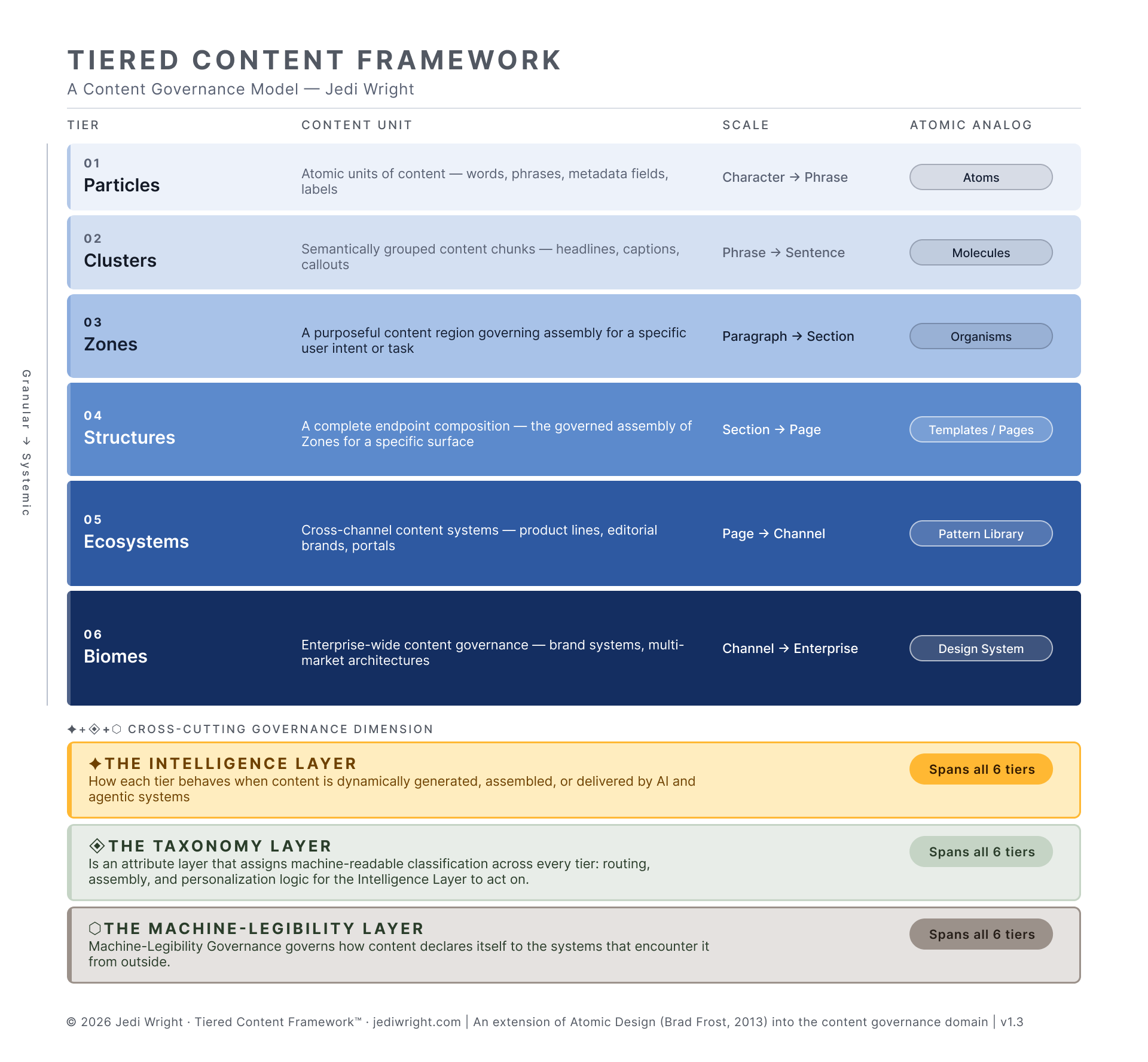
Design systems scale interfaces. Content frameworks scale the strategic intelligence behind every digital experience.
Governance follows a single rule: govern meaning at the lowest tier possible; escalate only when structural impact demands it. A change to a Particle affects everything downstream. A change to a Biome requires executive-level governance across the entire content presence.
Why It Matters
Most design systems address content through voice and tone guides or microcopy standards. What they don’t address is how content should be structured, modeled, governed, or reused across an enterprise digital ecosystem. That gap is where the Tiered Content Framework operates.
The framework provides a shared structural vocabulary across content strategy, UX, design systems, engineering, and product—field-level modeling and reusable semantic objects rather than editorial guidance, intent-driven page architecture that connects user journeys to content hierarchy, and governance that scales from a single content field up to an entire enterprise digital presence.
What This Is
What This Looks Like in Practice
The tier names are precise by design—they need to be, because the framework is used by engineers building CMS architecture and by content strategists writing briefs. But the underlying idea is simpler than the vocabulary suggests.
Here's the short version:
Every piece of digital content is built from smaller pieces. The Tiered Content Framework names those pieces, defines what each one is responsible for, and gives every team involved—strategy, design, engineering, content—a shared way to talk about them.
Think of it like this:
- A Particle is a single fact with a job. A product price. A button label. A street address. It's the smallest thing that can be governed—and governing it well means everything built from it inherits that quality.
- A Cluster is a few facts assembled into something meaningful. An author card. A product teaser. An address block with a map link. It exists because those Particles belong together, and the combination means something a single field doesn't.
- A Zone is a region of a page, or a section of an app screen, or a segment of a voice response, organized around what the user is trying to do at that moment. A trust-building section. A navigation area. A conversion prompt. The Zone governs what content belongs there and why.
- A Structure is the full thing delivered to a user: a web page, an app screen, an AI assistant answer. It's the complete, governed assembly of Zones—the content experience as the user encounters it.
- An Ecosystem is a connected set of Structures unified around a domain, journey, or brand area. A hospital's oncology service line. A software product's help center. A brand's campaign architecture. The parts that belong together, governed together.
- A Biome is everything—the complete digital content presence of an organization, across every channel and surface it maintains.
The governance rule that runs through all six tiers is the same one a good editor applies instinctively: make the decision at the lowest level it can be made. Get the field right, and the component built from it is easier to govern. Get the component right, and the page section built from it requires less review. Let a bad Particle propagate upward, and you're correcting it in six places instead of one.
The framework operationalizes that instinct—traceable, repeatable, and scalable across organizations where no single editor can review everything.
The Intelligence Layer
The six tiers describe how content is structured and governed in a world where content is authored, published, and delivered statically. Agentic systems, conversational interfaces, and AI-driven personalization introduce a different challenge: content generated, assembled, and delivered dynamically, in real time, at scale.
The Intelligence Layer is not a seventh tier. It’s a governance dimension that runs across all six—describing how each tier behaves when content is no longer static output but active, responsive, and machine-generated.
The practical implication: every governance decision in the Tiered Content Framework is also a prompt engineering decision. The more precisely an organization governs its content at each tier, the more reliably its AI systems will produce content that is accurate, on-brand, and structurally sound—without requiring human review of every output.
This is the governance foundation that intelligent experience systems require but rarely have. And it’s the same structural argument the governance essays make at a different scale: ungoverned systems, whether content pipelines or democratic institutions, produce emergent failures. The discipline of making implicit structure explicit is the same work, applied closer to home, and the structural condition the Intelligence Layer governs (dynamic generation outpacing the governance frameworks meant to constrain it) is the same condition the binding-authority gap describes at the civilizational scale. The TCF cannot close that gap. It can ensure that the content systems an organization controls do not contribute to it.
Taxonomy: The Attribute Layer
Taxonomy is the attribute layer that makes the tier structure machine-actionable. Classification originates at the Particle level: structured fields carry attributes like Content_Type, Audience, and Intent, and cascades upward through Clusters, Zones, and Structures, where dependencies and zone-affinity rules are validated.
Taxonomy isn’t a seventh tier. It’s a governance dimension that runs across all six, just as the Intelligence Layer does. Without it, the tiers are a governance vocabulary. With it, they become a routing and assembly system that the Intelligence Layer can act on.
The Machine-Legibility Layer
The Intelligence Layer governs how each tier behaves when content is dynamically generated, assembled, or delivered by AI and agentic systems. Taxonomy governs the attribute classifications that make the tiers machine-actionable internally. Neither addresses a third question that has become structurally consequential: how content declares itself to the systems that encounter it from outside.
Machine-Legibility Governance is the third cross-cutting dimension and layer of the Tiered Content Framework. It runs across all six tiers—describing how each tier declares its identity, relationships, authority, and epistemic status to search engines, knowledge graphs, AI retrieval systems, and large language models.
Every content object exists in two registers simultaneously. It has a human-readable presentation—the text a person reads, the layout they navigate, the hierarchy they interpret visually. And it has a machine-readable declaration: the structured data, schema markup, metadata, and entity relationships that tell external systems what this content is, who it's for, and what it means.
The machine-readable register carries one further declaration that has become structurally consequential as retrieval systems harden inferred content into operational fact: the content's epistemic status. Every content object can declare itself as confirmed, inferred, unverified, or time-sensitive, and can declare the verification record (or its absence) attached to that status. This is distinct from authority declarations (who published it) and provenance declarations (how it was produced). It governs which external systems are permitted to treat as established fact and which they must surface as inference. Without this declaration, retrieval systems and LLMs cannot distinguish between a Particle that has been verified against current conditions and a Particle that was inferred at authoring time and never re-checked. The Machine-Legibility Layer is where this declaration belongs because the consequence is external: it shapes what downstream systems do with the content, not how the content is internally classified or generated.
These are not separate concerns maintained by separate teams. They are two expressions of the same governance decision. A content object that is governed in the human register but ungoverned in the machine register is only half-governed, and as AI-mediated surfaces become primary discovery channels, the ungoverned half is increasingly the one that determines whether the content is found, understood, and correctly represented at all.
At the Particle level, machine-legibility governance means each structured field carries not only its human-readable value but its machine-readable declaration: what entity type it represents, what schema property it populates, what relationship it holds to adjacent fields. A price field that renders correctly on screen but carries no schema markup is a governed Particle in the human register and an ungoverned Particle in the machine register. The content framework and the code content structure are the same governance decision expressed in two registers.
At the Cluster level, machine-legibility governance means semantic objects declare their internal structure and entity relationships to retrieval systems. An author card that displays a name and bio to a human reader but carries no structured Person markup, no entity relationship to the content it authored, and no authority signals connecting it to external knowledge graphs is a Cluster that exists only in the human register.
At the Zone level, machine-legibility governance means page-area compositions declare their topical scope and intent to external systems. A Trust Zone that presents testimonials and credentials to a human visitor but provides no structured Review or Organization markup is a Zone whose persuasive architecture is invisible to every system encountering it through retrieval.
At the Structure level, machine-legibility governance means page templates encode their full relational context: what the page is about, how it relates to other pages in its topic cluster, what its canonical status is, when it was last substantively updated, and what content type it represents. These are not metadata afterthoughts appended during a technical SEO pass. They are governance decisions that belong to the Structure's definition. A Structure template that does not specify its machine-readable declarations has deferred a governance decision to a team that may not have the content context to make it.
At the Ecosystem level, machine-legibility governance means the site's entity architecture, topical authority structure, and internal linking logic are coherent and machine-traversable. Orphan pages, inconsistent taxonomy application, and unrelated CMS field proliferation are not technical debt in this framing; they are governance failures at the Ecosystem level, because they prevent external systems from understanding how the parts of the content presence relate to one another and to the broader knowledge domain.
At the Biome level, machine-legibility governance means the organization's full digital presence, across domains, brands, and platforms, maintains a consistent entity identity and authority architecture that external systems can resolve. Conflicting entity declarations across properties, inconsistent Organization markup, and fragmented knowledge-graph signals degrade the Biome's legibility to every AI system attempting to understand what the organization is and what it has authority over.
The AI Search Fragment Problem
AI-mediated search surfaces—no-click answers, AI Overviews, retrieval-augmented generation, conversational search—introduce a specific failure mode this dimension must name.
When an AI search system extracts a content fragment and presents it as a standalone answer, it is performing a Particle-level extraction from a larger Structure. The fragment inherits none of the governance context that gave the original content its meaning: no source authority signal, no relationship to adjacent content, no epistemic status declaration, no indication of recency or verification. The reader encounters what appears to be a fact. It is actually a Particle that has been stripped of its machine-legibility governance and re-presented without it.
This is not a problem content teams can solve by optimizing for fragment extraction. It is a problem content teams can mitigate by ensuring that their content's machine-readable declarations are rich enough that extraction systems have the structural context available—even if any given AI surface chooses not to surface it. The governance obligation is to make the context available. Whether a given platform honors that context is a platform governance question outside the framework's scope, but the content system's failure to provide the context is within it.
Relationship to the Intelligence Layer and Taxonomy
The three cross-cutting dimensions are complementary, not overlapping:
- Taxonomy governs how content is classified internally—the attributes that make the tier structure a routing and assembly system.
- The Intelligence Layer governs how content behaves when it is dynamically generated, assembled, or delivered by AI and agentic systems.
- Machine-Legibility Governance governs how content declares itself to the external systems that discover, retrieve, and re-present it.
A content object can be well-governed by Taxonomy (correctly classified), well-governed by the Intelligence Layer (correctly constrained for dynamic generation), and entirely ungoverned by Machine-Legibility (invisible or misrepresented to every external system that encounters it). All three dimensions are required for full governance coverage. The practical implication: structured data, schema markup, entity declarations, topical authority signals, and content freshness markers are not SEO tactics bolted onto finished content. They are Machine-Legibility Governance decisions that should be specified at the same time and by the same team making the content, taxonomy, and intelligence governance decisions they describe.
What This Layer Does Not Do
The Machine-Legibility Governance does not add SEO, GEO, or AEO as a named dimension or tier. The Tiered Content Framework describes the content governance architecture that produces machine legibility when done well—it does not prescribe the technical implementation or measure search performance outcomes. Practitioners working in SEO, GEO, and AI Experience Optimization should recognize those concerns addressed structurally here. The framework's value to those disciplines is that it locates that work within a governance architecture rather than treating it as a post-production optimization layer.
Applied Work & Practical Applications
The framework has been applied across enterprise, brand, and digital product engagements. Its primary contribution in practice has been providing a shared structural vocabulary that bridges content strategy, UX, design systems, CMS architecture, and engineering—reducing coordination overhead and making structural content decisions traceable, scalable, and governed rather than ad hoc.
It forms the theoretical backbone of the Content Strategy Product Suite—a modular platform that transforms content strategy from a consulting deliverable into a governed, repeatable, data-driven workflow.
The fourth tier, Structures, draws directly from the work of former colleague Andrew Kaufman, whose model of content structures provided the foundational thinking for this tier's subsequent evolution. With thanks also to Brian Lynn, Doug Holton, and teammates from those early years of feedback.
Here are practical applications of the Tiered Content Framework across common enterprise and agency scenarios:
Content Audit & Inventory
Rather than auditing a site as “pages,” you audit it by tier. You identify orphaned Particles (fields with no governing terminology rules), broken Clusters (components whose semantic objects don’t hold together), and missing Zones (page areas with no clear user intent). This gives you a structured gap analysis instead of a subjective quality review.
Enterprise CMS Architecture
When building or migrating a CMS, each tier maps to a content model layer. Particles become structured fields with validation rules. Clusters become content types. Zones become layout regions. Structures become templates. This gives the CMS architecture a semantic foundation—not just a presentation model.
AI Content Governance
The Intelligence Layer makes the framework directly applicable to AI-generated content. At the Particle level, you’re defining the field constraints, terminology guardrails, and tone parameters that get passed into prompts. At the Cluster and Zone levels, you’re governing how AI assembles dynamic content so it maintains structural coherence and intent alignment—even when no human authored it.
Brand Consolidation & Mergers
When two organizations merge digital presences, you can map each independently to the Biome/Ecosystem tiers, then identify where Structures and Zones overlap, conflict, or can be consolidated. It turns an abstract “content rationalization” project into a structured comparison with clear governance decisions at each tier.
Content Briefing Systems
Briefing templates can be built at the Cluster or Zone tier, so instead of briefing “a hero section,” you’re briefing a Zone with defined intent, required Clusters, and Particle-level constraints already embedded. Writers and AI systems receive structurally complete briefs, not blank slates.
Personalization Architecture
Personalization often fails because it operates at the page level, swapping whole pages rather than targeted semantic objects. The framework enables Cluster- and Zone-level personalization: you vary specific semantic objects (an author card, a trust signal, a CTA label) within a stable Structure, rather than forking entire experiences.
Design System Alignment
The framework gives content parity with the design system. Where a design system governs components at the UI level, the Tiered Content Framework governs the semantic layer beneath them. This enables true design-content co-governance, with every component getting a corresponding content object with its own rules, not just visual specs.
Governance Handoffs
When a content strategist leaves an organization (the “designer not present” constraint the framework was built around), the tier model serves as the handoff artifact. The next person inherits not just a style guide but a full operating model: what the content objects are, how they relate to one another, and the rules that govern each tier.
—
Additional Applications
Additional named applications will be added in as they’re identified or suggested.
The Paper
Content Strategy as Structural Infrastructure: Extending Atomic Design Methodology for Governed, Scalable Digital Experiences
Jedi Wright · v0.1 · Independent research · 2021–2026
Full paper available on request: jedi@jediwright.com
Changelog
v1.3, April 19th, 2026
Updated tier definitions for Zones and Structures to be endpoint-agnostic, and added named deployment contexts to each. Prior definitions anchored Zones as "page-area containers" and Structures as "page-level compositions"—language that breaks in headless, omnichannel, and AI assistant environments where the presentation layer is decoupled from the page entirely. Zones are now defined as context containers: functional regions within a Structure that govern content assembly for a specific purpose. Structures are now defined as endpoint compositions: the complete, governed assembly of Zones delivered to a specific surface. Named deployment contexts are added to each tier definition, specifying how Zones and Structures function when the endpoint is a web page, app screen, voice response, AI assistant answer, digital billboard, or watch face. The remaining tiers—Particles, Clusters, Ecosystems, and Biomes—are endpoint-agnostic by nature and require no revision. Responsive to practitioner feedback from a Director of AI Content Strategy identifying that page-centric terminology in the upper tiers misrepresents how the framework operates in modern headless and liquid content environments, where the endpoint is a delivery target, not a defining characteristic of the tier. No changes to the six-tier model structure or the three cross-cutting governance dimensions.
v1.2, April 16th, 2026
Added The Machine-Legibility Layer as a third cross-cutting governance dimension, peer to The Intelligence Layer and Taxonomy. Governs how content at each tier declares its identity, relationships, authority, and epistemic status to search engines, knowledge graphs, AI retrieval systems, and large language models. Names the AI Search Fragment Problem as the dimension's diagnostic failure mode: a Particle-level extraction stripped of the governance context that gave the original content its meaning. Responsive to practitioner feedback from a SEO and GEO practitioner identifying that the Intelligence Layer and Taxonomy together address routing and assembly logic but leave ungoverned the technical surface through which AI systems understand content relationships—structured data, schema, entity relationships, topical authority signals, and internal linking architecture. An ECD practitioner thread sharpened the specific failure condition: no-click AI search surfaces content fragments without the metadata, schema, and relational context required for accurate retrieval, confirming that the content governance framework must mirror the code content structure at the Particle level. The dimension extends the framework's reach from content strategy and governance into the technical SEO and GEO layer, which practitioners identified as going hand in hand rather than being separable concerns. No changes to the six-tier model or the two existing cross-cutting dimensions.
v1.1, April 14th, 2026
Added Taxonomy as a second cross-cutting governance dimension, peer to The Intelligence Layer. Governs machine-readable classification across every tier, providing the routing, assembly, and personalization logic that makes the tier structure machine-actionable. Classification originates at the Particle level—structured fields carrying attributes such as Content_Type, Audience, and Intent—and cascades upward through Clusters, Zones, and Structures, where dependencies and zone-affinity rules are validated. Names the static boxes failure mode as the dimension's diagnostic condition: tiers without taxonomy remain a governance vocabulary rather than a dynamic, flowing system. Responsive to practitioner feedback identifying that the Intelligence Layer's references to structured fields, semantic tagging, and dynamic assembly gestured at taxonomy without naming or operationalizing it as a formal construct; insufficient for practitioners building personalization systems or AI-driven experiences. Taxonomy is not a seventh tier; it is a governance dimension that cascades through every tier rather than residing at one. No changes to the six-tier model or The Intelligence Layer.
v1.0, April 13th, 2026
Initial publication. Six-tier content governance model extending Brad Frost's Atomic Design methodology into content strategy and information architecture. One cross-cutting governance dimension: The Intelligence Layer, governing how each tier behaves when content is dynamically generated, assembled, or delivered by AI and agentic systems. Creation Layer production chain documented. Content Strategy Product Suite named as commercial implementation.
This is a working model, not a finished artifact—five years in practice, now under public pressure testing for the first time. If you work in content strategy, information architecture, design systems, or enterprise digital product, what holds up? What breaks? Where does the model not account for how your organization actually works?
Next in the series: back to the governance window—and whether it’s still open.